



Negotiators at the World Trade Organization still working on a deal to end harmful fish subsidies face a new triple challenge as the U.S., India, and Indonesia all oppose the draft text to the latest proposal.
The WTO has been discussing a plan to end subsidies leading to overcapacity and overfishing for multiple years, and the latest round of talks are set to recommence in late September after ending in summer 2025 with parties still working to agree. Led by a new chair – Guyana’s WTO ambassador Leslie Ramsanny – the talks need to reach a conclusion by September 2029 or a sunset clause will void the WTO’s 2022 deal. That deal, often known as Fish 1, will expire if not expanded by a new deal, commonly referred to as Fish 2.
Previously a supporter of the draft text, the U.S. now opposes any preferential treatment in the deal for developing countries, a key demand of poorer countries and of major fishing nations like India and Indonesia.
The U.S.’s new position has resulted in observers of the negotiations having a less positive view of the chances of success for Fish 2.
“Given the new U.S. position, I am far less optimistic about Fish 2, which is very unfortunate for fish and fishers,” said Professor Rashid Sumaila, research chair for Interdisciplinary Ocean and Fisheries Economics at the University of British Columbia.
A source close to the talks told SeafoodSource that the American position on special and preferential treatment for developing countries has hardened, but a deeper problem may be American indifference to the fishery subsidy talks and other WTO issues.
“On the U.S., the level of engagement is indeed the real question,” the analyst told SeafoodSource. “What we can say so far is that [...] the delegation does not really sound enthusiastic about the negotiations – but that was already the tone before Trump’s [second term].”
The analyst said the U.S. was engaged in a WTO ministerial conference in Yaoundé, Cameroon, and brought a new set of instructions with them, showing no clear indication whether the U.S. delegation will engage or not.
“The second part of this year will be an interesting test,” the analyst said.
Having blocked progress to a deal in 2024, India lent the process some hope this summer when it ratified the Fish 1 deal reached in 2022 – which entered into force in 2025. Fish 1 barred WTO members from paying subsidies to vessels engaged in illegal fishing, as well as subsidies to fishing of overfished stocks or to fishing of the high seas.
India’s Commerce Ministry, when announcing the ratification, said Fish 1 protects small-scale fishermen by reducing illegal industrial fishing and through special carve outs for developing countries (who get two years grace to implement the provisions of Fish 1), while also helping India find valuable sustainable markets for its fish and farmed shrimp exports.
While it supports Fish 1, Indian officials said they remain opposed to the draft text for Fish 2, which seeks to address subsidies that lead to overcapacity of fishing fleets and subsidies that may lead to overfishing.
Mohan Krishnan, former principal scientist at the Central Institute of Fisheries Education in Mumbai, told SeafoodSource that “the ratification [of Fish 1] has neutralized critics who labelled India an obstructionist in international trade circuits.”
As negotiations on Fish 2 continue, Krishnan said India requires a 25-year special and differential treatment transition period for developing nations “and per fisher support systems before signing any agreement on Fish 2 overcapacity rules.”
According to Krishnan, industrialized fishing nations see India as lobbying hard for extensive exemptions for its exclusive economic zone (EEZ) while demanding an unreasonably long transition period of 25 years. However, from India’s perspective, Delhi “clearly differentiates between subsistence support and industrial distortion while standing for special and differential treatment for developing countries and artisanal fleets.”
India has consistently suggested that industrialized fishing nations with distant water fleets, like China, the E.U., and the U.S., should be forced to bear the brunt of cuts to subsidies given the subsidies they pay per fisher are far greater than those paid by India, whose “meagre subsidy is just livelihood support rather than capacity building,” Krishna said.
As India and the U.S. take their stance, Indonesia has yet to ratify Fish 1. Indonesia used the WTO ministerial meeting in Yaounde in March to outline its opposition to Fish 2, saying that the draft text (and the Fish 1 agreement) risked undermining United Nations Convention on the Law of the Sea (UNCLOS) and the sovereignty of the country’s EEZ, home to Indonesia’s vast subsistence fishing sector.
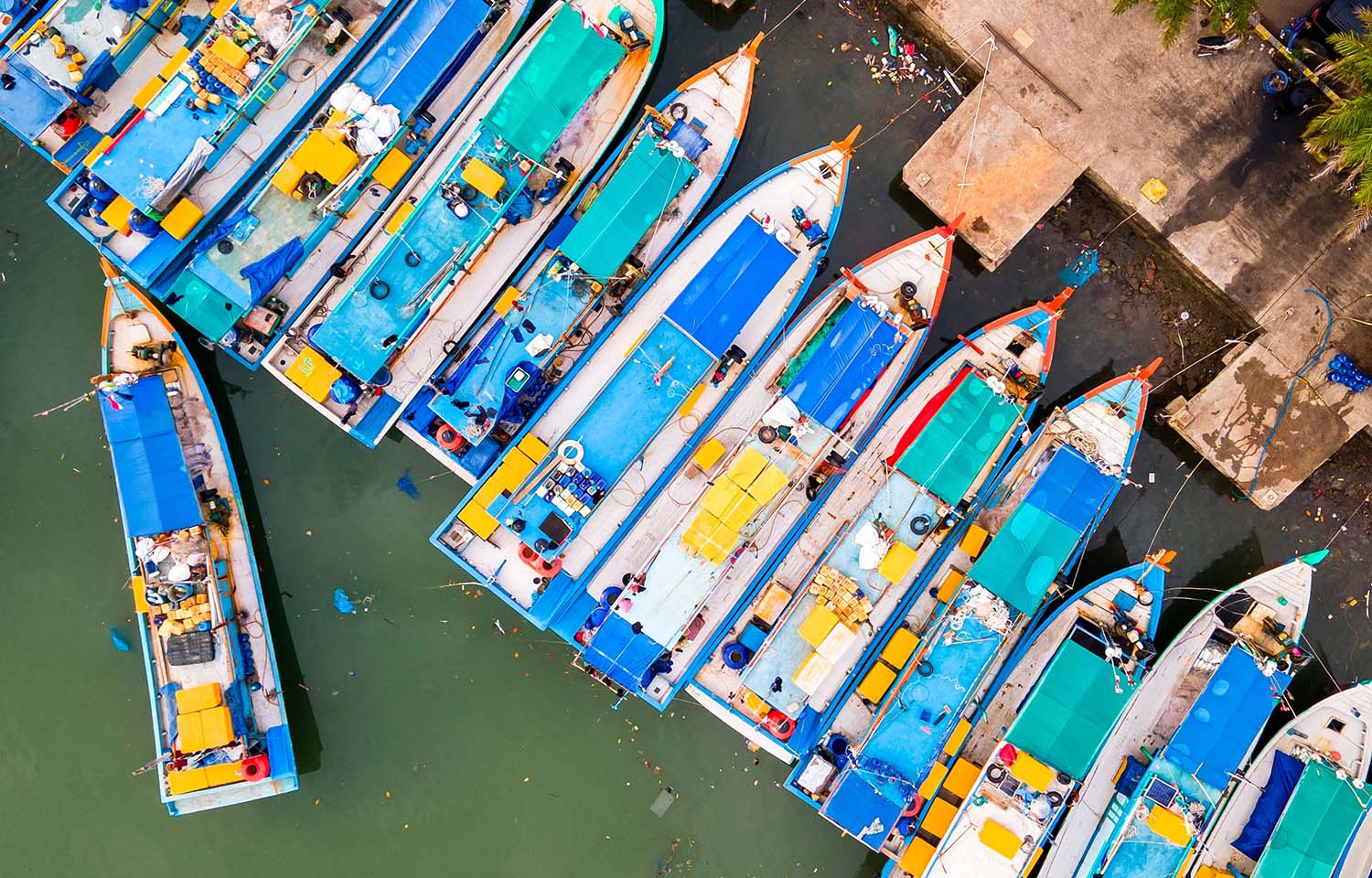
Researchers in Indonesia say the country’s reluctance in ratifying Fish 1 or backing the draft text for Fish 2 is likely rooted in fear for the livelihoods of a large artisanal fishing sector.
“The challenge is to discipline harmful subsidies [in Indonesia] without eliminating support that small-scale fishing communities legitimately need,” said Hollie Booth, a research fellow of the University of Oxford & Bangor University who compiled a policy brief with Professor Luky Adrianto of IPB University and Yayasan Kebersamaan Untuk Lautan (KUL).
In the paper, which Booth shared with SeafoodSource, the authors suggest Indonesia has a path to supporting the negotiations while also maintaining livelihoods in small-scale fishing communities.
"Existing domestic subsidy budgets can be reallocated from instruments that drive overcapacity like free gillnets, uncapped fuel, and vessel support to instruments that support fair transitions to sustainability [such as] selective gears and bycatch reduction technologies, vessel buybacks, performance-based rewards for sustainable actions and outcomes,” the paper states. “Such instruments would deliver on the goals of the WTO Agreement on Fisheries Subsidies while protecting small-scale fishing communities.”
Indonesian fisheries and aquaculture consultant Arie Prabawa told SeafoodSource that small scale fisheries are particularly important, as they generate roughly 80 percent of Indonesia's total national catch volume, with large industrial vessels accounting for under 20 percent.
“Any disruption to subsidy structures will directly impact major export commodities, including blue swimming crab meat bound for the U.S., frozen red snapper and grouper, squid, and wild-caught marine shrimp,” Prabawa said.
According to Prabawa fuel subsidies account for 60 to 70 percent of total operational costs for Indonesian fishers.
“Targeted fuel subsidies such as subsidized diesel for fishers, directly slash the largest single daily operational expense, enabling small-scale fleets to continue operating despite energy market volatility,” Prabawa said. “Financial support helps traditional fishers maintain stable incomes amid heightened economic vulnerabilities and climate change impacts."
The support of China – the world’s leading fishing nation by both size of fleet and catch – for the deal may reveal more about the fissure between top fishing nations and developing countries at the talks. Beijing has been intent for some time to reduce the size of its domestic fleet, according to Xuefei Shi, an affiliated researcher at the Norway-based Chr. Michelsen Institute, who also said the small scale of the fisheries sector relative to the overall Chinese economy drives China’s logic.
“Though it remains strategically important as a means to occupy the ocean, China has been pushing the agenda, alongside participating in the WTO negotiation, to further control and downsize the [domestic fishing] industry. Having a favorable international agreement can be useful for domestic agenda setting,” Shi said.
The size of China’s current domestic fleet is consistent with that goal, he said.
“Evidence of contraction in China’s domestic fleet is consistent in recent years,” said Shi. “Of course, we see a different trajectory in the DWF [distant water fishing] where newer, more capable vessels are being deployed and DWF bases are being developed.”
That contrast means China could satisfy some of the subsidy cut requirements being negotiated by the WTO, while not impacting its distant water fleet.
“This asymmetry is exactly what matters for the negotiation. China can easily reach the plausible subsidy cut requirement by targeting its sunset domestic fisheries, while keeping its DWF,” Shi said.
A successful agreement that addresses the livelihoods of small-scale fishers everywhere could be key to a Fish 2 deal. Shi said while India and Indonesia have presented themselves at the WTO as protectors of small-scale fisheries, both countries have their own industrial fleet, while China and E.U. have their own small-scale fisheries.
“Even the definition of small scale fisheries is not clearly legalized, and by any definition, small scale fisheries as a whole contribute to overcapacity and overfishing to a statistically substantial degree,” Shi said. “The key here, in my opinion, is not to protect the small scale fishery fleet or industry, but to protect the large number of small-scale fishers, the real reason behind India and Indonesia’s concerns.”
Shi said he believes that failure to reach a deal on Fish 2, which would in turn collapse Fish 1, “will strengthen the existing distant-water fishing powers and leave small scale fisheries in countries like India and Indonesia, ironically, the greatest losers of an out-of-control scenario at sea.”
