





Ecuador and India have continued to be shrimp-producing powerhouses, with both countries beating their records in 2025 and Ecuador continuing on a record pace in 2026.
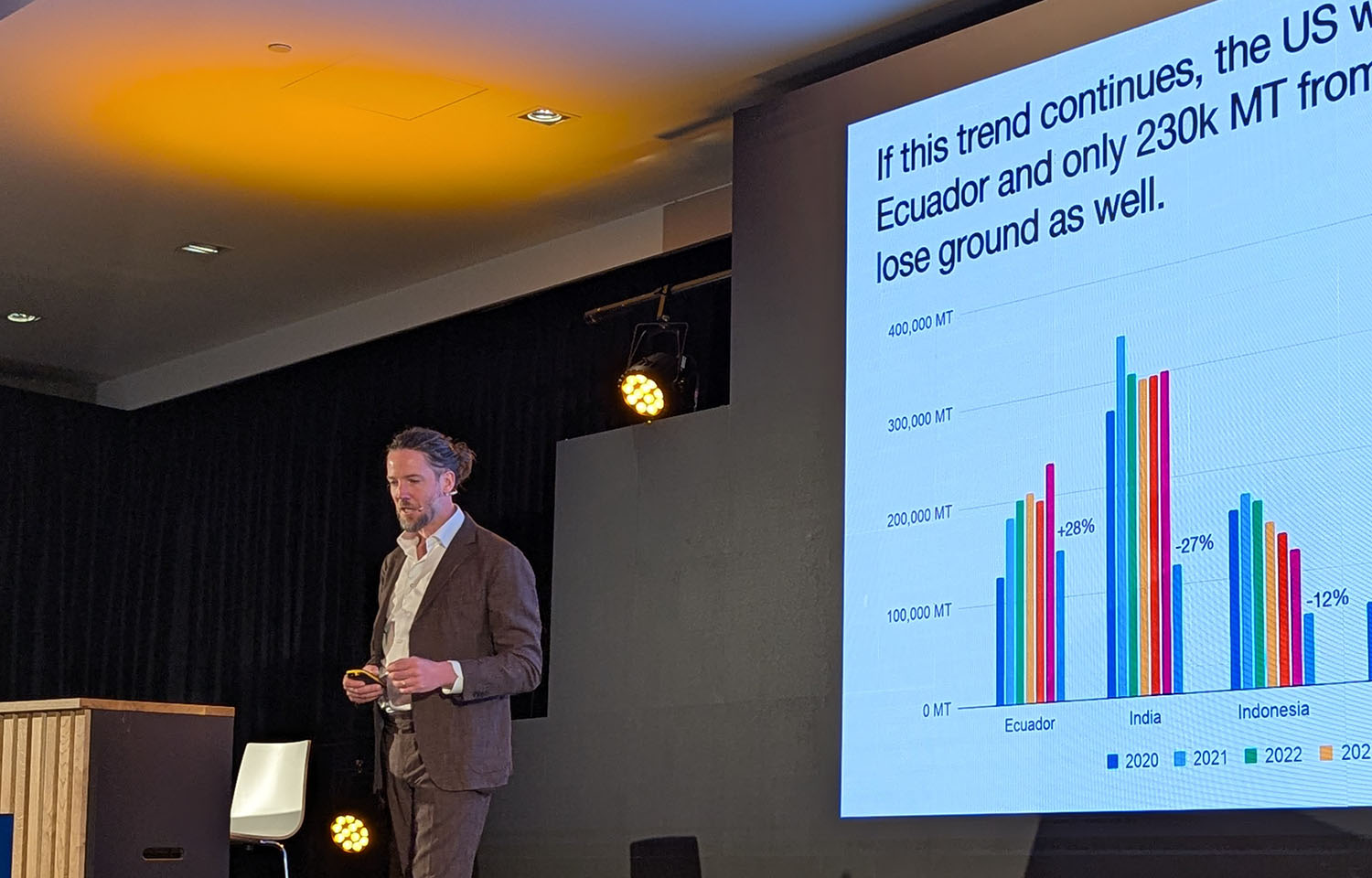
According to data gathered by and shared during the Global Shrimp Forum by managing director and co-founder Willem van der Pijl – Ecuador set a new record in Q2 2026, achieving nearly 450,000 metric tons (MT) of exports, up 14 percent on its previous Q2 record set in 2025. On a month-by-month basis, Ecuador has beaten its prior year every single month, and July saw its export totals jump by 49 percent.
“We have seen a new record in May, exceeding easily 150,000 MT,” van der Pijl said. “But I think more surprising is the most recent data of July.”
Typically, exports decline in July as the country is impacted by weather changes, and last year exports were just over 100,000 MT. This year, they’re over 150,000 MT, and that could be due to the impacts of El Nino, van der Pijl said.
“I think July is the first sign of the early part of El Nino, where the temperatures are staying high, and the rains are not coming yet,” he said. “Which means that the shrimp has grown better in Ecuador, resulting in a new, by far, all-time record for July.”
If that trend of warm weather and good growing conditions continues, it is like Ecuador will continue to see records, but the timing of the rain will be everything.
If the growth maintains its typical trajectory of 15 percent year over year, which it has managed or even exceeded in most years over the past decade, Ecuador’s shrimp exports could reach 1.6 million MT, making it by far the largest source of shrimp globally.
“It might be higher, though, depending on El Nino,” van der Pijl said.
As Ecuador has continued to set record after record in shrimp production and export, the markets it has been sending that shrimp to have begun to shift slightly. China still remains a dominant player for the country, with over 50 percent of Ecuador’s H1 2026 exports, but the U.S. has quickly become the second-largest market, surpassing the E.U. and potentially reaching 360,000 MT this year if trends hold.
Other countries have also seen massive growth in exports, likely as those countries snag raw materials for further processing. While Ecuador has begun to develop its own processing, van der Pijl said, some of the export destinations show it is still exporting shrimp for further processing.
“If you look at the destinations and think a little bit about what’s happening in those countries, you can clearly see reprocessing activity,” van der Pijl said.
Vietnam has seen growth in 2026 after a big increase in 2025, and Malaysia also saw increases in 2025 and so far in 2026.
“There are quite a few other small destinations for reprocessing as well,” van der Pijl said.
Of the companies exporting Shrimp, Santa Priscila has remained a powerhouse, accounting for 25 percent of the total exports to the U.S. The top five Ecuadorian shrimp companies now account for 75 percent of the country’s total exports to the U.S.
As Ecuador continues to make gains in the U.S., it is on track to surpass India as the country’s top source of shrimp. According to van der Pijl’s aggregated data, India’s exports have remained relatively flat so far in 2026 after a gain of 9 percent in 2025.
That increase doesn’t tell the whole story, van der Pijl said.
“India had to diversify away from U.S. markets; the other markets were more headless shell on and less peeled shrimp, so I guess if you made a weight equivalent, there might have been small drop [in volume],” van der Pijl said.
In 2026, volume stabilized compared to 2025. Taking into account the resumption of imports to the U.S. – which takes more peeled shrimp which tends to mean a lighter product – India may actually be increasing its production significantly even if export totals don’t necessarily show it.
“India keeps surprising,” van der Pijl said. “The resilience of the industry is really remarkable.”
Another key factor in India is slightly higher farmgate prices in 2026 when currency conversions are considered. While the price may have gone down slightly when considered in USD, the INR’s depreciation means the farmers are actually getting paid more.
“This is important, because the stocking for the second crop is motivated by those farm gate prices,” van der Pijl said. “The sentiment in the Indian farming community has not been that bad.”
If trends continue, van der Pijl predicts India will close in on 800,000 MT of shrimp exports in 2026 if the farm gate prices result in a successful second half of the year.
Despite India’s resilience, U.S. import data shows it may fall behind Ecuador in 2026, as the latter country continues to see a steady year-over-year increase while India’s totals are lagging behind.
