


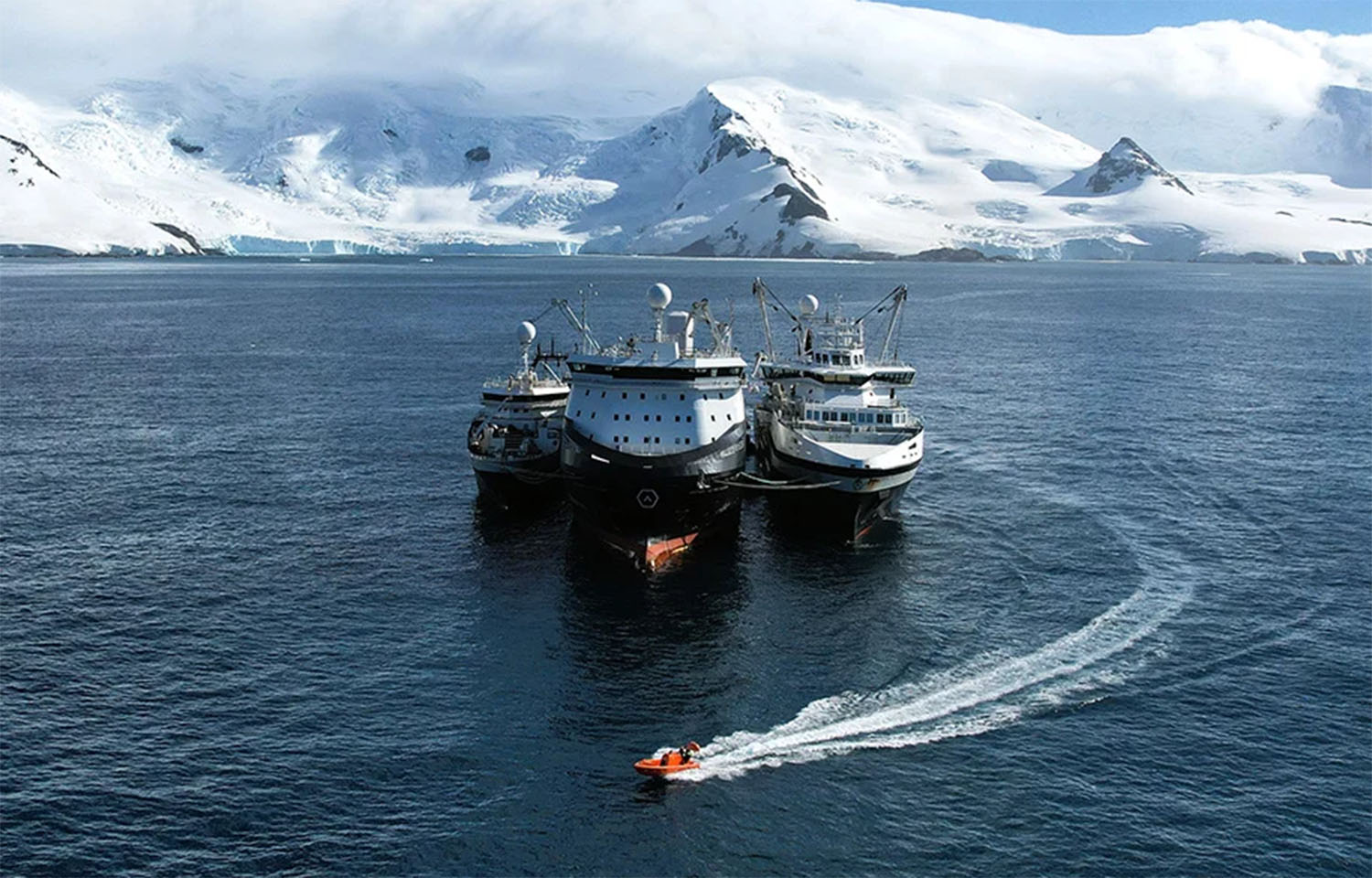
The closure of the Antarctic krill fishing season after the reaching of a catch limit of 620,000 metric tons (MT), is “not the crisis that some might suggest” according to leading krill catching firm Aker QRILL.
The Commission for the Conservation of Antarctic Marine Living Resources (CCAMLR) closed the Antarctic krill fishery for the season after fishing companies triggered the 620,000 MT catch limit designed to prevent overfishing in a critical ecosystem. The closure comes just days after an Associated Press report on the fishery indicated the season could be closed early for the first time in its history.
Environmental organizations have pushed CCAMLR to establish new catch limit rules, but Aker QRILL Chief Policy Officer Pål Skogrand told SeafoodSource that the 620,000 MT limit, while high compared to many fisheries, is still just a fraction of the krill biomass.
“Given that the 620,000 MT catch level triggering the closure represents just 11 percent of CCAMLR’s Precautionary krill catch limit of 5.61 million MT for Area 48 – and less than one percent of the estimated krill biomass of 63 million MT in that area – this development is hardly the crisis some might suggest,” Skogrand said. “The ten fishing krill vessels have maintained use of fishing grounds spread up to 450 kilometers apart, and industry voluntary closures of 30 - 40 kilometer buffers around penguin breeding colonies have also been maintained.”
Skogrand said Aker has found strong demand for krill-based human health products, while the firm’s QRILL Specialty Animal Nutrition Products uses krill as an input for pet food.
“We want to develop this underutilized resource which Antarctic krill is. But we also want a win for conservation,” he said.
The high catch rate of krill in Antarctica has drawn heavy criticism from environmental groups who CCAMLR’s failure to establish projections will result in detrimental effects on the ecosystem. The Antarctic Southern Ocean Coalition and Sea Shepherd have both urged world governments to take action to address krill fishing in the area.
"Antarctica's fragile future is under siege. The record-breaking krill catch and the emergence of localised fishing 'hot spots' in the Antarctic Peninsula are deeply alarming,” WWF-Australia Ocean Conservation Manager Emily Grilly said in a release.
At issue is the aforementioned Area 48, where fishing pressure increased by 60 percent through 30 June 2025. Sea Shepherd argued that because most fishing takes place in one area, the assertion that just a fraction of the total biomass is being affected falls flat.
Aker said that contrary to claims of environmental harm, it has been actively pushing for the establishment of a 455,000-square-kilometer marine protected area that will close 70-percent of the Antarctic Peninsula. However, disputes over new precautionary catch limits between member states of CCAMLR resulted in China and Russia vetoing demands to create that protected area.
“If parties in CCAMLR engage in good faith and accept the scientific and political compromises on the table for the Antarctic Peninsula, the result will be a balanced outcome where both conservation and fishing can benefit,” Skogrand said. “But you can’t just pick the parts you like. That kind of strategy won’t drive change –it’ll drive you straight into a wall.”
Pew Bertarelli Ocean Legacy Officer Nicholas Kirkham told SeafoodSource the first ever closure of the krill fishing season is a warning sign that CCAMLR and member countries need to take management of the fishery seriously.
“When agreed, the limit was distributed over a large area and was still considered by many to be set too high – it was not anticipated to be hit,” Kirkham said. ”Reaching it so quickly, and in the absence of spatial management measures designed to prevent concentrated fishing, is deeply concerning. It signifies intense fishing pressure in concentrated areas that are also vital feeding grounds for krill predators including penguins, whales, and seals. Without stronger safeguards, we’re pushing the limits of what this fragile ecosystem can handle.”
Kirkham said conservationists fully expected companies to hit the 620,000 MT limit in 2025 after CCMLR’s failure to establish new catch limits – which left any limits up to voluntary measures – meant there were no guardrails on fishing in the Southern Ocean.
“That opened the door for heavy concentration of catch in predator hotspots around the Antarctic Peninsula, something that CCAMLR had previously agreed could further impact the already threatened Antarctic species, such as penguins and rebounding whale populations,” Kirkham said. “What we’re seeing now – an early-season closure and a potential overshoot of the total catch limit – was both foreseeable and preventable.”
As international debate over the krill fishery increases in the wake of the first-ever closure of the fishery, local governments in China continue to encourage companies to invest in krill fishing as an industry of strategic importance to the state.
The fishing port of Zhangzhou in Fujian province in southern China is offering a CNY 40 million (USD 5.6 million, EUR 4.8 million) subsidy to purchase new Antarctic krill fishing vessels as part of a package of supports to expand the local distant water fleet.
The payments also include a “one off reward” of CNY 100,000 (USD 14,000, EUR 12,000) per vessel to a fishing company which enters a “new fishing country” – clearly an effort to expand the geographical reach of Zhangzhou’s fleet.
A major state-owned fishing firm, Liaoyu Group, last year signed an agreement with Greek-based shipping firm Lavinia Corporation to establish a joint venture aimed at building reefer vessels destined for use in the Antarctic krill fishery.
Some of China’s efforts have already resulted in new capacity; earlier this year a new krill trawler built by the Chinese firm Zhengguan Fisheries went into service.
