






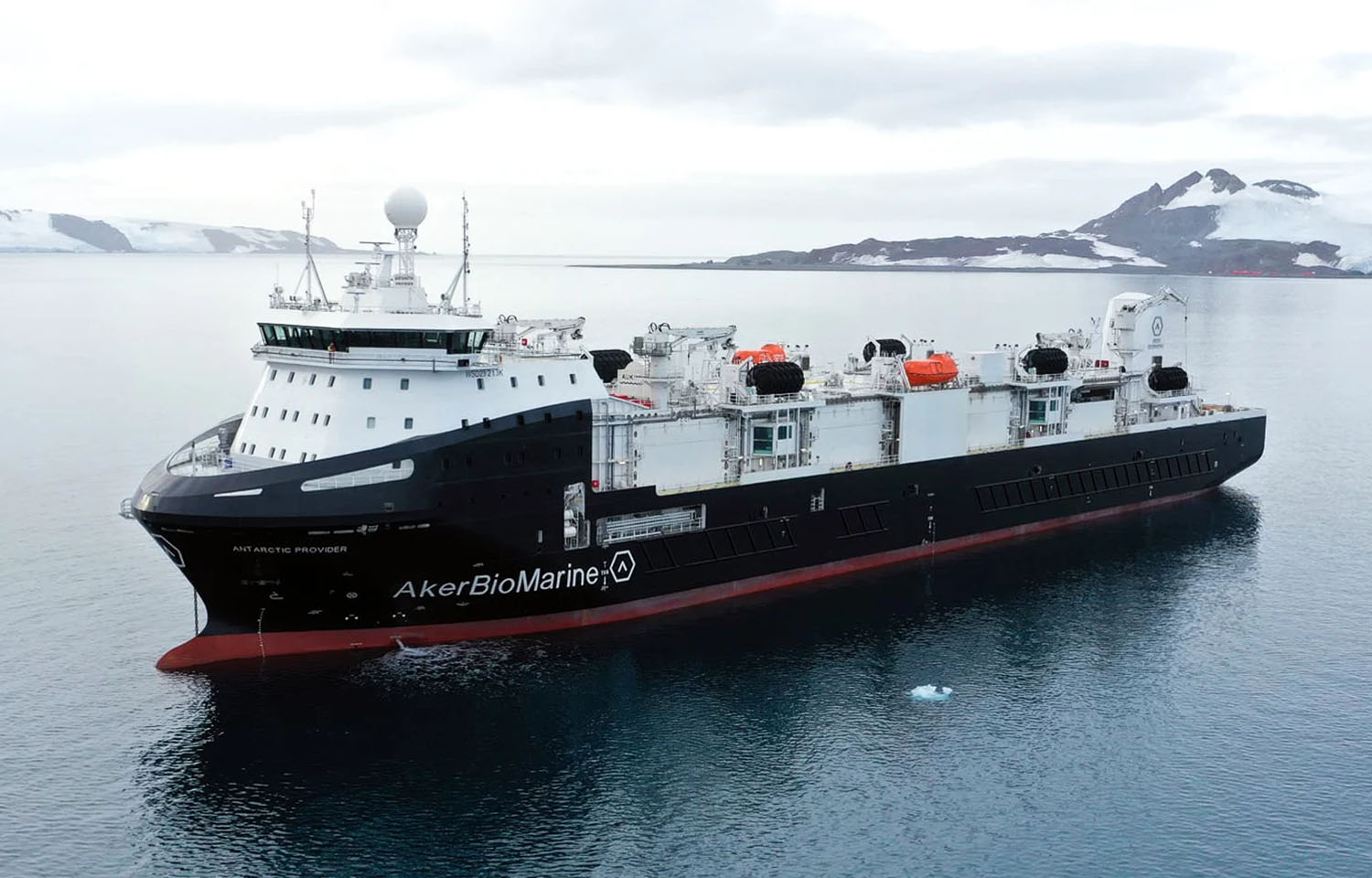
A big surge in the catch of Antarctic krill has the fishery approaching a potential early end to the season, according to an Associated Press report.
The Antarctic krill fishery is managed by the Commission for the Conservation of Antarctic Marine Living Resources (CCAMLR), a regulatory body composed of a number of countries. CCAMLR has been working to reach a consensus on fishing quotas for krill in the Antarctic but failed to set a 395,000-metric-ton (MT) limit in the Antarctic Zone 48.1.
In lieu of those formalized conservation measures, the industry has been enforcing voluntary measures in the area since 2019, which also include no-take zones that keeps any krill harvesting at least 30 to 40 kilometers away from breeding penguin colonies.
Industry representatives have long asserted that the krill fishery is sustainable due to its small catch compared to the recorded biomass of krill in the region. Pål Skogrand, the vice president for policy and impact at Norway-based Aker QRILL Company, said in January the fishery is fishing a tiny fraction of the overall biomass.
“Looking at smaller scales, scientific research has estimated a biomass of around 20 million MT to 25 million MT in 48.1 alone,” Skogrand said at the time. “You will struggle to find any fishery in the world that takes out less than 1 percent [to 2 percent] from the biomass it is targeting.”
As it failed to enact the new quota, CCAMLR also failed to renew a provision in its rules that spreads out the krill catch over a wider area – resulting in companies being able to target krill repeatedly in a smaller region of Antarctica’s waters.
Now, AP is reporting that in the first seven months of the 2024-2025 season, the total catch of krill in Antarctica is at 518,568 MT and could potentially get close to a 620,000 MT limit that has never been reached before.
That increase has caught the attention of environmental groups like the Antarctic and Southern Ocean Coalition (ASOC) and Sea Shepherd, which said world governments need to take urgent action to address the issue.
"Antarctica's fragile future is under siege. The record-breaking krill catch and the emergence of localised fishing 'hot spots' in the Antarctic Peninsula are deeply alarming,” WWF-Australia Ocean Conservation Manager Emily Grilly said in a release.
Sea Shepherd argued that while the 620,000 MT catch may be relatively small compared to the krill biomass, the recent rescinding of the rules that would have forced companies to spread out their fishing effort means that biomass was all caught in a small area.
“Most of the krill take is from an increasingly smaller area. It’s the equivalent of a hunter saying that they’re only killing 1 percent of the U.S. deer population but leaving out that all the deer were shot in Rhode Island,” Sea Shepherd said.
The Associated Press said the report it reviewed – which is not yet public – indicated the catch in pne hotspot through 30 June was 60 percent higher this year than last year. Data the AP sourced from Global Fishing Watch found fishing in Sub-Area 48.1 doubled so far this season.
"CCAMLR Member States are not meeting their obligation to protect the marine ecosystems of the Antarctic Peninsula, an area already under stress from rapid global warming,” ASOC Executive Director Claire Christian said in a release.
ASOC and Sea Shepherd both pushed CCMALR to work at bringing countries back to the table at its next meeting in October in order to reach an agreement on krill conservation.
“If CCAMLR hopes to retain credibility at this year's meeting in October, its members must restore precautionary, ecosystem-based krill management along with designating an MPA around the Antarctic Peninsula,” Pew Bertarelli Ocean Legacy Director Johnny Briggs said.
