




Chilean salmon-farming firm AquaChile has announced it will begin to incorporate renewable liquefied natural gas (BioLNG) as fuel in the trucks that transport the firm’s products.
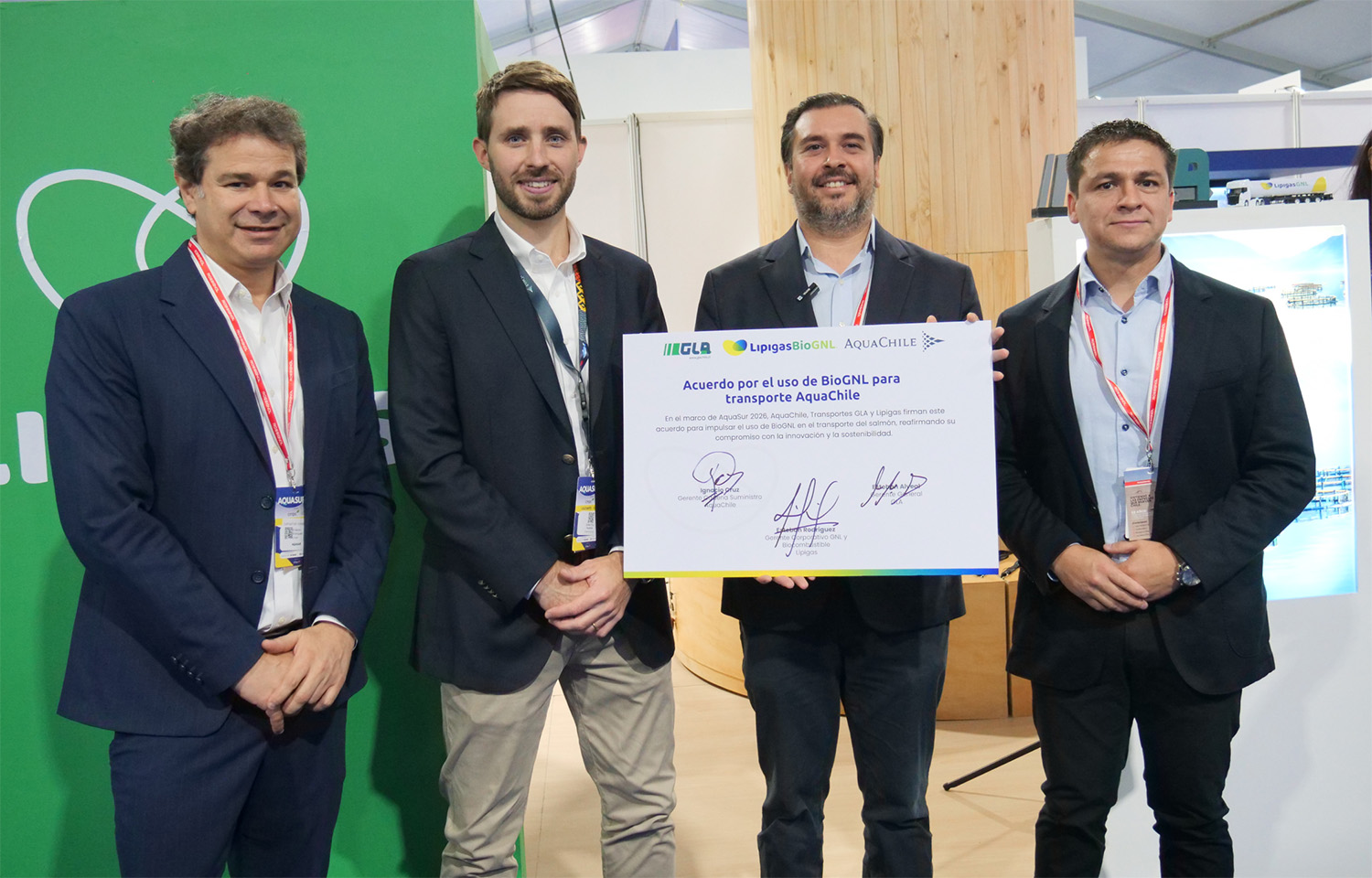
The project represents the next step in an initiative the firm has undergone with local transport firm Transportes GLA and logistics firm Lipigas, in which the three firms have aimed to incorporate lower-emission transport. The partners began operating a new fleet of LNG-powered trucks for the transport of AquaChile’s products at the beginning of 2025. The fleet will now progress to BioLNG, a fully renewable and carbon-neutral alternative that can be used with existing infrastructure and the same equipment that already operates with LNG.
The new fuel is produced by Lipigas at its BioLNG plant, inaugurated last November in the Ñuble region of Chile. This facility produces BioLNG through a process of purification and cooling of biogas from agricultural waste, integrating a circular economy model and enabling a feasible alternative to decarbonize heavy-duty transport.
In a fleet of 270 trucks, the use of BioLNG reduces emissions by more than 35,500 metric tons (MT) of CO2 per year, according to AquaChile, and also reduces particulate matter emissions by 96 percent, nitrogen and sulfur oxides by 85 percent, and noise emissions by up to 50 percent. These benefits are equivalent to taking more than 6,000 cars off the road or planting more than 38,000 trees.
“Alliances like this show that the energy transition is built on the collaboration between those who develop and supply energy, transporters, and load-generating customers,” Lipigas LNG and Biofuels Corporate Manager Esteban Rodríguez said. “This agreement allows us to advance in the incorporation of BioLNG into a real long-distance and high-demand operation, leveraged on our first renewable liquefied natural gas production plant in Latin America and on the network of stations that we have developed to make more sustainable logistics possible.”
The move comes shortly after AquaChile announced it had sent 3 MT of salmon to the U.S. aboard a plane using sustainable aviation fuel (SAF), as part of a larger effort to incorporate solutions with a smaller environmental impact into its international logistics. In that project, AquaChile partnered with logistics firm Andes Integración Logística and Latin American airline LATAM for a flight that emitted 10 percent less carbon dioxide than normal emissions for the flight.
Chile’s salmon farmers are increasingly taking a harder look at their environmental footprint as international buyers, particularly those in the United States and Europe, become increasingly discerning with the products they buy.
Last year, the Chilean branch of Oslo, Norway-based salmon-farming firm Cermaq announced the incorporation of BioLNG into its land transport network under its “Building the Road” project, which had been developed over the last three years in conjunction with local partners including Transportes GLA, Lipigas, and the Transport and Logistics Center of Andrés Bello University.
Previous to that, Puerto Montt-based salmon-farming firm Ventisqueros announced it had incorporated the use of certified biofuel in its salmon export shipments in collaboration with international transportation services firm Andes Integración Logística and shipping company Hapag-Lloyd.
AquaChile is Chile’s largest salmon-farming firm by volume. It posted USD 1.88 billion (EUR 1.59 billion) in revenue for the full year of 2025, while net profits reached USD 197 million (EUR 166 million).
