



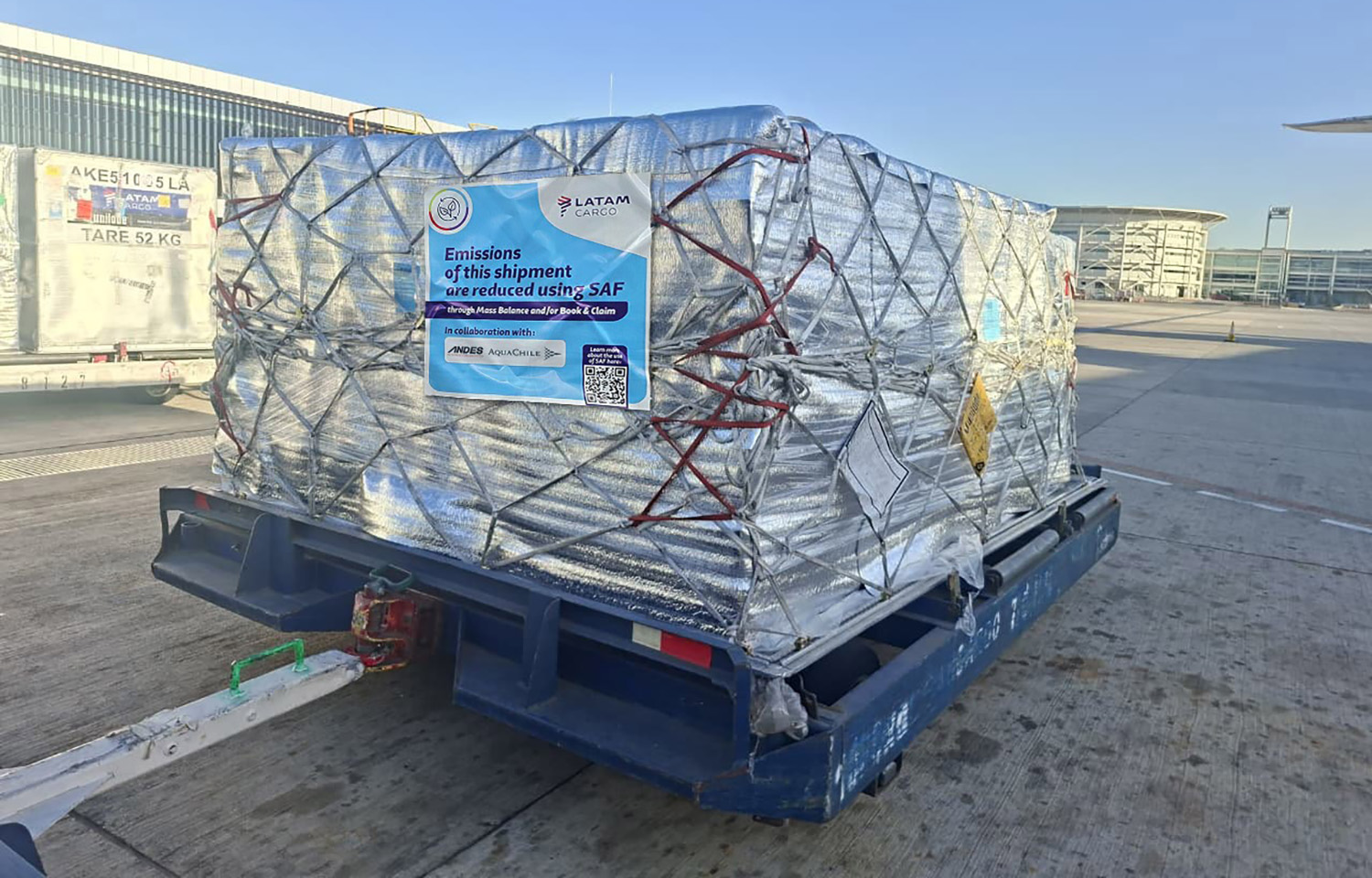
Chilean salmon-farming firm AquaChile has sent 3 metric tons (MT) of salmon to the U.S. aboard a plane using sustainable aviation fuel (SAF), as part of a larger effort to incorporate solutions with a smaller environmental impact into its international logistics.
Logistics firm Andes Integración Logística oversaw the project, managing the operational and environmental implementation, as well as tracing and recording the total emission reduction. The carbon dioxide (CO2) emissions for this first shipment were 10 percent below normal emissions for the flight, equivalent to 0.6 MT of CO2 emissions, AquaChile said in a statement.
Latin American airline LATAM was the operator under the “book and claim” system, whereby the buyer reserves or “books” a certain amount of SAF upon purchase and then “claims” the emissions reduction that can be credited toward its sustainability targets. As such, the buyer can claim the environmental benefits without physically possessing the fuel.
“We value being part of initiatives that allow us to continue advancing toward more sustainable logistics, especially in export operations to markets as relevant as the United States. This type of solution contributes to strengthening a more efficient chain and incorporating concrete improvements in environmental matters,” AquaChile said in a statement, calling the move a “strategic milestone” as it demonstrates the possibility of reducing emissions without affecting service quality.
The firm also said it provides a powerful signal to the rest of the salmon-farming industry regarding the importance of sustainable aviation fuels.
“This operation represents a first step toward a broader transformation, with a view to generating consistent use of SAF for different products and routes, especially to demanding markets such as the United States and Europe,” AquaChile said.
SAF is a renewable, lower-carbon alternative to traditional fossil fuel-based jet fuel that is chemically engineered to mimic conventional fuel and is usually blended with traditional fuel for “drop-in” capability, meaning the aircraft engine requires no adjustments to use SAF. It can be made from such ingredients as used cooking oil, animal fats, agricultural waste, and municipal trash, and since the plants or waste materials used to create the fuel previously absorbed CO2 from the atmosphere, the total amount of carbon released or reintroduced into the atmosphere during combustion is considered significantly lower than that of traditional fuels.
The announcement of the initiative comes as AquaChile posted USD 1.88 billion (EUR 1.59 billion) in revenues for the full year of 2025, compared to USD 1.65 billion (EUR 1.39 billion) the previous year. Its net profits reached USD 197 million (EUR 166 million) in 2025, up from USD 158 million (EUR 133 million) in 2024.
