






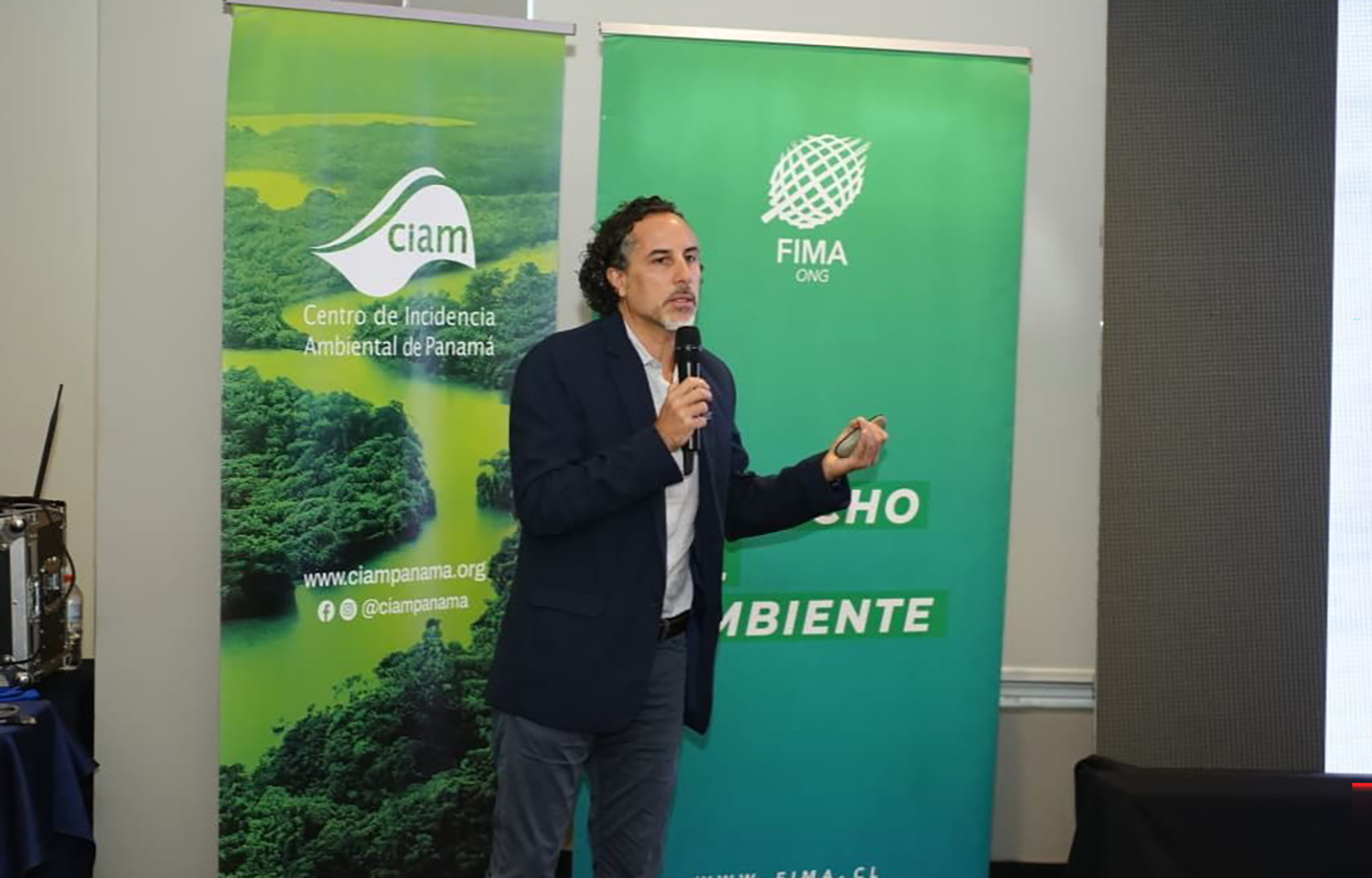
The Legal Ocean Watch (LOW) initiative, led by Chilean environmental NGO ONG Fima, is gaining momentum in the battle against illegal, unreported, and unregulated (IUU) fishing in Latin America.
LOW is a regional project that holds international seminars and publishes reports focused on combating IUU fishing in Latin America. The initiative has partners such as Global Fishing Watch to empower civil society to use satellite technology, including automatic identification systems (AIS) and vessel monitoring systems (VMS), to strengthen legal actions and fisheries governance.
Examples of concrete work carried out by LOW include the detection of a Chinese vessel acting erratically in Chile’s exclusive economic zone (EEZ) last October. ONG Fima acted as the whistleblower, warning of the vessel's intrusion into national waters based on data published on the Global Fishing Watch platform, which shows the flow of fishing fleets worldwide through satellite sensors.
“We can find this evidence thanks to these digital platforms that cross-reference available data, which are public, but that allow us to visualize the information in a way that allows us to verify that this behavior is precisely illegal because the state of Chile prohibits extractive fishing by foreign vessels [in its waters],” ONG Fima Coordinator Antonia Berríos told Chilean national television station Mega. “Performing a fishing maneuver, it entered the Chilean EEZ maintaining that maneuver and left after 40 to 50 minutes.”
The vessel was identified as Lu Rong Yuan Yu 667, belonging to the Rong Yuan Fishery company and flying the Chinese flag.
According to Milko Schvartzman, the ocean policy coordinator at Argentina-based environmental NGO Circulo de Politicas Ambientales, this particular vessel has no previous record of violating countries’ EEZ regulations but forms part of a large Chinese jigger fleet fishing for squid throughout the Pacific and Atlantic oceans that has a history of regularly entering other countries’ exclusive fishing areas.
Esteban Donoso, the interim director at Chile’s National Fisheries and Aquaculture Service (Sernapesca), called the law-skirting fleet “effectively pirates.” He noted that the vessels can be identified by such actions as turning off electronic monitoring systems but leaving lights ablaze so as to attract squid, “in which case we can detect them from space.”
Another telltale sign is the speed at which a vessel moves, Schvartzman added, as squid fishing is done at less than 2 knots, and this particular ship was moving at less than 1 knot.
"We don't think this is involuntary,” he said. “The squid on their migratory route usually approach the coasts, and that is why these vessels are bunching together in the EEZs of Ecuador, Peru, Chile … [and] Argentina.”
With this discovery, the whistleblowers did not wait for a government body to act; as NGOs, they made use of the citizen's right to environmental justice.
“We filed a complaint with the Iquique Court of Appeals for distribution to the court that was on duty the day the facts were discovered, and in parallel, [the complaint] was presented to Sernapesca,” Berríos said.
Sernapesca, in turn, activated its protocols in response to the complaint and hopes to validate the satellite tests.
“In our collaboration with Global Fishing Watch, we asked them to review this information and … to transmit to us some type of analysis in relation to this alert of apparent operation,” Donoso said.
This action taken against the Chinese vessel is the first concrete result in Chile stemming from the LOW project. Hefty fines could be levied if wrongdoing is determined, with penalties ranging from the equivalent of CLP 4.3 million (USD 4,830, EUR 4,160) to CLP 28.6 million (USD 32,100, EUR 27,700) per gross metric ton (MT) registered, and in the case of Lu Rong Yuan Yu 667, it is registered at 1,531 MT. Therefore, fines could reach as high as CLP 43.8 billion (USD 49.2 million, EUR 42.4 million).
The move sets a precedent in Chile, and new developments are forthcoming, Schvartzman told SeafoodSource.
“There is already another case in Chilean courts, and there are already two more pending – another case of illegal fishing and another vessel,” he said.
Berríos added that momentum in Chile is important but global stakeholders will need to follow suit if the sector wants to assure longlasting change.
“Today, a third of the oceans are part of national jurisdictions,” Berríos said. “Therefore, it is very important that other countries and other organizations also join this effort.”
Calling IUU fishing “a very serious problem at the global level,” she noted that the activity is estimated to cause global economic losses of USD 10 billion to USD 20 billion (EUR 8.6 billion to EUR 17.2 billion) per year, owing to overfishing of certain resources, pollution, and “other illegal activities that occur when certain companies operate outside the law.”
