
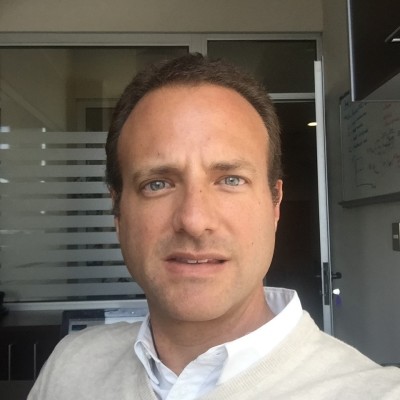
The coast of Argentina is home to a cemetery of sunk vessels that have participated in illegal, unreported, and unregulated (IUU) fishing activities, according to Milko Schvartzman, the ocean policy coordinator at Argentina-based environmental NGO Circulo de Politicas Ambientales.
“There is a graveyard of ships on the seabed of Mile 201,” he said, referring to the area just outside Argentina’s 200-mile exclusive economic zone (EEZ), and explained that many of those vessels were self-sunk by the crews themselves in order to evade capture for IUU activities.
“Historically, many ships [discovered as participating in IUU fishing] that have been chased, before being captured, self-sunk in the South Atlantic. There are some cases from the 1980s and 1990s and then in 2016 with Lu Yan Yuan Yu 010, which was scuttled. The Argentine Navy chased them and fired warning shots, and then they sank themselves so as not to be caught,” he said.
Under an Argentine law passed in 2001, the Special Registry of Fishing Projects for the Exploitation of the Squid Species Illex argentinus was created to allow foreign-flagged ships to enter the nation’s EEZ to capture any surplus of unexploited or underexploited species. That permission could be passed to other jiggers in the same fleet, as long as none in the fleet or the controlling companies had any record of IUU activity.
Nevertheless, ships like Lu Yan Yuan Yu 010, which was owned by Shandong Yantai Marine Fisheries Co. that is itself a subsidiary of the state-owned China National Fisheries Corporation (CNFC), were still granted permission to Argentine waters.
“The interesting thing is that during the process of the sinking, CNFC was requesting permission to enter two vessels into Argentinean waters to fish for squid. Argentine law prohibits permitting, or suspends permits, to any company or vessel related to illegal fishing. However, the Argentine government granted the permits to CNFC, without taking into account that this ship that was scuttled belonged to CNFC,” Schvartzman said. “CNFC was rejected [from entering Argentina’s EEZ] in 2005 and 2006 in relation to illegal fishing, but this was granted in 2017.”
In a further turn of events, the ship that rescued the crew of Lu Yan Yuan Yu 010 in 2016 was also a vessel belonging to CNFC, the Zhong Yuan Yu 011, which had also been captured for illegal fishing in 2005.
In 2019, the Zhong Yuan Yu 011 went on to collide with Spanish vessel Pesca Vaqueiro and sank off the coast of Argentina. There were no casualties.
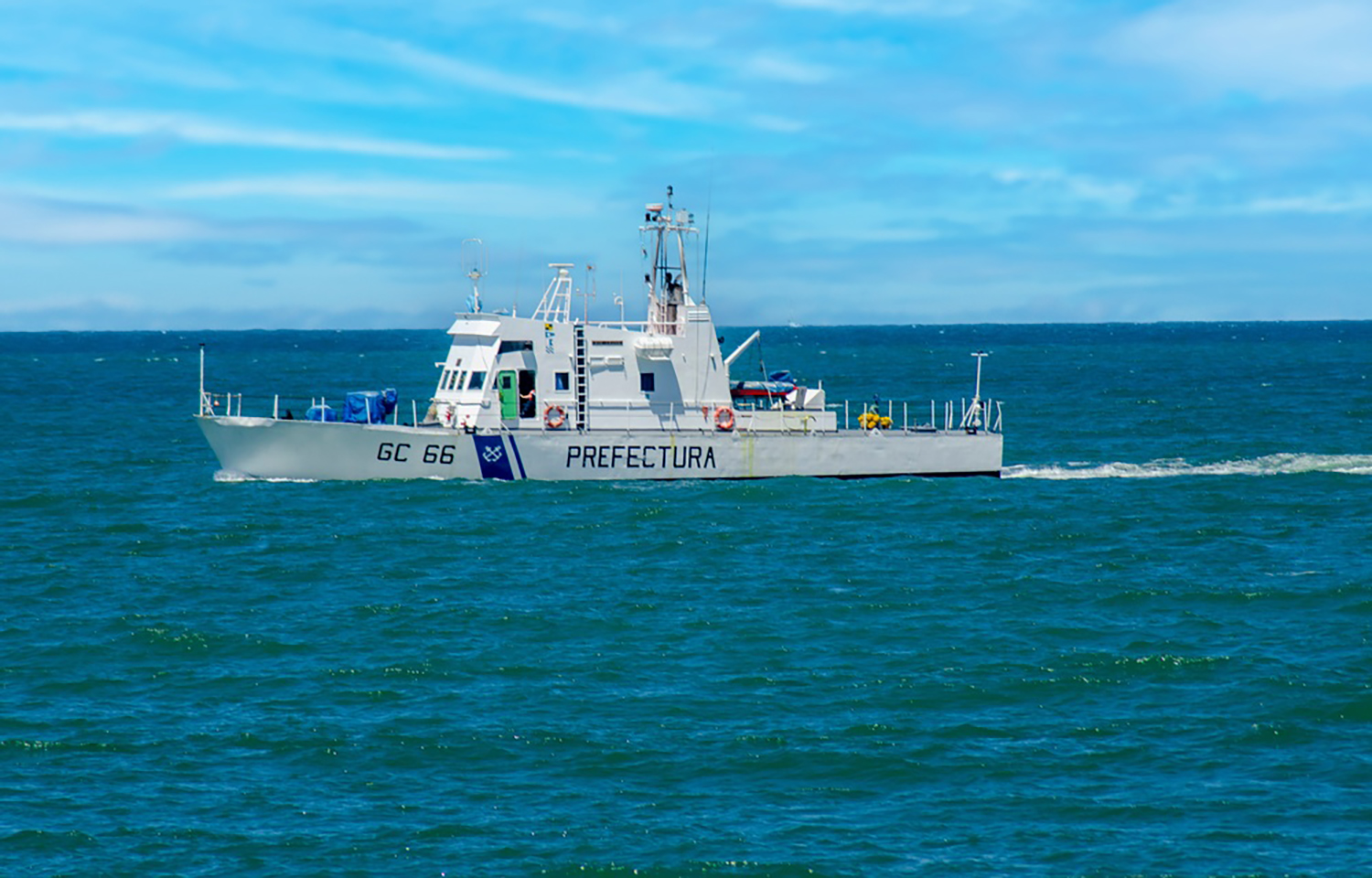
“I discovered all this because I analyzed videos taken by the prefecture's planes when the sinking occurred, and by reviewing those videos, I was able to identify the name of the ship that rescued the crew members and analyze the shipowner. I detected that it was the same shipowner – CNFC,” Schvartzman said. “There are other cases in the past; there are several ships on the seabed that are from that fleet.”
According to Circulo de Politicas Ambientales, much of Argentina’s information on the permitted fleet is not publicly available, and any available information is often fragmented, outdated, or dispersed in meeting minutes, making monitoring by control bodies, supply chain actors, civil society organizations, or concerned citizens in general difficult, the NGO said.
The lack of transparency is exacerbated by the opacity of certain corporate structures, the NGO further explained, especially in the case of distant-water fleets such as China's, which resort to legal mechanisms to obtain Argentine permission to operate within its EEZ, even when they have a history of illegal fishing. The complexity and lack of traceability in the actual ownership of vessels may allow shipowners linked to IUU fishing to circumvent restrictions.
Circulo de Politicas Ambientales assessed the accessibility and visibility of fishing vessel data in the region, comparing a dozen registries of Latin American countries. In its resulting transparency index, Argentina was ranked in last place, with a score of zero, meaning there is absolutely no visibility or accessibility to permit and vessel data. According to the NGO, this opacity limits the ability to verify whether a vessel is authorized to catch certain species, what fishing gear it can use, or whether its operator has a record that should prevent it from accessing a particular fishing area.
This situation has led to a socioenvironmental catastrophe, according to Schvartzman, as evidenced by a recently performed oceanographic campaign by Argentina’s National Institute for Fisheries Research and Development (INIDEP).
INIDEP sought to evaluate the health of the Argentine coast’s ecosystem and quantify the impact of foreign fleets that perform unregulated fishing in the area just outside of Argentina’s EEZ. The scientific expedition sought to analyze both the state of fisheries resources and any environmental impact on the seabed.
The campaign identified vulnerable marine ecosystems such as coldwater corals and giant sponges – structures extremely sensitive to the impact of fishing.
“These are formations that take many years to develop and can be easily destroyed by trawling or certain fishing practices,” INIDEP National Director of Research Otto Wöhler told local publication Revista Puerto.
The campaign also discovered troubling amounts of human-generated waste, especially jigger lines, plastics, and other elements associated with squid fishing, Wöhler said.
INIDEP's findings coincide with the red flags Schvartzman has been raising for years.
“We have been warning about this problem for more than 20 years, and now, INIDEP is demonstrating it with scientific evidence,” he said.
Schvartzman explained that in high season, up to 450 vessels can be registered operating simultaneously in the South Atlantic, with many of them remaining for months at sea without returning to port.
“We have ships that go more than a year without entering port. It’s clear that all that garbage ends up in the ocean,” he said.
To alleviate the issue, Schvartzman proposed moving toward the establishment of a regional body similar to the United Nations’ Environment Program’s Convention on the Conservation of Antarctic Marine Living Resources (CCAMLR) in order to regulate activity on the high seas.
“It is not a question of preventing fishing but of establishing minimum environmental and control standards,” he said.
