
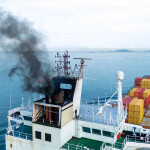

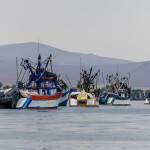
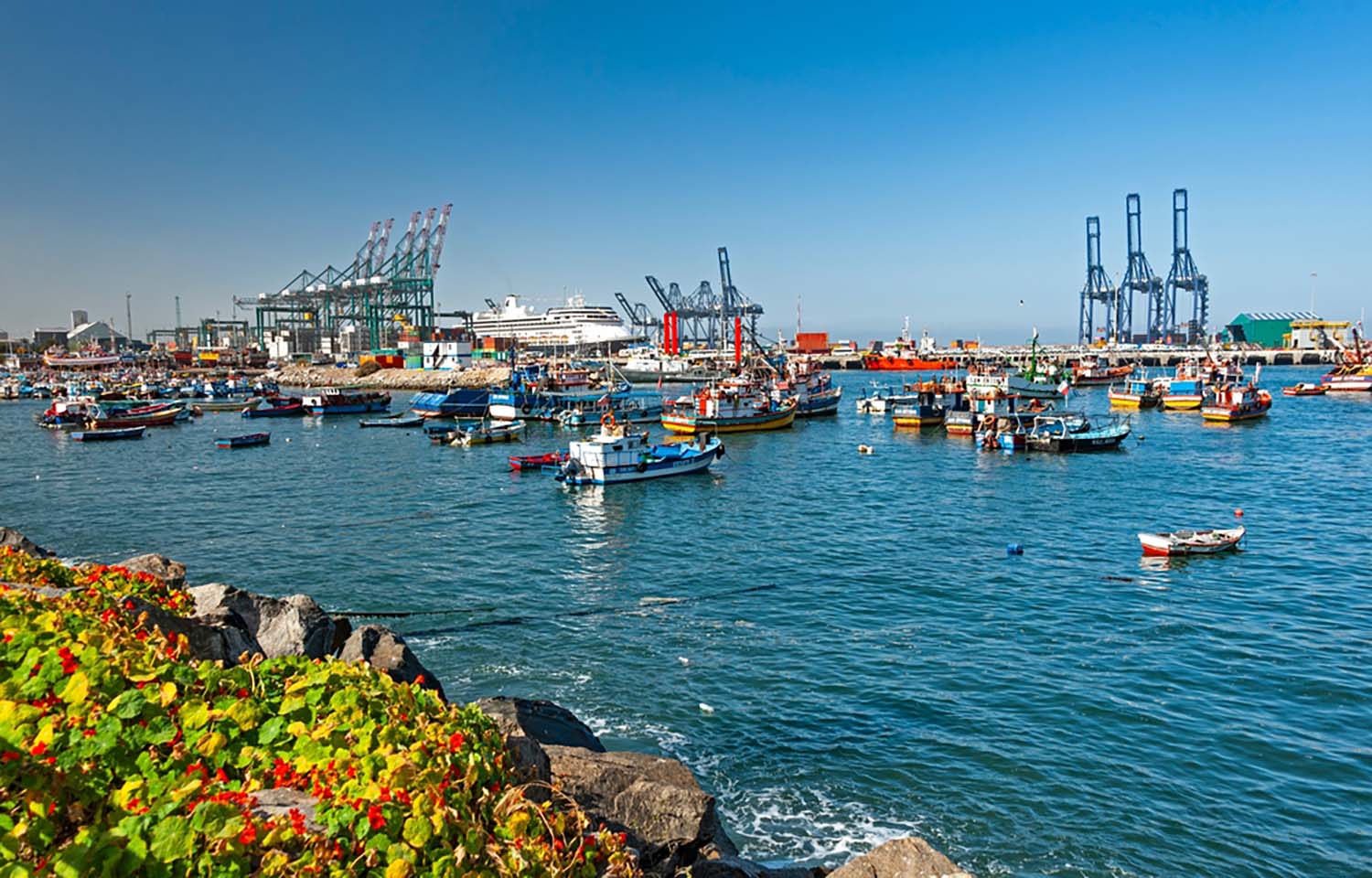
Argentinian environmental NGO Circulo de Políticas Ambientales (CPA) has put forth evidence it claims proves fishing vessels which have engaged in illegal, unreported, and unregulated (IUU) fishing activities are being increasingly serviced at Chilean ports.
Using data from Global Fishing Watch and IUU data firm Skylight, the NGO said the number of vessels serviced during the first half of the year in Chile, which have allegedly engaged in IUU activity, has reached a total of 25 – compared to zero such vessels registered during the same time period in 2024.
Chile was the only South American country in the CPA registry that saw an increase in the number of such vessels serviced year over year; in the first six months of 2024 and 2025, respectively, numbers in Argentina fell from three to zero, Brazil decreased from two to one, and Peru’s numbers dropped from 61 to zero. Meanwhile, Ecuador remained unchanged at zero and Uruguay – where the capital of Montevideo is known as Latin America’s preferred port for IUU vessels – remained flat at 23.
Earlier this year, the Committee for the Sustainable Management of the Southern Pacific Jumbo Flying Squid (CALAMASUR) suggested that Peru’s enforcement of stricter regulations, mostly directed toward China’s distant-water fleet, had IUU vessels looking to find “friendlier” ports, at which they could be serviced with logistical support – including landing of unregulated fish, repairs, refueling, and crew changes. Peru recently implemented stricter regulations including requiring any foreign vessel looking to enter the country to have a government-sanctioned SISESAT satellite device onboard and activated, regardless of the reason for its entry.
The CPA report backs CALAMASUR’s suggestions, and though the information has yet to be officially shared with the Chilean government, CPA “suspects” that the data has reached Chilean authorities indirectly, CPA Ocean Policy Coordinator Milko Schvartzman told SeafoodSource.
“We have no representation in Chile, and we are [currently] overwhelmed with work, but I think it's a good idea [to present it to Chile],” he said. “We're going to follow the evolution of the fleet until the end of the year, and we're going to evaluate it.”
All 25 of the vessels in question are Chinese, and all of them have been documented to have operated in an unregulated manner, with two of them – Fu Yuan Yu 7871 and Fu Yuan Yu 7872 – belonging to a shipowner sanctioned by the U.S. Treasury Department for illegal fishing and human rights abuses, according to Schvartzman.
“They are vessels that don’t comply with any regulations, that operate on the high seas, that make catches out of season, etc,” he said.
The CPA evidence comes as Chile is actively trying to position itself to be the host country for the secretariat of the Biodiversity Beyond National Jurisdiction (BBNJ) Agreement.
Also known as the High Seas Treaty, the BBNJ aims to regulate and protect marine biodiversity in areas and spaces that are outside national jurisdictions. It requires ratification by 60 countries to come into effect, and when the United Nations Ocean Conference ended 13 June, there were just 10 ratifications left to go. That number has since shrunk to 8 with the addition of Pakistan and Kyrgyzstan.
“However, by providing logistical support to a fleet sanctioned for plundering ecosystems and violating human rights, Chile sends a contradictory message,” CPA said. “The presence of ships such as the Fu Yuan Yu 7700, Hua Ying 77, or Tian Xiang 58 at its ports puts its environmental credibility at risk and exposes a gap in regional maritime governance.”
The CPA’s list was not an exhaustive account of IUU fishing vessels operating in the waters off of South America.
For example, U.S. Customs and Border Protection (CBP) ordered its officers to immediately seize all seafood from Chinese commercial fishing vessel Zhen Fa 7 should it enter a U.S. port, owing to what the law enforcement organization said was “reasonable suspicion” that the ship employed forced labor to harvest seafood, including squid. According to Argentine outlet Infobae, the vessel was back operating in the Argentine Sea in June.
CBP said it had identified a number of International Labor Organization forced labor violations in Zhen Fa 7's operations, including abuse of vulnerability, isolation, retention of identity documents, abusive working and living conditions, physical and sexual violence, and debt bondage.
“Combatting forced labor is central to CBP's mission to protect the economic security of the United States,” CBP Acting Commissioner Pete Flores said. “The President [Donald Trump] recently charged us to restore American seafood competitiveness by combatting unfair trade practices, and issuing this order is one way we are contributing to that goal.”
The move marked the sixth WRO that CBP has issued on a fishing vessel since 2020.
Other vessels not listed by CPA, but that continue to operate off of South America, include Din Fa 57, which was the subject of a late July report from another Argentine NGO: Fundación NUESTROMAR.
In the report, the NGO highlighted the story of two Indonesian workers who were lured into working on the Chinese fishing vessel.
According to the NGO, Sukarno Bajagur and Nahir Sungra, two 18-year-olds, were looking for a better living when they signed on to work on the fishing ship for USD 10,000 (EUR 8,570) a year. Three months after they boarded, they were fishing jumbo squid near the Galapagos Islands off the coast of Ecuador. In order to reach the promised payment, they started with a base salary of less than half of that originally agreed upon and were told they would receive USD 20 (EUR 17) per metric ton processed.
They were asked to work in the cargo hold, toiling in temperatures below freezing, and were given used clothes, including a pair of well-worn boots, to protect them from the cold. The vessel’s officers quickly turned to physical punishment if they made mistakes, according to NUESTROMAR.
After the squid season in the Pacific, the ship set sail south, crossed the Strait of Magellan, and entered the Atlantic to position itself in an area outside the exclusive economic zone (EEZ) of Argentina. It had already been a year since the two boys’ departure.
The ship would often encroach into Argentina’s EEZ, according to the report, but crew would put a metal bucket over the vessel’s automatic identification system (AIS) to block the signal and avoid detention. The Indonesians, desperate to get off the ship, decided to remove the metal bucket so the ship would be caught in Argentine waters.
Their ploy worked, and Din Fa 57 was detected fishing in national waters; the Argentine Coast Guard was deployed to seize the vessel. When the ship was docked and brought into Argentine jurisdiction, Sukaro and Nahir were able to escape and denounce the exploitation that took place on board. The Indonesian embassy facilitated their return home.
