



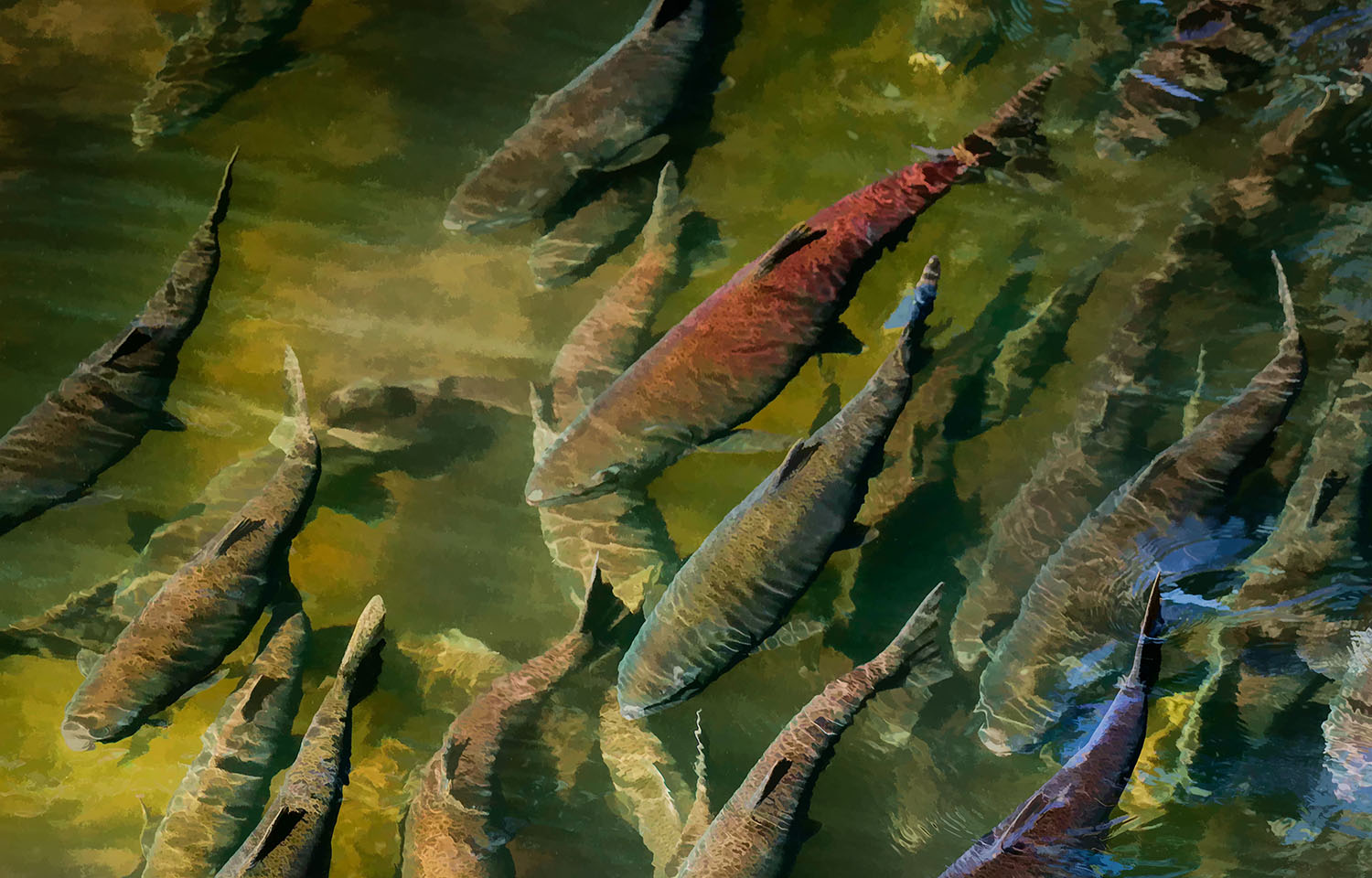
More than two years after a petition was filed, NOAA has determined that listing Alaskan Chinook salmon under the Endangered Species Act (ESA) is not warranted – a decision supported by many Alaskan fishing groups.
“This decision by NMFS Assistant Administrator Eugenio Piñeiro Soler indicates strong support for Alaska’s management of natural resources,” Alaska Department of Fish and Game (ADF&G) Commissioner Doug Vincent-Lang said in a release. “Alaska became a state, in large part, to hold authority over our own natural resources such as fisheries. Since then, the sound science and fisheries management by our department has been recognized globally.”
Wild Fish Conservancy initially filed a petition in January 2024, calling on NOAA to “delineate and list one or more evolutionary significant units (ESUs) of Gulf of Alaska Chinook salmon as threatened or endangered under the Endangered Species Act,” according to a release by NOAA. The Wild Fish Conservancy further argued that Chinook salmon populations were declining rapidly due to multiple commercial and personal use factors. NOAA’s recently completed review determined those claims were untrue.
“We conclude that the three ESUs of GOA Chinook salmon are not currently in danger of extinction throughout all or a significant portion of their ranges nor likely to become so within the foreseeable future,” the agency said in a posting in the Federal Register. “Therefore, we find that listing any of the ESUs of GOA [Gulf of Alaska] Chinook salmon under the ESA is not warranted at this time.”
The process evaluated the Southeast Gulf of Alaska (GOA), Central Gulf of Alaska, and Northwest Gulf of Alaska as possible ESU areas due to genetic differences, barriers to migration, and habitat breaks. Once the petition was filed in January 2024, a 90-day period indicated more research should be conducted, and NOAA enlisted help from ADF&G, a Tribal liaison, Alaska Native Tribes, and corporations in the GOA for the Status Review Report. The report analyzed four criteria: abundance, productivity, spatial distribution, and diversity. Within that criteria, researchers looked into five negative outcomes including habitat destruction, over-utilization of the species, disease or predation, inadequate regulations, and natural or human-made factors.
After the 12-month review, NOAA came to four conclusions, none of which supported a high risk of extinction. Instead, it found that environmental variability, or climate change, is the most significant threat. Although Chinook salmon run sizes are trending low, the fluctuations are typical and show signs of stabilization in future runs with large population sizes and diversity in both ecology and genetics. Finally, NOAA also found that current management practices are sufficient to support population viability in all three areas.
This ruling is a final decision, and no further public comments will be allowed.
“Natural factors, specifically environmental variability, pose a threat to GOA Chinook salmon, and there is uncertainty about future environmental conditions,” the agency said in the Federal Register. “However, GOA Chinook salmon are ecologically resilient, and fluctuations in abundance and productivity levels are expected for salmon.”
In a 10 March 2026 statement the Wild Fish Conservancy called an ESA listing causing an absolute ban on fishing a “common misconception,” and said the ESA does not arbitrarily shut down fisheries.
“Rather, it requires that harvest be strictly and scientifically managed to ensure it does not jeopardize the survival and recovery of any population,” Wild Fish Conservancy said in the release. “Ironically, it is the prolonged failure to implement this kind of precautionary and science-based management that has led to the devastating, blanket emergency closures that Alaskans are suffering through today in the Gulf of Alaska and the larger region. A comprehensive federal recovery plan provides the most credible pathway for rebuilding these populations to support sustainable fisheries again.”
The lack of an ESA declaration is likely supported by many Alaskan fishing advocacy groups, who were all outspoken prior to the decision.
"Failing to meet an escapement goal is not evidence that a stock is at risk of extinction; rather it is a proactive management trigger to ensure stocks are not overfished," Vincent-Lang said. "Alaska takes the decline in Chinook abundance very seriously. That is why we have taken significant management actions to reduce harvest and have invested heavily in research to better understand the causes of reduced productivity of these stocks."
