





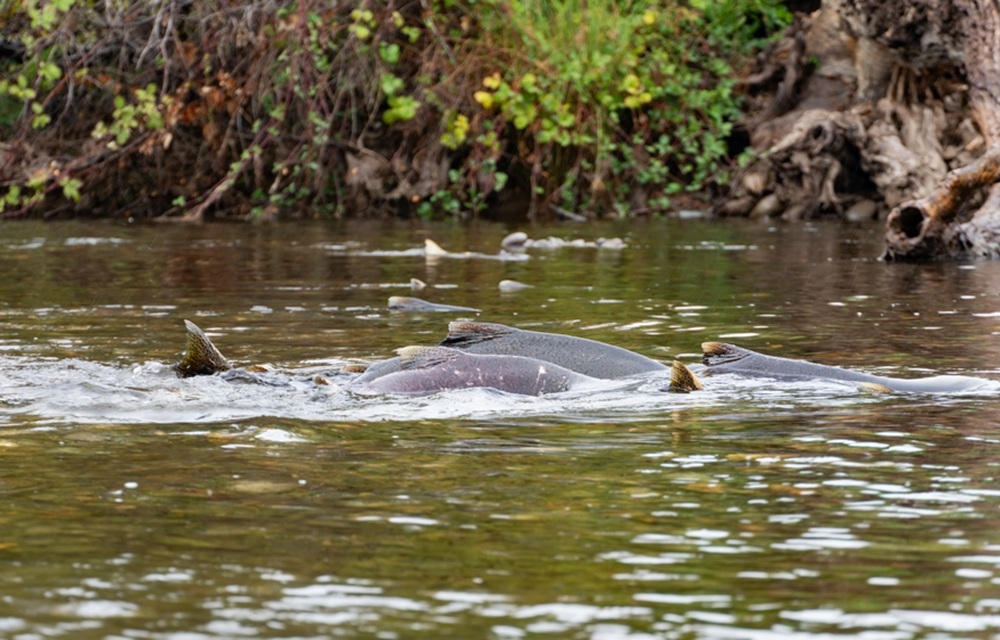
NOAA Fisheries has determined that coastal Chinook salmon in Oregon and Northern California do not warrant protections under the Endangered Species Act (ESA), finding that the fish are not in danger of extinction.
The finding is in response to a 2022 petition filed by three conservation groups: The Native Fish Society, Center for Biological Diversity, and Umpqua Watersheds. The groups argued that the Evolutionarily Significant Units (ESUs) of Oregon Coast (OC) and Southern Oregon/Northern California (SONCC) coastal Chinook “badly need protections” and could go extinct.
"Umpqua Watersheds has been tracking this population for decades and has never seen the wild spring Chinook population even close to its designated viability number for survival,” Stanley Petrowski, a member of Umpqua Watersheds, said in a statement earlier this year. “The science is clear. This unique, ecologically significant species is going extinct."
Though NOAA Fisheries acknowledged that the ESUs could warrant protection under the ESA in its initial 90-day finding – which was issued in 2023 – the agency blew by its deadline for issuing a full 12-month finding. In February 2025, the conservation groups sued NOAA Fisheries, asking a court to force the agency to complete the legally required 12-month finding. In June, the U.S. District Court of Oregon sided with the groups, ordering NOAA Fisheries to complete and release its findings by 3 November 2025.
Now, more than a month after the court-set deadline, NOAA Fisheries has released its findings, rejecting the petition and determining that OC and SONCC Chinook salmon do not deserve new protections under the ESA.
“Based on our review of the best available scientific and commercial information and the findings of the status review report, we determined that the OC and SONCC Chinook salmon ESUs are not currently in danger of extinction, nor are they likely to become so within the foreseeable future,” NOAA Fisheries stated. “They both have high overall abundance, with numerous, well-distributed spawning populations. Additionally, their high productivity allows them to maintain abundance even in the face of relatively high exploitation rates.”
The groups had sought to secure protections specifically for spring-run Chinook, which have lower numbers and face greater threats than their fall-run brethren, however, the government declined to consider them separately.
“While the status of spring-run Chinook salmon continued to be an area of concern, the overall numbers of fall-run Chinook salmon in this ESU and the recent increases in abundance in many of the smaller coastal streams were considered indicators of low extinction risk,” NOAA Fisheries reported.
The Center for Biological Diversity told Oregon Public Broadcasting it was considering challenging the agency’s finding.
