



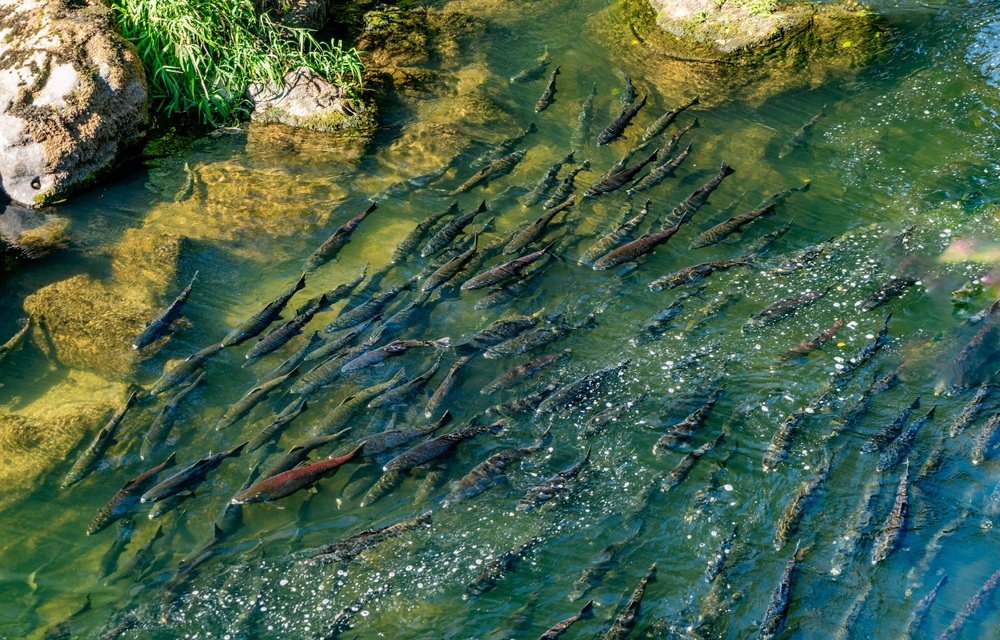
More than two and a half years after a petition was filed, NOAA Fisheries has determined that spring-run Chinook salmon on the Washington coast are not a distinct group from their fall-run counterparts and don’t warrant listing under the Endangered Species Act (ESA).
“NMFS has independently reviewed the best available scientific and commercial information,” NOAA Fisheries stated in a post on the Federal Register. “NMFS concludes that Chinook salmon spring-run populations on the Washington coast do not meet the definition of a species.”
Conservation NGOs Center for Biological Diversity and Pacific Rivers filed a petition in July 2023 asking the federal government to list the spring-run Chinook salmon as endangered or threatened under the ESA, arguing that the spring run was an evolutionary significant unit (ESU) distinct from their fall-run brethren. Washington coast Chinook salmon predominately return in the fall, with fall runs averaging 30,000 to 40,000 fish annually, compared to spring/summer runs of 5,000 to 7,000 fish.
Ultimately, though, NOAA Fisheries determined that the spring-run and fall-run stocks constitute a single ESU.
“Spring-run populations are not substantially reproductively isolated from the other portions of WC Chinook including WC fall-run populations, and WC spring-run populations are not a significant component of the evolutionary legacy of the species as a whole,” NOAA Fisheries said. “Therefore, NMFS determined the WC Chinook salmon ESU should not be partitioned based on run timing.”
When all the runs are considered together, Washington coast Chinook salmon are not at risk of extinction, the agency concluded.
Conservation groups had made a similar argument for spring-run Chinook salmon on the Oregon coast and in Northern California/Southern Oregon, though NOAA Fisheries ultimately denied that petition in December 2025 on similar grounds.
