






SeafoodSource is closely following the sustainable seafood movement by compiling a regular round-up of sector updates about sustainability initiatives and certifications.
– The Responsible Fisheries Management (RFM) certification program, originally a program geared toward certifying Alaska fisheries as sustainable, will now support certification for fisheries around the globe.
Created in 2010, the RFM certification was transferred from the Alaska Seafood Marketing Institute to the nonprofit Certified Seafood Collaborative (CSC) in 2020. That same year, it expanded its scope to cover fisheries across North America.
“Since RFM expanded to North America with Pacific whiting in 2020 and most recently with U.S. Gulf of Mexico shrimp, we’ve seen a growing interest from fisheries across the globe looking for choice in wild-capture certification,” CSC Chair Mark Fina said in a statement. “Today, the global expansion of RFM Fishery Standard V2.2 ensures that well-managed wild-capture fisheries from anywhere can have a certification choice and the opportunity for assessment against our standard.”
RFM was created as an alternative to Marine Stewardship Council certification, and it carries a lower cost since it doesn’t charge logo licensing fees.
“As our program grows, we remain dedicated to prioritizing origin on our label at no cost. We ensure the RFM logo is customizable per the fishery origin,” RFM Program Manager Jeff Regnart said. “Currently, Pacific whiting and U.S. Gulf Mexico shrimp use our U.S.A. version, while Alaska fisheries use our Alaska version. As global fisheries are assessed and determined well-managed, we will customize our logo to accommodate their regional call-out.”
RFM has caught on in Japan and has gained interest in Iceland, Regnart previously told SeafoodSource.
“Any well-regulated wild-capture fishery from anywhere in the world that would like to be assessed against the RFM Fishery Standard can contact the RFM program at [email protected] or one of the accredited certifying bodies to get started on a pre-assessment,” he said.
In 2023, RFM signed a partnership agreement with the Global Seafood Alliance, the operator of the Best Aquaculture Practices certification, to reduce costs and launch joint promotional efforts.
– The Monterey Bay Aquarium’s (MBA) Seafood Watch Program has lifted its rating of Pacific bluefin to yellow for the first time in 25 years.
A new assessment showed Pacific bluefin tuna is rebounding, resulting in the program upgrading fisheries in California and Mexico using FAD-free purse seines and the U.S. pole-and-line fishery to its yellow, or “good alternative,” rating. All Pacific bluefin tuna was previously rated red (“avoid”) for the past 25 years due to overfishing, which brought the population to 2 percent of its historical size. Mexico's ranching operations are still rated red by the Seafood Watch program, though MBA recently launched a program to better assist red-rated fisheries to improve their rating.
"The yellow rating is proof that a collaborative, science-based approach to fisheries management works,” MBA President of Global Ocean Conservation Jennifer Dianto Kemmerly said in a release. "After decades of research and work to recover this iconic species, we're encouraged to see Pacific bluefin tuna making a comeback, but they're not out of the woods yet. Consumers can play their part by making informed decisions. That means asking where, and how, your fish was caught and sticking to yellow-rated Pacific bluefin tuna."
In 2016, Pacific nations – including representatives from the United States, Japan, Mexico, South Korea, Taiwan, and several Pacific island countries – formed an international joint working group that eventually committed to rebuilding the Pacific bluefin population to 20 percent of its historic level by 2034. That target was achieved in 2023, more than 10 years ahead of schedule.
"This upgraded rating of Pacific bluefin tuna is something to be celebrated by seafood lovers, conservationists, and the seafood industry, but there's more work to do," MBA Fisheries and Aquaculture Policy Director Josh Madeira said. "Through continued international cooperation, Pacific nations can adopt a comprehensive long-term harvest strategy that ensures this species not only survives but thrives far into the future."
Madeira participated in past negotiations and was recently named a co-chair of the joint working group, which will meet in early 2025 to begin its next round of negotiations, in advance of a meeting in July 2025 in Japan to finalize a long-term management plan for the species.
– Cooke Inc. has joined the Global Sustainable Seafood Initiative (GSSI) as a funding partner.
GSSI is a non-governmental organization that operates a benchmark for third-party sustainability certifications. As a GSSI partner, Cooke “aims to play a larger role in empowering our sustainability leaders to collaborate and share knowledge to ensure confidence in the supply of certified seafood,” according to Cooke Chief Sustainability Officer Michael Szemerda.
“We recognize that it is important to our customers that our values and company mission are reflected in the daily work of our employees across our divisions, our supply chain, and in our communities,” Szemerda said. “As a family company, we know that providing a sustainable food source to the world is a top priority and that sustainable aquaculture and fishing are crucial elements in feeding generations to come. Working with GSSI and their members, we will continue to ensure our seafood is certified to the highest standards.”
– The Republic of Sierra Leone has committed to join the Fisheries Transparency Initiative (FiTI) and to implement the FiTI standard.
FiTI is a global partnership aiming to increase transparency and participation in marine sustainable management among fisheries. It has been performing country-by-country studies via its Taking Stock assessment series, which provides investigative analysis highlighting where their fishery transparency efforts currently stand.
Sierra Leone Minister for Fisheries and Marine Resources Princess Dugba said in her letter of acceptance that making the country’s fisheries data and information publicly accessible will improve decision-making processes and enhancing the trust of stakeholders in the country’s fisheries, including investors, fishing vessel operations, the private sector, and local and international partners.
“I am committed to working collaboratively with FiTI to enhance transparency in the fisheries sector and ensure that fisheries activities within our jurisdiction are conducted in a manner that is socially, economically, and environmentally sustainable,” Dugba said.
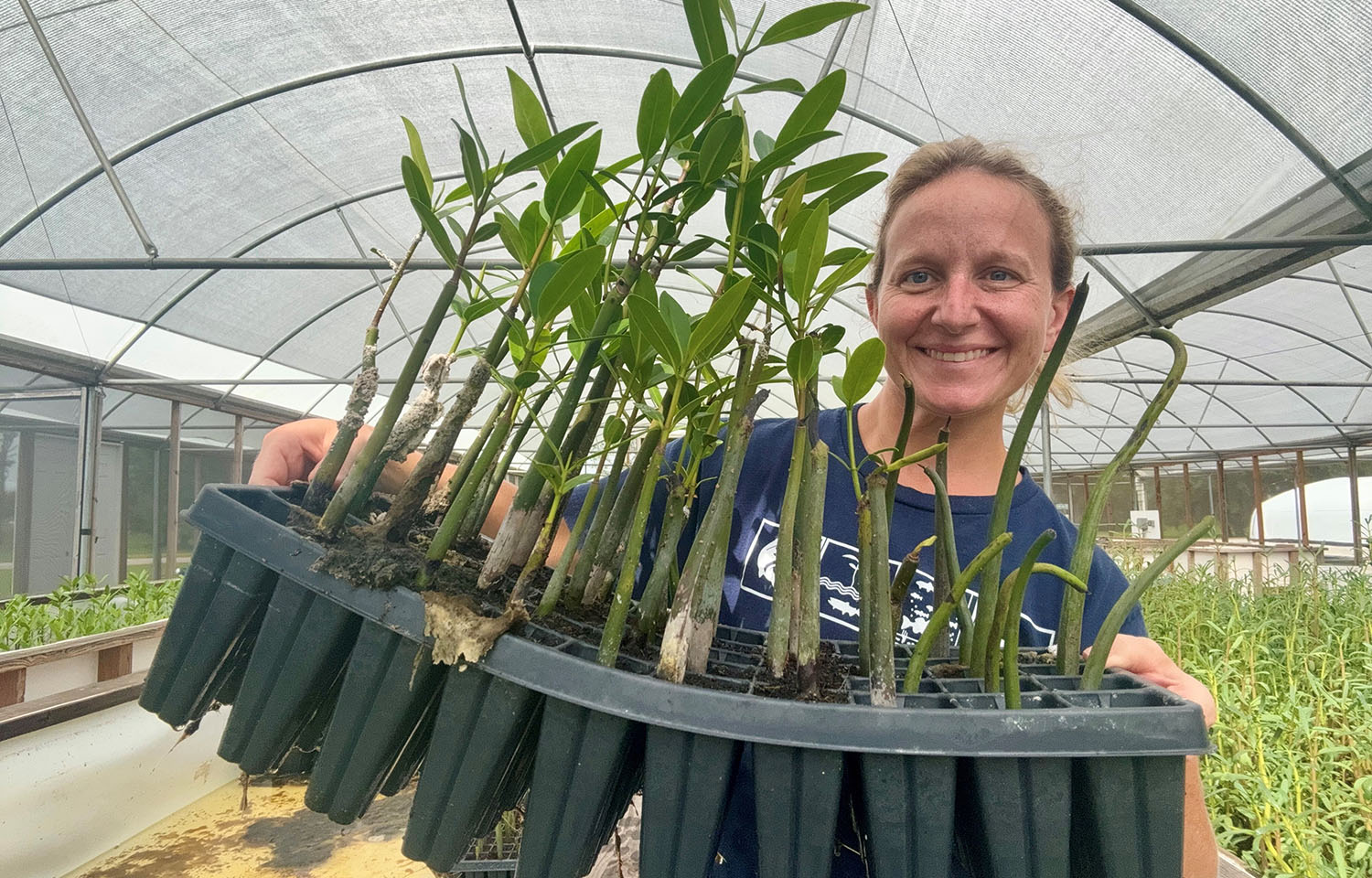
– Pine Island Redfish, a Pine Island, Florida, U.S.A.-based startup aiming to build a recirculating aquaculture system growing red drum, has formed a partnership with apparel company MANG.
Pine Island Redfish and MANG are teaming up to collect mangrove seeds as part of its Propagule Collection Project, which will then be cultivated in Pine Island Redfish’s nursery spaces, prior to being transplanted along the west coast of Florida.
“MANG [is] another Florida-based company with a shared vision for strengthening our coastal community ecosystems. MANG’s amazing gear supports their core mission to restore our mangrove ecosystems. And at Pine Island Redfish, we are passionate about producing our fish in a way that also supports restorative improvements to our coastal ecosystems and communities,” Pine Island Redfish Co-Founder and CEO Megan Sorby said. "This type of community engagement is critical to the success of environmental initiatives; everyone has to be in on it. We find this in aquaculture, as well; we are the business neighbor that is providing healthy, beautiful seafood while supporting ecosystem health and community resilience.”
– Canada’s federal government has committed to building two hatcheries to support Pacific salmon populations through its Pacific Salmon Strategy Initiative.
One hatchery will be built on the Kitwanga River, a tributary of the Skeena River, and will be operated by the Gitanyow Nation. Construction on the facility is expected to begin in the fall of 2024, and when complete, it will primarily raise Kitwanga sockeye salmon, a culturally important species to the Gitanyow.
"These latest investments by the federal government to help the Gitanyow recover Kitwanga sockeye represent a high point in our efforts to preserve and rebuild a stock that has been the life blood of our people since time immemorial,” Gitanyow Hereditary Chiefs Office President Chief Malii said in a release. “We voluntarily stopped fishing them over 50 years ago because of conservation concerns, and we hope these new measures to establish a state-of-the-art, modern, conservation-based hatchery will once again allow us to see strong and healthy sockeye salmon returns to our river."
A second hatchery will be built along the same timeframe on federally administered land on the north bank of the Nechako River, near its confluence with the Fraser River, in Prince George, British Columbia. Raising Chinook and sockeye salmon, it will be operated by Canada’s Department of Fisheries and Oceans (DFO) in collaboration with Lheidli T'enneh First Nation and with support from Canfor Pulp.
"Planning for this hatchery shows how Canada and First Nations are working together to conserve and restore vulnerable Pacific salmon populations, which are so important to all of us, and integral to Indigenous communities in British Columbia,” Canada Minister of Fisheries, Oceans, and the Canadian Coast Guard Diane Lebouthillier said. “With this new facility, DFO and Lheidli T'enneh First Nation are embarking on a partnership that will help address historic salmon declines and improve access to the fish that are the lifeblood of Indigenous peoples in the region."
Lebouthillier said Pacific salmon populations are under threat due to climate change and habitat degradation, with some endangered and at-risk populations having dropped dramatically and at risk of disappearing completely.
“Hatcheries, which incubate, rear, and release Pacific salmon to live alongside their wild counterparts, are a key component in supporting and restoring these vulnerable populations,” DFO said in its release.
The DFO's Pacific Salmon Strategy Initiative has funded a multi-year initiative to modernize Canada’s federal hatcheries, with the primary goal of conservation and targeting supports for specific at-risk Pacific salmon stocks, according to the agency.
For Lheidli T'enneh, the hatchery project represents the opportunity to provide support for salmon stocks that have been in serious decline, according to Lheidli T'enneh First Nation Chief Dolleen Logan.
“As a Nation, fisheries are central to the work we do. We remain committed to maintaining biodiversity in our traditional territory while enhancing salmon populations throughout the region. With an eye towards our shared future, we are positioned to impart traditional knowledge and opportunities on Nation youth, while developing new skills and employment opportunities,” Logan said.
