





The Fishery Transparency Initiative (FiTI), a global partnership aiming to increase transparency and participation in marine sustainable management among fisheries, released an assessment on 28 February labeling the U.S. as a global leader in fisheries transparency.
FiTI published the report, “Taking Stock: Online Transparency of Fisheries Management Information for the United States of America,” as part of its Taking Stock assessment series, which provides countries with an investigative analysis highlighting where their fishery transparency efforts currently stand.
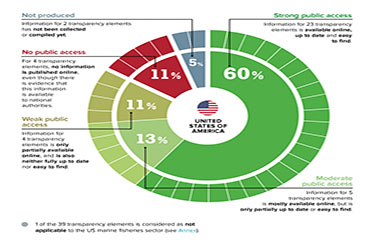
According to the U.S. report, 60 percent of transparency elements within the country have “strong public access,” 13 percent have a label of “moderate public access,” 11 percent have “weak public access,” 11 percent have “no public access,” and 5 percent are classified as “no [analysis] produced or collected yet.”
“The main finding is really that the U.S. is a global leader when it comes to making that information publicly available,” FiTI International Secretariat Executive Director Sven Biermann said. “We also found … that in the U.S., there seems to be a very clear understanding that transparency is not just about a website full of data … but also efforts to make sure that the data is actually being understood. That includes not only the fisheries experts or the people that are in the industry but also other people that may not have such a deep knowledge of the sector.”
According to Biermann, transparency gives fisheries managers the foundation for sustainable oversight of the industry. A lack of transparency also leads to harmful practices in fisheries such as illegal, unreported, and unregulated (IUU) fishing, fleet overcapacity, overfishing, corruption, and workers' rights abuses, Biermann told SeafoodSource.
FiTI’s assessment also found greater transparency globally deters illicit behavior, enhances positive fishery management decisions based on the best available information, and fosters appreciation of the socioeconomic contributions of fisheries.
FiTI has now completed nine Taking Stock assessments covering Mexico, Bangladesh, Ecuador, Comoros, Mauritius, Panama, Peru, São Tomé and Príncipe, and the U.S.
“We don’t assign priorities to the recommendations we make in the Taking Stock reports. Instead, what we would like to see is that these recommendations, which are basically improvement opportunities, will be discussed in some of the existing civic forums with the government and the NGOs and the industry around the table so that there are frank discussions about which priorities should be given to close some of the information or access gaps – from a domestic as well as an international point of view,” Biermann said.
While FiTI was mainly positive in its review of U.S. fisheries transparency, it highlighted four issues with the country’s current system: a lack of published information on fishery subsidies, sparse information on the post-harvest sector, inconsistent approaches to published information on fishing vessels and ownership fishing rights, and a lack of information on IUU fishing.
Biermann said the U.S. lacks a central vessel registry, which may not be important for certain regions of the country like Alaska and the Pacific region, which have their own effective registries, but other areas within the country lack this type of documentation. Internationally, however, players within the industry may view the absence of a unified central vessel registry as slightly hypocritical, he said.
“If you look at this from an international point [of view], the lack of a consolidated central vessel registry is really a missing building block of an IUU strategy. It was, therefore, surprising that the U.S. – [which] advocates for such registries abroad – doesn't have such a registry with sufficient information on the domestic level. It does not seem to be much of a priority,” Biermann said. “From an international point of view, the U.S. is playing a global leadership role and should, therefore practice what it preaches, even if some aspects are not seen as a priority.”
While the U.S. Corporate Transparency Act provides a legal basis to collect beneficial ownership information for all U.S. businesses, and the U.S. Department of the Treasury’s Financial Action Task Force organizes a central registry, it is not publicly available. Because of this lack of visibility into the sector’s ownership, it’s possible the U.S. fisheries sector could become less diversified over time and controlled by a few influential stakeholders.
“Quite often, the whole topic of beneficial ownership is seen only as a tool to counter illegal activities, such as money laundering and tax evasion and corruption,” Biermann said. “What is quite often overlooked is that this information could also be used to understand better whether there is an unhealthy economic concentration or disguised foreign ownership. So stakeholders in the U.S. should look at the lack of information on beneficial ownership in fisheries from this point of view.”
FiTI’s recommended the U.S. publish more data not currently available to the public, including the terms of international treaties containing fishing agreements. And it suggested federal consolidated of data now controlled by regional fishery management councils.
Furthermore, FiTI encouraged the U.S. to become a louder advocate for transparency in the international community, even if every nation cannot replicate the U.S. model.
“What has so far been lacking is an equally strong voice into the international community when it comes to strengthening transparency for fisheries management, which is what this Taking Stock transparency assessment is all about,” Biermann said. “One of our recommendations is, therefore, to have the U.S. nudging other countries to strengthen their efforts on transparency for fisheries management, which will not only contribute to the sustainability of fisheries but also complement existing efforts to counter IUU fishing.”
Photo courtesy of FiTI
