





Following the U.S. government’s promise to take “deregulatory-focused action” on a vessel speed limit rule designed to protect critically endangered North Atlantic right whales, NOAA Fisheries has issued an advance notice of proposed rulemaking to gather feedback.
“This reckless decision threatens the future of North Atlantic right whales,” Conservation Law Foundation Senior Counsel Erica Fuller said in a statement. “The species can’t afford to lose a single whale. Eliminating one of their strongest protections would imperil right whales' already challenging recovery. At a time when we need stronger, not weaker, protections, this would be another shortsighted move by this administration to help special interest groups.”
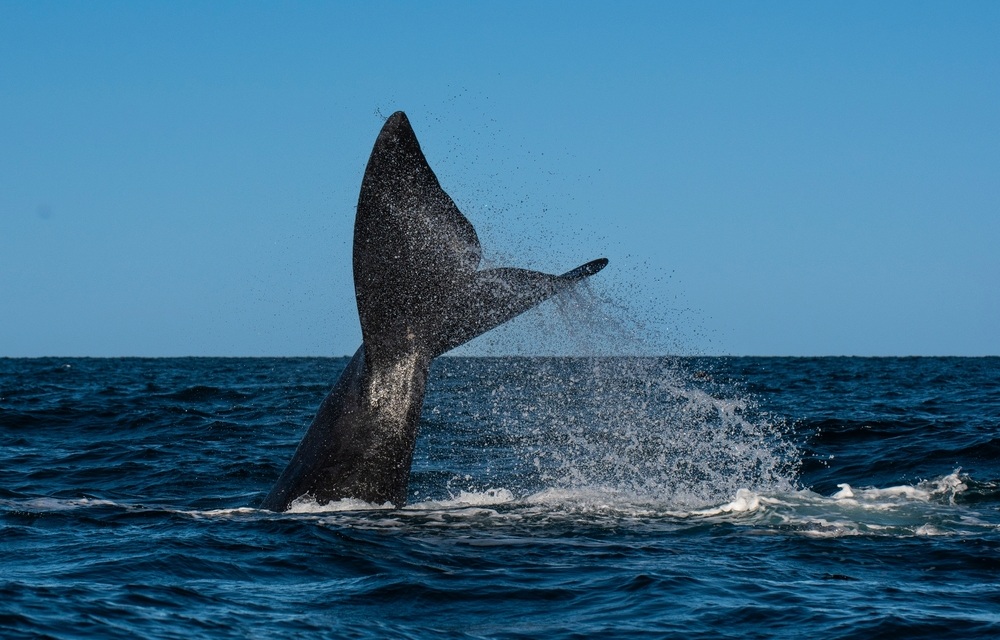
Since 2008, the federal government has set “seasonal management areas” where North Atlantic right whales gather, limiting speeds for vessels 65 feet or longer to 10 knots. North Atlantic right whales are endangered, with only about 380 left in existence. NOAA Fisheries lists vessel strikes and entanglements as the two biggest threats to the species and their recovery.
Though the announcement doesn’t lay out the government’s new proposal, it did clarify that the administration plans to replace the seasonal speed limits that are currently used to reduce vessel strikes.
“The goal of this initiative is to reduce unnecessary regulatory and economic burdens on the regulated community by replacing current seasonal speed restrictions with alternative management areas and advanced, technology-based, strike-avoidance measures that maintain or enhance conservation efficacy for the endangered North Atlantic right whale,” NOAA Fisheries said in its announcement. “The agency intends to craft durable programs that consider both conservation and the economic vitality of coastal communities.”
With its advance notice, the administration of U.S. President Donald Trump is seeking feedback on seven specific areas:
- The effectiveness of technologies to reduce vessel strikes with whales;
- Vessel-size specific risk assessment;
- Alternative management areas;
- Safety deviation provision improvements;
- Efficacy of the speed rule;
- Economic impacts on industry; and
- Outreach
Comments will be accepted through 2 June 2026.
The advance notice of proposed rulemaking quickly drew condemnation from conservation groups.
“It’s incredibly sadistic to destroy a solution that helps shield endangered whales from being killed by speeding ships. Trump officials are attacking one of the only protections North Atlantic right whales have against extinction,” Center for Biological Diversity Oceans Policy Specialist Rachel Rilee said in a release. “This is a brutal blow to right whales, who need and are legally entitled to far more help than they’ve been getting. I’m disgusted to see the Trump administration going after these beloved animals.”
At the same time the Trump administration is proposing rolling back the speed limit policy, the 2008 rule is being challenged in court. The NOAA Fisheries rule was challenged by a Florida boat captain who was fined USD 14,250 (EUR 13,190) for speeding through a seasonal management area in a 110-foot-long superyacht in 2022. The plaintiffs claim NOAA Fisheries did not have statutory authority to implement the 2008 rule in the first place.
“NOAA does not have the power to impose speed limits on the ocean,” the Pacific Legal Foundation, which is representing the captain before the U.S. District Court for the Middle District of Florida, said of the case on its website. “Congress has only authorized the agency to investigate and prosecute those who hunt or kill marine mammals. The speed limit is an unlawful power grab that endangers human lives.”
