



The Western Pacific Regional Fishery Management Council (WPRFMC) has decided to move forward with allowing commercial fishing within marine national monuments in the Pacific Ocean.
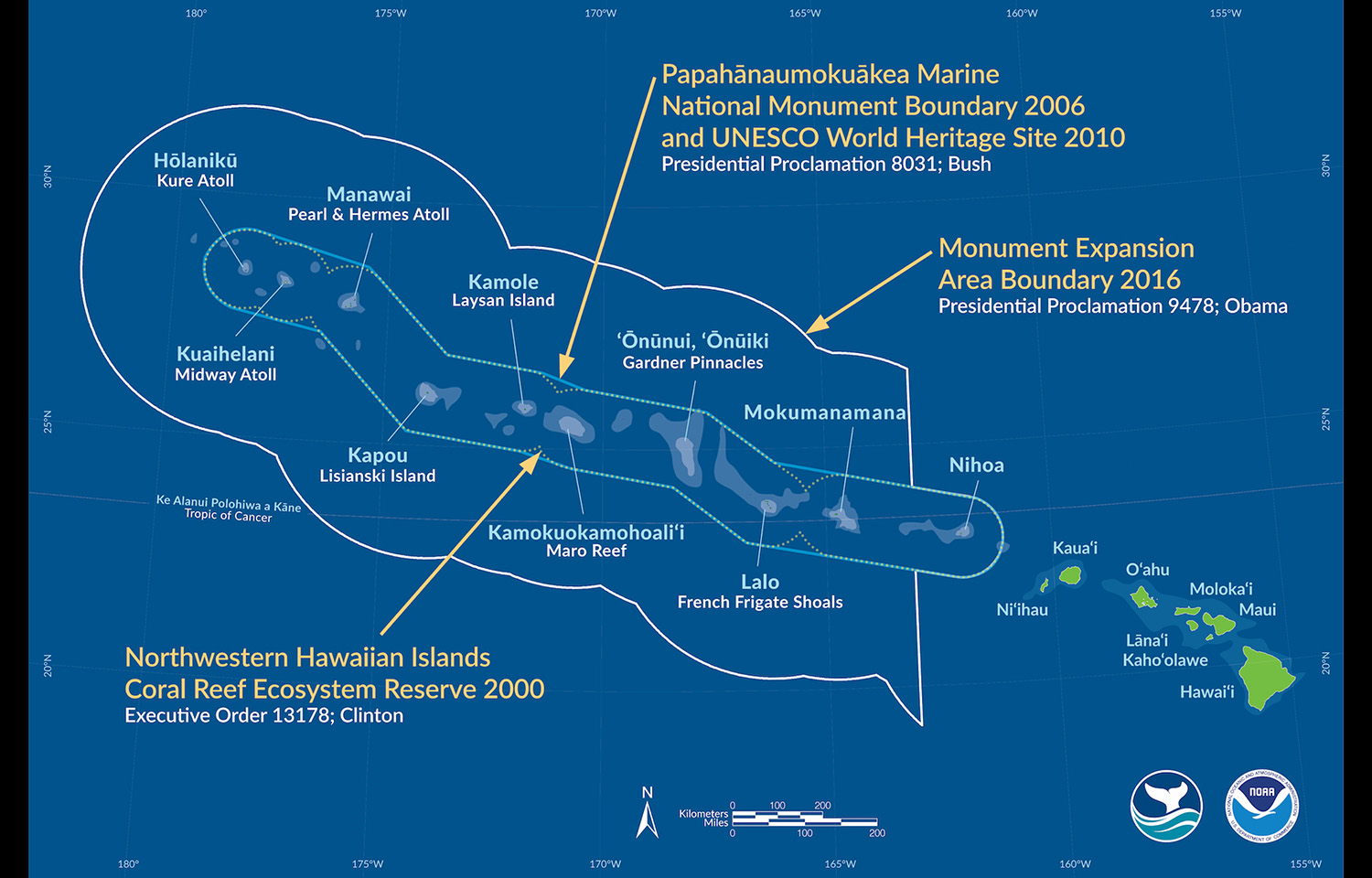
In a press release, the council said it is reopening the four marine national monuments in its management area – the Pacific Islands Heritage, Rose Atoll, Mariana Trench, and Papahānaumokuākea Marine national monuments. U.S. President Donald Trump directed much of those areas to reopen to fishing in a sweeping proclamation issued in April 2025 designed to benefit the U.S. seafood industry.
“The Council is responding to the proclamation through the council process of the [Magnuson-Stevens Act]. It is transparent, and people have the opportunity to voice their opinions,” Hawai‘i Council Member Matt Ramsey said. “If the council takes no action, others might make the decision for us. I appreciate the opportunity to shape and reform those commercial fishing regulations.”
The council put out a clarifying statement following Trump’s order outlining its impacts, emphasizing that the 0- to 50-mile area around islands in the area will remain protected and that the 50- to 200-mile zone is deep ocean where longliners and purse seine fishing have lower impacts.
The council has also directed its staff to analyze management options for implementing Trump’s proclamation and plans to share the results of that analysis at its meeting in December.
“U.S. fishermen need to fish in our healthy U.S. waters. The bottom line is eating our own fish,” WPRFMC Chair Will Sword said.
Guam Fishermen’s Cooperative Association member Manuel Duenas said during the meeting that there are no “commercial” fishers in the region, only “community-based fishers.”
“The boats are owned by local families and fish for the benefit of the community,” Duenas said.
The WPRFMC has long questioned the value of marine monuments in the Pacific and criticized a proposal by U.S. President Barack Obama to expand a conservation zone in the Pacific in 2014. At the time, the council said the monument would have little conservation benefit and would cause economic harms to fishermen in the region.
The council called on Trump to ease fishing restrictions during his first term, saying they were impeding the U.S.’s three main tuna fisheries in the Pacific and causing economic hardship. U.S. President Joe Biden later proposed the creation of a new marine sanctuary that would cover 770,000 square miles of ocean, which would have been the largest area of its kind in the world, leading to the WPRFMC, again, saying such a move would devastate the local economies of American Samoa.
The WPRFMC has also cited research finding little evidence that the establishment the Papahānaumokuākea Marine National Monument benefited fishing stocks in the region.
Ray Hilborn, a professor at the University of Washington’s School of Aquatic and Fishery Sciences and a member of the Science and Statistics Committee of the Western Fisheries Management Council, has also called for the reopening of the monuments and objected to criticisms of the earlier decision to ban all commercial fishing in the area.
Conservation groups have sued the Trump administration over the decision to reopen national monuments to commercial fishing, and in August, a U.S. judge blocked commercial fishing in the Pacific Islands Heritage Marine National Monument. That court case is still ongoing.
Some groups voiced their opposition to the most recent reopening announcements, including members of the Office of Hawaiian Affairs and the Native Hawaiian Cultural Working Group.
