


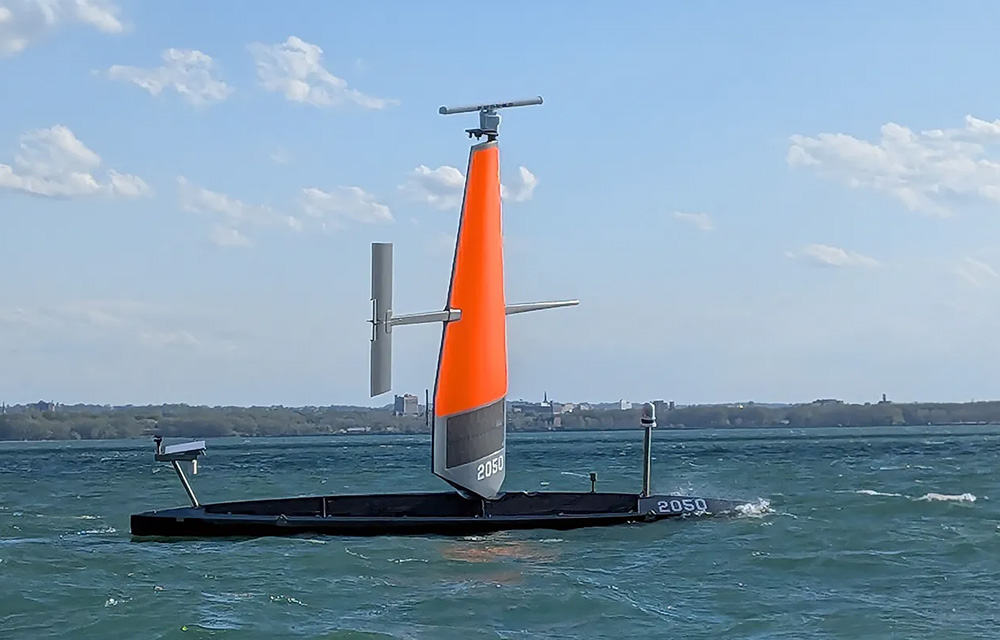
Alameda, California, U.S.A.-based Saildrone has been awarded USD 15.5 million (EUR 13.3 million) to supply 16 Saildrone Voyager unmanned surface vehicles (USV) to support the U.S. Coast Guard’s border security and counter illegal, unreported, and unregulated (IUU) fishing missions.
The autonomous 10-meter-long USVs will be deployed across the Great Lakes and the Northeast Atlantic, building on the company’s ongoing partnership with the Coast Guard. The vessels have high-resolution cameras, advanced radar, and automatic identification system to collect data and send back to Coast Guard operators.
“The expansion of our partnership with the Coast Guard into the Great Lakes and Northeast regions reflects the value Saildrone has delivered in prior missions,” Saildrone President John Mustin said in a release. “This Voyager fleet will help the Coast Guard maintain persistent, scalable maritime domain awareness across these expansive waters, identifying threats in real time and enabling focused, high-impact interdiction.”
According to the company’s release, the Great Lakes deployment will increase the Coast Guard’s visibility of maritime activity and any illicit operations. The company has previously worked on the Great Lakes with the U.S. Geological Survey’s Great Lakes Science Center conducting fishery monitoring.
Saildrone Voyager USVs deployed in the Northeast will focus on detecting IUU fishing activity.
“The North Atlantic is vast, remote, and operationally demanding, making it difficult to maintain continuous visibility with crewed patrol assets alone,” Saildrone said in a release. “By deploying Voyager USVs to monitor fishing vessel activity, the Coast Guard establishes a continuous maritime intelligence layer without overly burdening personnel. This persistent presence helps detect potential violations, support enforcement decisions, and deter illegal activity while reserving crewed assets for interdiction and enforcement at the moment of need.”
