






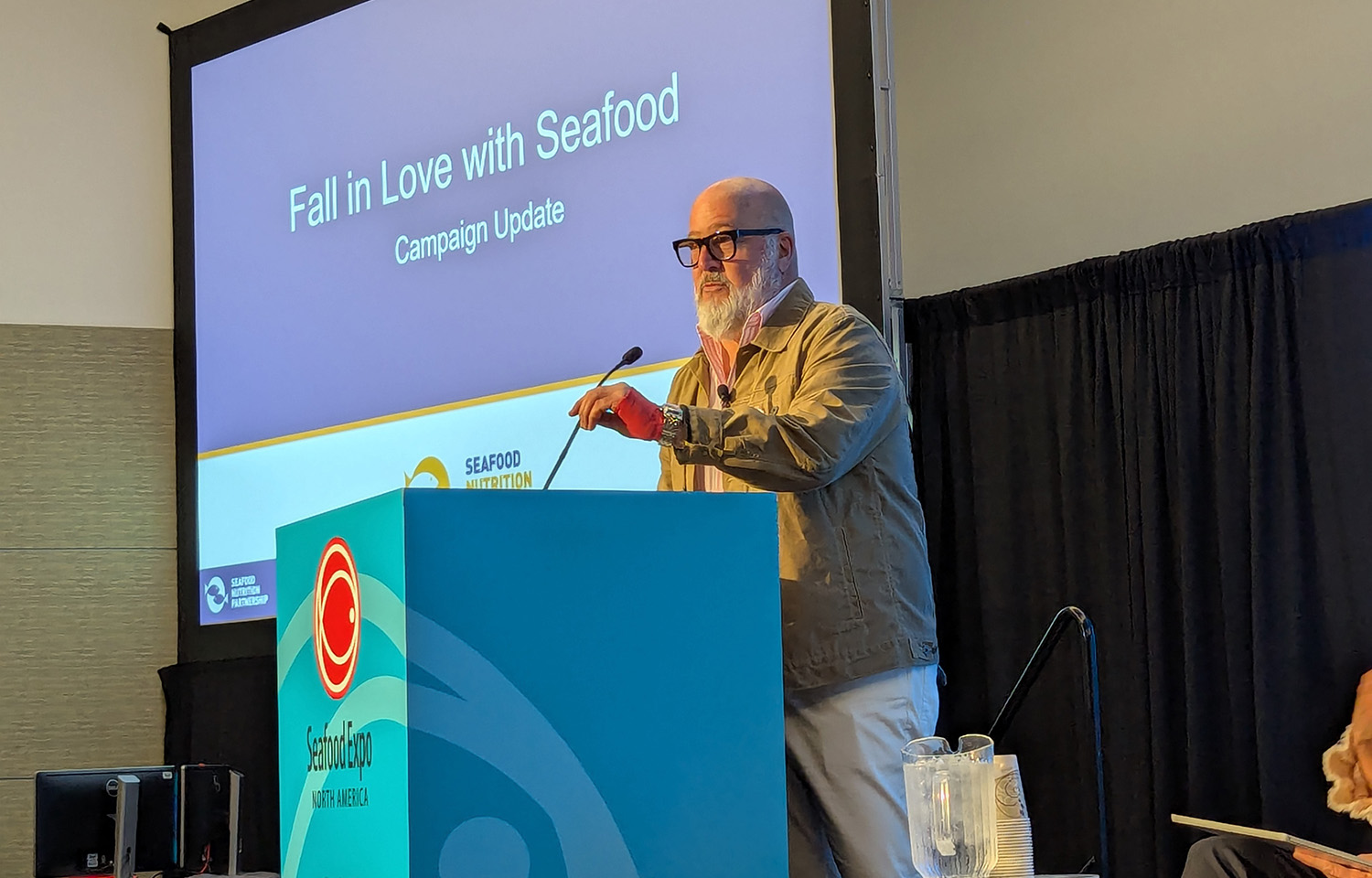
TV personality and James Beard award-winning Chef Andrew Zimmern said all it took was one great sentence from the Seafood Nutrition Partnership (SNP) for him to sign on to its mission.
Speaking during a panel session at the 2025 Seafood Expo North America covering SNP’s recent efforts to promote seafood consumption, Zimmern said the organization’s singular purpose was one he could fully support and was one of the main motivators for partnering with the health and wellness nonprofit on its “Fall in Love with Seafood” campaign.
Zimmern said a Zoom meeting he had with SNP Founder and President Linda Cornish and SNP Vice President of Marketing and Communications Sarah Crowley was all it took.
“When I talked to Linda and Sarah in our first Zoom meeting, they said, ‘We want Americans to eat one more seafood meal a week,’” Zimmern said. “I was like, ‘OK, I’m in.’ That, to me, is a win. I know what that looks like. I think I know some ways that I can help move that needle, but most importantly, it’s a really easy metric to get behind.”
SNP first launched its campaign in October 2023 as a way to increase seafood consumption and later partnered with U.S. grocery retailer H-E-B to roll out the campaign inside its stores. It's continuing to expand its campaign in the U.S., working to use advertising and messaging that grabs attention to boost seafood consumption.
Zimmern said that SNP's mission of increasing seafood consumption is an important one for multiple reasons, and based on his experience with SNP, that goal is reachable. However, there are several gaps between desire and consumption that need to be bridged if the industry hopes to move the needle.
The majority of Americans when surveyed say they want to eat more seafood, and Zimmern said that “want” is the most important part of that question.
“They didn’t say, ‘We did eat more seafood.’ They didn’t say ‘need to eat more seafood.’ They said ‘wanted to eat more seafood,’” Zimmern said. “So, what is preventing people who want to do something from doing it?”
Zimmern said there are probably a number of different reasons that people are reluctant to purchase seafood, one of which is transparency. Consumers increasingly want to know where the food they are eating comes from, and at restaurant and at retail, employees need to be able to tell them.
“I’m a big fan of Culver’s, and I like their fish sandwich. Any 16-year-old working summers at Culver’s will tell you where their fish is from or where they’ve gotten it that year. Every single one of them can tell you,” Zimmern said. “I go into fancy restaurants where I’m paying USD 250 [EUR 217] for a meal, and I say, ‘Where is this mackerel from?’ They can’t tell me. That’s wrong. Transparency is really, really, really important.”
Zimmern said another key barrier to consumption is price – which is consistent across a lot of food in the U.S.
“Food is becoming so expensive in America, and it’s not just seafood,” Zimmern said. “Prices in America for all foods are soaring, and it is happening at a time as our food systems, not just ones that come from fresh and saltwater, become more and more tenuous and wonkier.”
Zimmern said it is urgent that seafood producers find ways to bring down the costs of seafood to appeal to people as finances become tight.
“People are worried about their pocketbooks,” Zimmern said. “The vast majority of Americans are going to get poorer over the next two or three years before they become more well-off, that is just a fact, and we are going to see [decreases] and lose a lot of the progress that we’ve made on these issues unless we collectively understand this is a problem and there are solutions for them.”
During the panel discussion, Crowley highlighted the latest data from SNP’s efforts which showed that seafood retailers that partnered with SNP saw a USD 3.00 to USD 5.00 (EUR 2.64 to EUR 4.40) return on investment for every USD 1.00 (EUR 0.88) invested.
“We’re making money efficiently, and we’re getting more people to eat seafood,” she said.
Crowley said SNP has engaged a number of influencers and partnerships like the one it has with Zimmern to help engage a wider audience.
“We can tap into that following with partners who are really relied on and trusted. Andrew has 3 million followers, and we get to have him give the message of falling in love with seafood and eating more seafood,” Crowley said. “We like to partner with regional and national influencers; it makes a big difference.”
Zimmern said the main goal across all of the campaigns should be to expand understanding of seafood in the U.S.
“A well-informed consumer is probably the most important asset to this campaign that we could hope for,” Zimmern said.
At a retail level, getting someone to that well-informed level could be as simple as enhancing signage or training staff so that someone coming in with an idea and willingness to try something new are encouraged to do so.
“I stand in line at my seafood shopper supermarket, and I see bewilderment on the face of whoever is doing the grocery shopping,” he said.
