




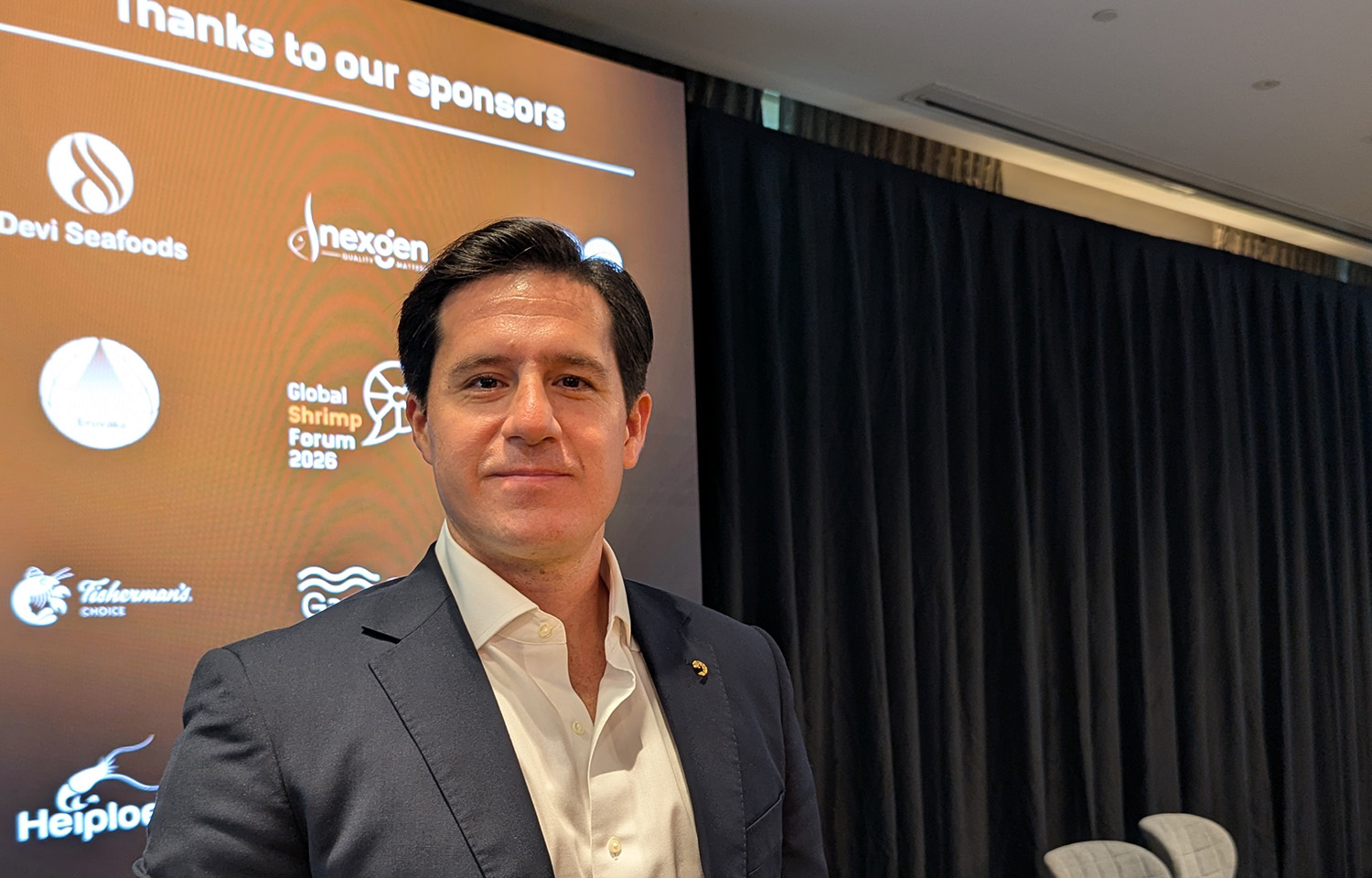
Ecuador’s shrimp industry has experienced explosive growth over the last decade, and Jose Camposano – the executive president of Ecuador’s National Aquaculture Chamber (CNA) – is working to continue that trend.
Throughout the Global Shrimp Forum, held from 1 to 3 September in Utrecht, the Netherlands, the story of Ecuador’s dominance was a common thread. Ecuador set a new shrimp export record in Q2 2026, and presentations speculated on what it would take for the industry to be on a similar level as Norway’s salmon industry.
Camposano has been the executive president of the CNA since 2011, and in that time has overseen the shrimp industry’s growth from 392 million pounds (MT) to 3 billion pounds in 2025.
He told SeafoodSource he credits that growth to the industry’s willingness to collaborate through an organization like the CNA, which is a nonprofit dedicated to the sustainable development of aquaculture in the country, and represents individuals, corporations, and associations engaged in activity related to the industry.
“One of the pillars of the industry is the integration of its members, and this is not only at the individual level,” Camposano said.
He said many Ecuadorian companies have integrated their shrimp aquaculture operations across the supply chain, from broodstock and feed through to final processing, but that integration also exists between different companies despite the fact they are competing with one another.
“Internally, the dialogue between those big, medium-size, and small companies through the chamber has demonstrated that it’s also one of the strengths of Ecuador,” Camposano said.
The chamber presents a united front for the industry where companies can collaborate and identify issues, and then bring those issues to its government through a private-public dialogue.
“Ecuador is a Latin American country, so you may imagine political uncertainty has been a variable that we have had to deal with in the past, and we are dealing with in the present. Having this private governance put in place in 1993 – when the chamber was founded – has been a strength of the industry,” Camposano.
The CNA gives the industry a pre-competitive platform for the industry to discuss those ongoing challenges and try and find solutions to them, he said.
Those challenges include more than just the normal foibles of shrimp farming like white spot syndrome virus and feed pricing. Ecuador has faced a myriad of outside issues, such as severe power shortages caused by droughts that reduced hydroelectric production and illicit activity that has driven up costs by forcing companies to hire more security against the threat of theft by organized crime.
“We have this precompetitive platform where we can discuss ongoing challenges, situations, problems, and opportunities,” Camposano said. “This is a process that is repeating itself, and has repeated itself for more than three decades.”
The origins of the chamber – which was formed by the exporters, producers, and laboratory associations coming together – have helped it encompass the whole industry as well, he said.
“I cannot say that we have perfected it, but definitely it is one of the strengths of the industry,” Camposano said.
That unified voice has also helped it overcome challenges from international regulators, he said. Recently China banned imports from multiple Ecuadorian shrimp-farming companies, and the CNA played a part in negotiating with China and lifting suspensions on some of those companies.
“You will always see that when a situation appears, the chamber appears once there is a consensus,” Camposano said.
That effort is also a symbol of what CNA's purpose is in many instances – a mobilization body toward change of some sort, whether that be implementation of standards or addressing challenges for the industry.
“It’s not only regulations, but it’s dealing with the challenges of the future,” Camposano said.
Those challenges can include things like how to solve looming shortages of feed ingredients, he said.
“In the end, it’s always getting the dialogue moving. We’ve seen a lot of examples of other industries, and with colleagues, that just have the private dialogue organized, and then organize the private-public dialogue is a nightmare,” Camposano said. “Having the chamber in Ecuador, and I cannot stress that enough, is a strength of the industry not only for local companies in Ecuador, but also for companies or investors trying to get into Ecuador.”
Looking forward Camposano said the CNA is always exploring new ways for it to aid the country’s aquaculture industry, and its always looking for new services to provide to its own members companies or individuals outside the country looking to find new opportunity in the country. It also helps be accumulating data for the Ecuadorian shrimp industry on a range of topics to help prove its credentials, both in terms of product quality and sustainability.
Those efforts are beginning to pay off, and he said many European customers are now beginning to seek out Ecuadorian shrimp.
“We think we have the credentials to differentiate ourselves enough to have a preference on origin, but again, it has to be communicated in a way that consumers get it,” Camposano.
To that end, the CNA is now close to signing agreements with groups in Europe to help establish Ecuadorian shrimp, building awareness of the product.
“There’s a lot of misinformation out there, and the right things to do is provide the right information so the consumer is well informed and can make the right choice,” Camposano said. “My responsibility towards my stakeholders, consumers included, is to provide them with facts.”
He said promotion is the next frontier for the industry, now that it has managed to establish itself as the largest producer through hard work over the last several years.
“The last four decades, we’ve been very concentrated on production,” Camposano said. “We need to be promotion focused now that the volumes are there – the variables are well managed, so the volumes will be there, what we need to change is to better communicate and better promote the product.”
