


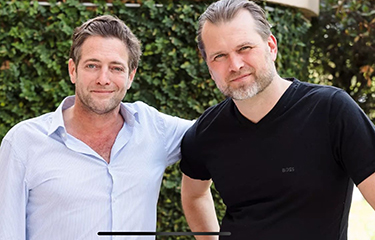
AquaFounders Capital, founded by former Kingfish Company CEO Ohad Maiman and former Atlantic Sapphire CTO Thue Holm, is changing its funding and development strategy and plans to develop a new recirculating aquaculture system solution and a high-value species farming operation in Europe.
The Amsterdam, the Netherlands-based company was formed earlier this year as an investment company, with the goal of investing in multiple farming, software, and hardware solutions for land-based aquaculture. But based on several factors, the firm is pivoting to focus on two objectives: developing a lower capex faster deployment farming system, and forming a new farming operation likely to be built in the Netherlands.
“In many ways, the goal hasn’t change, because we always thought we would eventually create these two companies, but we realized we would need do it almost bottom-up instead of top-down,” Maiman told SeafoodSource. “What we found out there is that one, it would stretch us quite thin if we had to sit on the boards of 20-plus companies that we had a minority stake in. That would miss the purpose in some ways. It would take up a lot of our time it will not give us the capacity we need to guide the development of these companies and to eventually consolidate them.”
Holm acknowledged both men are still consumed by an entrepreneurial spirit that is pushing them to lead on projects, rather than simply advise.
“It's just more natural for us to develop a farm from the ground up rather than to come in late with a small piece and take a bit of a backseat there,” he said.
Holm and Maiman met with the project leaders for more than 50 startups looking for funding, but eventually determined they already had an idea of their own they wanted to pursue – a concept they’ve dubbed a “farm in a box.”
“We did meet a few companies that have exciting technical capabilities, but we saw that we could either at a later stage potentially acquire these companies or engage with them as a preferred supplier for that capability. So it just it seemed like it would be holding us back and be less effective than actually targeting that concept and building it from the ground up,” Maiman said.
The “farm in a box” idea is centered around the development of modular RAS systems capable of being deployed around the globe, for use in growing a number of high-value species.
“The idea is similar to creating Lego pieces – likely three sizes of modules that you can then mix and match to reach your desired target for volume. So if it's 1,000 tons or 5,000 tons of a specific species, it would translate to X number of modules,” Holm said. “It would be like picking from a dropdown menu for species and volume. The design will change a little bit between species but would be as standardized as possible, as close to a plug-and-play type of almost greenhouse that you can ship and assemble to shorten the construction time.”
Holm said the concept came in response to investor concern about ballooning costs for RAS farm development and concern that bespoke land-based systems have too many problems.
“We think we can do it cheaper, faster, and smarter,” he said. “With custom projects, there are always surprises and cost overruns. Farm in a box takes the risk considerably down, and if your construction period is six months instead of two years, that is also a big difference.”
The farm-in-a-box concept also reduces dependence on local suppliers, and should be viable for a number of different species, according to Maiman.
“The design and construction process of these farms is the most problematic bottleneck for additional deployment,” Maiman said. “If I look back in 2015, the challenge was more to design reliable systems and I wouldn't say the prevailing attitude was cost be damned, but cost was less of an issue at that moment. But like every technology that matures, the cost and the complexity of designing and building them is the prevailing concern. Once you've proven that you can make a cell-based burger for USD 250,000 [EUR 230,000], you need to figure out how to do it for USD 0.25 [EUR 0.23], and I think we’re at that stage now with RAS. We've seen various other sectors in which that bottleneck is solved by rethinking how to deploy the technology, and we think our initial concept of prefabrication with fast assembly on site does that.”
To provide proof of concept, AquaFounders hopes to build an RAS farm in the Netherlands. It has initiated a conversation with the Dutch Water Authorities and expects to know within three months whether the site it is exploring is viable. If that doesn’t work out, the company is considering building instead along the Atlantic coast of Spain or Portugal, or in Iceland. A site with cold sea-water access is important for the two or three species the company is considering growing simultaneously.
Maiman and Holm acknowledged their choice of a modular design for their farms came partially in response to lessons learned in their previous roles at The Kingfish Company and Atlantic Sapphire.
“We’ve seen a lot of projects that need readjustments – it’s clear you cannot go from zero to 10,000 tons. Before, you could fund some really, really big projects on basically just an idea, which almost worked for some,” Holm said. “Sapphire and Kingfish walked the hard road to get there with a commercial pilot, but it’s clear you need to have a good proof of concept.”
Maiman said he now believes the modular concept is the future for RAS design and construction.
“RAS farms should be looking at smaller starting points and a faster road to profitability, and then potentially expand on that basis,” Maiman said. “I think it’s bit of a conceptual mistake in the design of large farms – when you're building a 100-ton system, putting pipes in the ground and building a structure around that is less cost-prohibitive, but if you think of how these designs ballooned to address thousands of tons, the basic design concept is the same, just larger, and that leads to prohibitive costs.
There are a few elements that we are trying to rethink and shave off that are not necessary in a large industrial outlook of how these farms should be built. But as long as farms keep getting proposed with the current design principles, the cost has become untenable in terms of materials, labor, and construction time. Investors do not like a business that is capex heavy, which takes six to seven years to see the first fish come out.”
Maiman said he thinks it’s a problem that RAS suppliers have been “effectively experimenting with their clients’ money.”
“For our farm in a box solution, we plan on doing the experimenting. But once we are able to show our proof of concept working well and have potential clients visit the prototype and see it for themselves, that should help us gain significant market share and smoothen our commercialization process.”
Holm said AquaFounders will also seek to develop the operating system aspects of RAS farming to minimize the need for trained labor, another major bottleneck for the industry.
“The current need for trained and experienced personnel is a major challange. We see a need for smart management software solutions that are well-tested and reliable, so both traditional fish farmers and newcomers to the space know it’s safe to use and invest in,” he said.
Maiman said investors have moved on to a new phase in their thinking about RAS – away from wondering whether the technology works, and towards seeking a faster road to profitability.
“The concern today is the capex and the long period of construction, but there is no question of the need for additional seafood,” Maiman said. “We had one investor effectively tell us, ‘So you're talking about making a better shovel, not prospecting for gold.’ Investors seem to like that position.”
Fundraising “is going to be a lot of work,” Maiman said, but the pair remain confident they’ll be successful. “We think we’ve come up with the right business model for farming and with technological improvements that change the calculus on capex and construction time, and that it will be very well-received,” he said. “As far as farming goes, we're quite familiar with the processes required there and we hope to implement lessons learned and have a bit of a smoother development this time.”
Photo courtesy of AquaFounders Capital
