

China’s recent embrace of deepwater mariculture is generating massive opportunities for the country’s seafood industry, but it’s also presenting challenges for certification bodies, which are finding it difficult to assess these facilities properly.
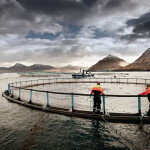
China has been doubling down on deepwater offshore mariculture and pushing major expansions of the sector in recent years. Major state corporations, including Shandong Marine Group and Qingdao-based Guoxin Development Group, have been working to launch offshore aquaculture platforms that can often combine mariculture and tourist activity.
The increased push for offshore aquaculture is creating dilemmas for aquaculture certification bodies, as the process is still in many cases in a pilot phase and differs heavily from traditional near-shore net pen aquaculture. One such certifying body is the Global Seafood Alliance, which runs the Best Aquaculture Practices (BAP) certification program. The organization has signaled it may need to alter certain guidelines to meet the unique needs and features of deepwater facilities.
“We keep a close eye on deepwater offshore aquaculture, as it’s a trend [highlighted] by the government,” Iris Xin Wang, a market development manager for BAP in China, said. “But, it also brings challenges for a certification standard like us. [Our] environment assessment might be more difficult [to conduct], and the social clauses might need to be updated [for deepwater facilities].”
The GSA has had a presence in China for several years and has certified offshore cage farms in the country, including a golden pompano farm that earned BAP certification in 2018, as well as Ningde Muyu, a yellow croaker farm using deep-sea cages.
Wang’s office has also been in talks with the Guoxin Development Group about certifying its mariculture vessel: Guoxin 1. Described as the world’s first 100,000-ton “smart-aquaculture” vessel, the Guoxin 1 is a large moving ship containing 15 aquaculture “cabins” which the company plans to use to grow yellow croaker or other valuable species.
Deep sea aquaculture vessels like Guoxin’s offer new categorization challenges for certifications like BAP, Wang explained to SeafoodSource.
Guoxin 1 hasn’t secured BAP certification yet “not because it cannot meet our standard,” Wang said. “After several conversations, our program integrity team thinks they need more time to learn and evaluate [Guoxin] … and ensure BAP can control [its] unique risks.”
BAP isn’t the only certifying body seeing new demand stemming from China’s expansion of deepwater mariculture.
Speaking at a recent conference in Guangzhou attended by mariculture company representatives, Fang Qing, head of the Aquaculture Stewardship Council’s (ASC) office in China, said certification would become increasingly important to reassure investors and regulators that deepwater mariculture is sustainable..
Like the Global Seafood Alliance, the ASC has also maintained a presence in China for many years, and continues to work to certify new species and farming methods.One example of its work is Guolian (Yiyang) Crayfish Breeding Biotechnology Co., Ltd. – a unit of the giant Guolian Aquatic Group – which recently became the first crayfish farm in the world to earn ASC certification for responsible seafood farming.
Chen Han, the president of the Guolian Aquaculture Group, said that earning ASC certification epitomized “full validation of Guolian’s active efforts to transform and improve crayfish farming.”
The ASC also recently certified a golden pomfret marine cage farm operated by Hainan Xiangtai Fishery Co. under the ASC Tropical Marine Finfish category.
The particular certification deepwater facilities choose to pursue, if they choose to do so at all, will depend on whether either certifying body can properly analyze the unique projects.
Regardless of certification, it seems as though China will continue to invest heavily in deepwater mariculture, and government officials have touted some of its benefits to justify such investments.
“The world is confronting food security challenges,” said Chen Pi Mao, head of the mariculture research bureau at the Chinese agriculture ministry, during a recent television interview, pointing to a U.N. report published last year that showed 828 million, or 9.8 percent of the global population, suffered from food insecurity and malnutrition in 2021.
China’s mainland has an 18,000-kilometer coastline, of which 16,000 kilometers are suitable for mariculture projects that could help to ease food security issues, Chen said.
However, government emphasis on the potential of deep-sea mariculture to ease food security woes directly contrasts the view of researchers who have pointed out that these deepwater projects are likely to solely focus on high-value or luxury species.
A 2020 paper published in Marine Communications and Nature suggested planned investments in offshore finfish projects in Chinese waters would singularly produce “luxury species” like Japanese seabass, salmon, and large yellow croaker rather than attempt to meet food security needs.
“Projects such as these, if eventually realized, would do little to contribute to global food and nutrition security, ameliorate malnutrition, or support nutritionally vulnerable people,” suggested the paper.
Photo courtesy of Guoxin Development Group
