






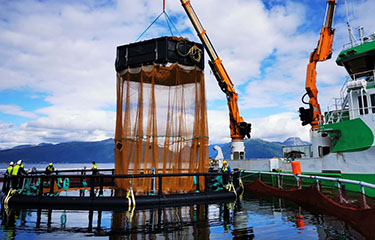
A high-tech method of fish farming has been advanced by Oslo, Norway-based Cermaq.
The iFarm project – a collaboration between Cermaq, BioSort, and ScaleAQ that uses artificial intelligence and machine learning to improve management and oversight of salmon-farming operations – formally launched in January 2020. According to Cermaq, the project was recently advanced to its third phase.
The iFarm uses a closed pen with a narrow surface opening, forcing the farmed fish to travel through an image-capturing station that is able to identify individual salmon while they are swimming, enabling the farm to monitor growth rates, lice count, and mortality rates inside the cages.
Phase one of the iFarm concept took place at Cermaq’s Martnesvika farm-site in Steigen, and primarily focused on perfecting the project’s equipment and its use, according to iFarm Project Manager Karl Fredrik Ottem. Phase two took place at Cermaq’s sea site in Vesterålen, Norway, with work focused on perfecting camera-cleaning and equipment-maintenance processes and procedures.
Now, in the third phase, which began in early December 2022 at Cermaq farm in Øksnes and Steigen in Nordland, Norway, the focus is on machine learning – specifically the iFarm’s sensors and sorters.
"At Hellarvika, we will concentrate on the sensor arrangement to retrieve images with good quality and follow up the annotation of key parameters such as fish identification, lice, growth, and fish welfare in the net-pen, and on further developing sorters," BioSort Managing Director Geir Stang Hauge said. "After a successful test of the first-generation sorter in net pens, where we saw that the mechanical sorting mechanism worked with fish swimming through the system, we are now testing the second generation, and we will try to lead the fish from the sorter into another volume through a pipe. The aim is to validate that it is possible to take out individual fish according to specific sorting criteria.”
Hauge said the sorter is designed to function autonomously, automatically sorting salmon based on the discovery of lice or wounds, or any other defined parameter.
“It is a complicated and extensive development process, which requires the development of precise machine vision, rapid processing of large amounts of data, and interaction with a mechanical sorting unit with its own control systems,” Hauge said. "It's complicated work, and it's work that hasn't been done before, so it's demanding, but also very exciting.”
The iFarm project has a scheduled length of five years, with four development concessions on the line for Cermaq if it succeeds. The first fish were released in the first version of iFarm in September 2020.
"With the first version of iFarm, everything was new, and we had an incredibly steep learning curve, but as we got started with operations, we think it worked out quite well," Cermaq Hellarvika Site Manager Tor Hansen said. "Now a number of adjustments have been made both to the set-up and to operations based on experiences gained in Øksnes, where we now have version two of iFarm, so it will be exciting to get started with operations, and to follow how the fish thrive in the third version of iFarm.”
Photo courtesy of Cermaq
