






Chile’s government is stepping up its regulation of the country’s USD 6.6 billion (EUR 6.1 billion) a year salmon sector.
In recent months, the government has stepped up its regulatory oversight of overproduction and fish escapes across the country's salmon-farming industry.
Chile’s Superintendency of the Environment (SMA) has been more-actively investigating salmon farmers and the amount of fish they are producing, levying steep penalties on companies found to have breached the parameters of their permits. In its latest move, in late February, the National Fisheries and Aquaculture Service (Sernapesca) passed on information regarding overproduction to SMA, which subsequently initiated a sanctioning process against two salmon firms in the Aysén and Magallanes regions. Nova Austral was accused of overproduction at two grow-out centers within the Alberto de Agostini de National Park in the Magallanes region, and Multiexport was accused of overproduction at a grow-out center in the Las Guaitecas National Reserve, in the Aysén region. The overproduction caused significant environmental detriment, according to SMA Director Marie Claude Plumer.
“Environmental permits granted to salmon grow-out projects establish maximum production limits, associated with the environmental load that this evaluated sector can effectively receive. When these limits are exceeded, there is a potential risk of generating anaerobic conditions, which is a lack of oxygen in that water column, as well as difficulties in absorbing, dispersing, or consuming the residues generated in this fattening process by non-consumed salmon feed,” she said. “This is of particular interest in protected areas, where the ecosystem balance must be maintained.”
Commercial salmon overproduction carries a fine of up to CLP 3.7 billion (USD 4.5 million, EUR 4.2 million) – the fine is levied in an inflation-based unit.
In the case of Nova Austral, the charge is for exceeding its maximum authorized production by 11 percent at the Aracena 1 center, and by 24.4 percent at the Aracena 13 center, both during the 2019-2021 production cycle.
Multiexport, the other company facing a sanctioning process, reportedly breached maximum production by 13.2 percent at its May grow-out center, located in the Chaffers Canal, during the 2018-2020 production cycle.
SMA has taken previous action against Nova Austral for alleged overproduction at three other growout centers also in the Alberto de Agostini National Park. Separately, SMA is pursuing sanctions against Cooke Chile for alleged overproduction at some of its salmon farms located in a national park. Cooke has denied the allegation and called the ruling arbitrary. And SMA has undertaken a sanctioning process against Australis Mar for exceeding authorized production limits at one of its growout centers.
REcently, Chile’s senate passed a bill to modify Law 18,892, the General Fisheries and Aquaculture Law, regarding salmon escapes, non-compliance with security measures, and the responsibility of the salmon farm owners. The law regulates the use of antibiotics, penalizes tampering with farms for the purpose of stealing fish; prohibits the release of specimens from farming, centers and sets penalties in case of salmon escapes.
Senator Iván Moreira, a member of the commission that penned the bill, said that if animal welfare violations are detected at a salmon farm, the responsible company will have to pay the equivalent of half the price of the salmon's harvest. In the event of an escape, the fine will be equivalent to the harvest value of all the uncaptured fish, and the company may be prohibited from operating for up to four years years.
It's unclear if the new law will apply to the escape of more than 60,000 fish from Caleta Bay Agua Dulce’s Phillipi and Puerto Phillipi farming centers in Llanquihue Lake, in the Los Lagos region. On 23 February, an estimated 60,023 fish escaped, of which 20,780 were rainbow trout with an average weight of 23.2 grams, and 39,243 were coho salmon with an average weight of 419 grams.
Caleta Bay claims it was a victim of sabotage, with unidentified third parties intentionally damaging the farms' infrastructure, resulting in the escape.
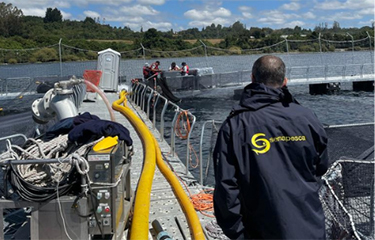
Photo courtesy of Sernapesca
