






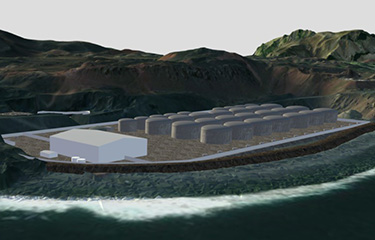
Icelandic Land Farmed Salmon (ILFS) is building a 10,000-metric-ton Atlantic salmon farm in Iceland’s Westman Islands.
The farm is expected to receive its final environmental assessment in November 2022, project manager Kristin Hartmannsdóttir told SeafoodSource. When completed and operational, the farm will produce 9,000 metric tons (MT) of head-on, gutted salmon annually, according to Hartmannsdóttir.
The project, initiated in 2018, is being led by ILFS chairman and founder Lárus Sigurður Ásgeirsson, a former engineer for Marel, Sjóvá, and Icelandic Group; Daði Pálsson, a board member and founder of Leo Seafood; and Hallgrímur Steinsson, who previously served as the manager of the Langa fish-processing facility in the Westman Islands.
The farm site, at Vidlagafjara on the northeast side of Heimaey, the largest of the Westman Islands, situated off the south coast of Iceland, was until recently used as a quarry. The site has many benefits, including an abundance of hydro and thermal energy, which will help to keep the cost of production down and the company’s carbon footprint as low as possible, Hartmannsdóttir said. Organic waste from the fish farm will be used to improve local soil conditions and also to help regenerate barren land around the island’s volcano. Hartmannsdóttir said an agreement has been signed with the town of Vestmannaeyjar and the Soil Conservation Service of Iceland to facilitate this.
“This is a really exciting project, which will create around 100 direct local jobs, and that is important in a small island community,” she said.
While the project has undergone technical and financial analyses, research and monitoring work continues on the groundwater source, sea-water temperatures, and oceanic currents, to ensure the best possible conditions can be achieved in the fish farm, she said.
ILFS plans to pursue Aquaculture Stewardship Council certification for its salmon, and Hartmannsdóttir said the farm will also aim to avoid antibiotics and maintain low farming densities.
Processing will initially be outsourced to one of the three fish-processing facilities on the island. The primary markets for ILFS’ salmon will be Europe and the United States, and Hartmannsdóttir said transportation links with mainland Iceland and Europe are frequent from the Westman Islands, “giving the ILFS Board confidence that salmon can be supplied in the freshest condition to market.”
“Our belief is that by maximizing quality, new standards will be created that will ensure good long-term business with loyal and satisfied customers,” Hartmannsdóttir said.
In September 2022, ILFS awarded AKVA Group a contract to build a hatchery and smolt grow-out facility for the farm incorporating its “Zero Water Concept” technology. The facility will have a capacity of producing of 3.5 million smolt per year of an average weight of 100 grams. Construction is already underway, and the first batches of eggs are expected in Q3 2023.
“We were impressed with AKVA Group´s Zero Water Concept, which will enable us to maximize our water utilization in the facility,” Hartmannsdóttir said. “Most of our freshwater is pumped in from the mainland as we don’t have much of our own on the island, so this aspect of the project is very important.”
In a press release, AKVA Group said the site presented unique challenges due to its limited fresh water and the presence of a volcano on the island, but that it also offered an opportunity to prove the value of its technology.
“Icelandic waters have many opportunities for salmon farming, but in some areas the water is too cold for an efficient and safe production, and there is a limited availability of licenses for sea-based fish production,” the group said. “Luckily, there are many great locations on land, with access to clean seawater at a favorable temperature for salmon farming, all year round. Fish farmers are now directing their attention to land-based production.”
Photo courtesy of Icelandic Land Farmed Salmon
