






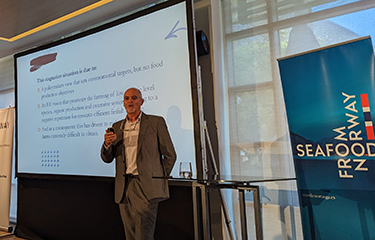
For aquaculture to thrive, according to Apromar Managing Director Javier Ojeda, the industry needs to change the conversation.
Oreda, speaking during a sustainability seminar hosted by the Norwegian Seafood Council in Barcelona, Spain, on 24 April – the day before Seafood Expo Global starts on 25 April – said the Spanish aquaculture industry is an example of what happens when advocacy and sustainability only considers the “ocean-to-plate” perspective.
“This is not enough for a fish farmer. If you do ocean-to-the-plate sustainability, you arrive too late,” he said.
Spain’s aquaculture production, he said, is an example of how the ocean-to-plate perspective is not enough for the industry to grow. Apromar, or the Asociación Empresarial de Acuicultura de España, is the Spanish business association of aquaculture. A nonprofit organization, the association helps promote and develop sustainable aquaculture in Spain.
Ojeda said Spain has had relatively stagnant aquaculture finfish production totals since 2010. The industry's quest for growth faces major obstacles that require outside support to overcome, he said, including help from governments to make it easier to permit commercial operations.
“The legal framework is extremely important with aquaculture,” Ojeda said.
Much commercial aquaculture development is reliant upon the use of public lands and waters, making the industry more reliant on governmental policies that encourage - or at least don't discourage - development, he said.
“We have to be in public domain spaces,” Ojeda said.
Ojeda said seaweed, algae, and mollusks have a generally positive reputation, but a negative perception continues to hover over the aquaculture industry, especially finfish aquaculture.
“When you talk about your fish, you have a negative reputation sticking to you,” he said.
That negative reputation can result in challenges in establishing new farms, Ojeda said.
“This has direct consequences, so that licenses for producing are extremely difficult to obtain,” Ojeda said.
To combat this stigma, the industry needs to do a better job starting conversations about aquaculture “before you go to the water.” The industry, he said, needs to culture a more positive public perception about the aquaculture industry and finfish farming.
Norway may be a juggernaut of production compared to Spain, with "a few more zeros” on production weight totals compared to Spain, but it too could face stagnancy in its aquaculture sector's growth if the government doesn't do a better job supporting it, Ojeda said.
“This could be Norway in couple of decades,” he said, pointing to Spain’s flat production numbers. “At the end of the day, it’s a very fragile sector.”
Ojeda said he remains hopeful, despite the challenges. Companies can get ahead of negative perceptions and work together to produce sustainability messaging that resonates with consumers and the public. The conversation, he said, should be changed to highlight how much food aquaculture can produce with a low carbon footprint – food that also happens to be healthy and delicious.
“We are convinced that we [Spain] have a bright future in aquaculture, so we are working hard on it,” Ojeda said.
Photo by Chris Chase/SeafoodSource
