






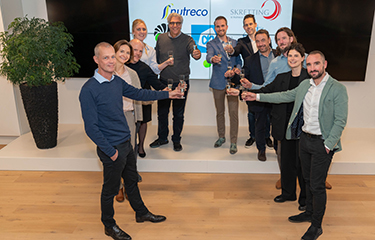
With the aim of supplying European consumers with larger volumes of sustainable, Latin American shrimp, Netherlands-based shrimp importer Klaas Puul and global aquafeed manufacturer Skretting have embarked on a supply chain collaboration that will not only provide local farmers with a new diet that utilizes novel ingredients, but which also has a major retailer onboard.
Skretting Ecuador, alongside alternative ingredient developers Protix and Veramaris, intend to develop and provide shrimp farmers in Latin America with a novel feed that partially replaces fishmeal and fish oil ingredients with an insect meal made from black soldier fly larvae and an algae oil.
Completing the partnership, Dutch supermarket chain Albert Heijn (AH), part of the global retail giant Ahold Delhaize, has become the first retailer to commit to the project, stating that the move is in line with its own sustainability ambitions. Among these, the company recently set a new supply chain (Scope 3) greenhouse gas (GHG) emissions reduction of 45 percent by 2030 (from a 2018 baseline).
This new feed will be used by Klaas Puul’s suppliers in Latin America to produce shrimp for Albert Heijn, and possibly other retailers in the future.
The partnership was brokered by Shrimp Insights’ Willem van der Pijl.
Klaas Puul Senior Purchase Manager Jan Bootsman, who is also responsible for the project’s implementation, told SeafoodSource the project will initially work with dedicated vertically integrated producers in Ecuador, before expanding to others as it scales.
“We hope that other producers will see the market potential of a proposition where the shrimp is fed with more sustainable feed and that also other farmers outside the project will look for partners to do similar projects,” he said. “We hope that our project contributes to the faster adoption of alternative and more sustainable feed ingredients to make the shrimp industry as a whole more sustainable and resilient in the future.”
The collaboration will start with AH, as Klaas Puul supplies almost all the shrimp the retailer sells in its refreshed segment. Outside of the Netherlands, Klaas Puul is also actively promoting the project with other retailers and inviting them to come aboard, Bootsman said.
“Now we have all the infrastructure in place we are ready to scale. Any retailer based in Europe is welcome to get in touch and learn more,” he said. “We are very ambitious and hope that the volume will grow significantly. We expect it to be a matter of time to expand within AH and with other retail organizations in Europe.”
The project follows the recognition by Klaas Puul that supermarkets in northwestern Europe have been increasingly sourcing shrimp from Latin America, and that they have also been looking beyond the requirements of aquaculture certification schemes to identify additional ways to reduce risk in supply chains and provide more sustainable seafood.
Bootsman said Albert Heijn plans to “actively communicate” all the components of the project to Dutch consumers.
Klaas Puul and Nutreco-owned Skretting established the consortium aimed at launching a new sustainable shrimp proposition three years ago, with Veramaris and Protix joining at a later stage.
In a press release, Alan Dale, the CEO of Klaas Puul and also of Sykes Seafood and Ruskim in the United Kingdom, said the company was taking its role in the shrimp supply chain “to the next level” by helping global retail organizations meet their environmental sustainability ambitions.
“Working with partners like Nutreco/Skretting, Veramaris and Protix shows us how instrumental we can be in bringing more sustainable shrimp products to consumers across Europe,” Dale said.
Protix’s insect meal is being made from black soldier fly larvae, while Veramaris’ algae oil, certified by the Marine Stewardship Council and Aquaculture Stewardship Council, is a regenerative source of the omega-3 fatty acids EPA and DHA.
All of the remaining marine ingredients will be sourced from seafood processing byproducts, and all will be traceable back to MarinTrust-accredited fisheries in Ecuador. Additionally, the soy in the feed will be sourced from deforestation-free and land-conversion-free origins.
Over the next three years, the consortium partners will continue to improve the feed formulation according to their own sustainability goals, drawing on developments in shrimp nutrition, while also adjusting to the changing ingredients market.
The consortium will gradually increase the inclusion rates of insect meal and algae oil and look at other options to further reduce dependency on marine ingredients. It will also guarantee that all shrimp is produced from unablated broodstock and is ASC-certified.
As for other making the new diet available to shrimp production regions, Bootsman told SeafoodSource the partnership is concentrating on Latin America for now, but if the demand of other clients leads it to Asia, for example, it’s “ready to engage” with those producers who are “ready to take shrimp farming to this next level.”
Similarly, with regards to other end-markets, the partnership is currently focused on Europe, he said.
“But there might be other partnerships with similar propositions looking to penetrate the North American and other markets as well,” he said.
Photo courtesy of Nutreco
