






Norway’s new resource rent tax for salmon farming has hit AKVA Group’s land- and sea-based business arms, with the company saying it was forced to take corrective measures, including the termination of 50 positions.
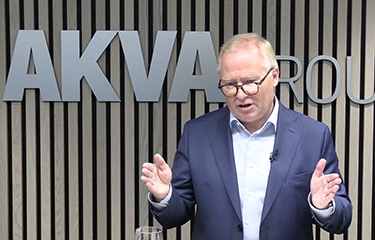
Delivering the Norwegian aquaculture services and equipment provider’s Q3 2023 results on 10 November 2023, CEO Knut Nesse said the company will carry out a “rightsizing process” – targeting NOK 45 million (USD 4.1 million, EUR 3.8 million) in annual cost savings – in Q4 2023 to adapt the organization to the additional tax, which is applicable retroactively from 1 January 2023.
Nesse said the company's order intake in Q3 was “sound,” with the award of a NOK 40 million (USD 3.6 million, EUR 3.4 million) RAS contract from Nordic Aqua Partners, and the NOK 60 million (USD 5.4 million, EUR 5.1 million) post-smolt RAS contract for Cermaq Norway, but he acknowledged the resource tax has created a challenging and uncertain market outlook.
“After the introduction of the resource tax in the Norwegian market, it has been slow, in particular for the land-based, post-smolt business, but also for part of the sea-based business – particularly the barges, which are among the more costly investments for farmers,” Nesse said. “At AKVA Group, particularly towards our own employees, we have shown patience, we have continued to invest in all three businesses, and we have also maintained our capacity in terms of the number of people [we employ] in the belief that the market will improve. However, it’s now time to not wait any more so we are taking the correct measures to ensure profitability and profitable operations going forward.”
Nesse said AKVA has already made staff cuts. Of the 50 positions the company is eliminating, 20 to 25 will be natural departures, while the remaining 25 will be layoffs. The company expects the latter will cost the business around NOK 10 million (USD 900,000, EUR 847,000) in Q4 2023.
Despite the short-term negative impacts, Nesse said his company's “fundamentals are still strong,” with the expectation that global salmon demand will grow to between 700,000 and 1.3 million metric tons (MT) by 2030, and that prices will remain high. Nesse said Norway is still “the most-profitable place” to farm salmon, but the full impact of the resource tax remains uncertain.
“The resource tax is here to stay; it will not go away. However, the burning issue these days is more about how it will work in practice … I think it will take some time before the farmers have all the answers to all their questions,” he said. “In addition to all those fact-based things, it is also about a lack of trust – between the industry on one side and the government on the other. And my take is that the avenue of trust is a two-way street.”
Nesse predicted there will eventually be an industry-wide shift in the wake of the resource tax that could include bigger investments in land-based operations.
“Our view is there will be a new normal, but we do not have a view on the timing,” he said.
Consequently, while it does have a lot of work in progress, AKVA said it doesn’t expect to sign any new RAS contracts in Norway for the rest of 2023, Nesse said.
According to AKVA’s Q3 report, the group received orders totaling NOK 600 million (USD 54.1 million, EUR 50.8 million) in Q3 2023, representing a year-on-year decrease of NOK 50 million (USD 4.5 million, EUR 4.2 million). At the end of the period, it had an order backlog of NOK 2.6 billion (USD 243.3 million, EUR 220 million).
AKVA's revenue in the quarter decreased 3 percent to NOK 817 million (USD 73.6 million, EUR 69.2 million), but its earnings before interest, taxes, depreciation, and amortization (EBITDA) increased by NOK 53 million (USD 4.8 million, EUR 4.5 million) to NOK 78 million (USD 7 million, EUR 6.6 million), while its net loss for the period decreased from NOK 93 million (USD 8.4 million, EUR 7.9 million) to NOK 3 million (USD 270,000, EUR 254,000).
AKVA’s profitability is continuing to improve compared to last year, but is still below expectations, according to its report. Its Land-Based Technology (LBT) business segment was impacted by a high-cost base compared to current its activity level, and by lower profitability in parts of the firm's project portfolio. The Sea Based Technology (SBT) business segment’s profitability, in contrast, enjoyed a healthy product mix supported by its new deep farming concepts Nautilus, Tubenet, and OptiCage, Nesse said.
AKVA's SBT segment achieved revenues of NOK 660 million (USD 59.5 million, EUR 55.9 million) in Q3 2023, down from NOK 681 million (USD 61.4 million, EUR 57.6 million) a year previously. Its revenue in the Nordic region ended at NOK 417 million (USD 37.6 million, EUR 35.3 million), a year-on-year increase of NOK 36 million (USD 3.2 million, EUR 3 million). The Americas region, meanwhile, achieved revenue for AKVA of NOK 171 million (USD 15.4 million, EUR 14.5 million), a decrease of NOK 15 million (USD 1.4 million, EUR 1.3 million). AKVA's Europe and Middle East operation suffered a NOK 41 million (USD 3.7 million, EUR 3.5 million) drop in revenue to NOK 73 million (USD 6.6 million, EUR 6.2 million).
AKVA's Sea-Based Technology segment’s EBITDA reached NOK 79 million (USD 7.1 million, EUR 6.7 million), mirroring the NOK 79 million it achieved in the same period last year. Its quarterly EBIT was NOK 41 million (USD 3.7 million, EUR 3.5 million), compared with NOK 44 million (USD 4 million, EUR 3.7 million). The segment’s order intake was up NOK 124 million (USD 11.2 million, EUR 10.5 million) year-on-year to NOK 574 million (USD 51.7 million, EUR 48.6 million).
AKVA's Land Based Technology’s revenue for the quarter fell to NOK 124 million (USD 11.1 million, EUR 10.4 million), down NOK 10 million (USD 900,000, EUR 842,000) year-on-year. Its EBITDA in Q3 2023 improved but still represented a loss of NOK 11 million (USD 991,000, EUR 931,000), versus a loss of NOK 63 million (USD 5.7 million, EUR 5.3 million), while its EBIT was a loss of NOK 13 million (USD 1.2 million, EUR 1.1 million) compared to a loss of NOK 106 million (USD 9.6 million, EUR 9 million) in Q3 2022. The segment’s order intake decreased NOK 163 million (USD 14.7 million, EUR 13.8 million) to just NOK 4 million (USD 360,448, EUR 338,611).
Revenue for AKVA’s Digital (DI) segment amounted to NOK 33 million (USD 3 million, EUR 2.8 million), NOK 8 million (USD 721,000, EUR 677,000) more than in Q3 2022. Its EBITDA ended at NOK 10 million (USD 900,000, EUR 842,000), while its orders decreased by NOK 11 million (USD 991,000, EUR 931,000) to NOK 21 million (USD 1.9 million, EUR 1.8 million).
Also in the quarter, AKVA completed the acquisition of 51 percent of the shares in Submerged AS, with the option remaining to increase its ownership to 100 percent in 2028. The company increased its ownership in Newfoundland Aqua Service from 70 percent to 98.5 percent in October 2023.
Nesse advised that due to the changes in market conditions, AKVA will revise its medium-term financial targets during Q4 2023.
Photo courtesy of AKVA Group
