



Måsøval has confirmed it is reorganizing and has begun a process to streamline its management and public reporting processes, which will result in different parts of the business splitting into separate legal entities.
As of 1 January 2024, Måsøval will become a holding company, and all the group’s licenses will be merged into one company: Måsøval Lisens. The group’s farming operations will be a part of Måsøval Drift, the company stated in its Q3 2023 financial report.
The Frøya, Norway-headquartered salmon farmer largely attributes this change to consequences stemming from the Norwegian government’s introduction of a 25 percent resource tax on the production of salmon at sea. It estimates its total costs from the new rent tax totaled NOK 33 million (USD 3.1 million, EUR 2.8 million) for the first three quarters of 2023. For Q3 alone, costs stemming from the tax were an estimated NOK 11 million (USD 1 million, EUR 937,000).
Like many other companies throughout Norway, though, Måsøval continued to improve its bottom line despite the tax in Q3. The company achieved operating revenues of NOK 670.1 million (USD 62.3 million, EUR 57.1 million) in Q3 2023, up from NOK 377.6 million (USD 35.1 million, EUR 32.2 million) reported for the corresponding period of 2022. Its profit before tax doubled to NOK 105 million (USD 9.8 million, EUR 8.9 million). This increase was due to a larger harvest and high sales prices in the period.
Måsøval’s Q3 operational earnings before interest and taxes (EBIT) of NOK 113 million (USD 10.5 million, EUR 9.6 million) doubled that of Q3 2022, even though it was negatively affected by smolt culling in its Farming West region, which led to higher costs.
The company harvested around 7,037 metric tons (MT) of head-on gutted (HOG) weight fish in the three-month period, compared to 4,863 MT in the same period a year previously. The quarter’s average sales price was NOK 82.80 (USD 7.70, EUR 7.05) per kilogram against NOK 63.50 (USD 5.90, EUR 5.41) in Q3 2022.
The group’s Farming segment achieved sales revenues of almost NOK 632 million (USD 58.8 million, EUR 53.8 million), of which NOK 583 million (USD 54.2 million, EUR 49.7 million) comprised the sale of salmon.
The higher prices and larger harvest led to a NOK 303 million (USD 28.2 million, EUR 25.8 million) jump in sales, while the operational EBIT climbed from NOK 78 million (USD 7.3 million, EUR 6.6 million) to NOK 144 million (USD 13.4 million, EUR 12.3 million). The Q3 2023 operational EBIT per kilo was NOK 20.50 (USD 1.91, EUR 1.74), up from NOK 16 (USD 1.49, EUR 1.36) a year previously.
Farming Mid, which is the group’s largest division, achieved sales revenues of NOK 432 million (USD 40.2 million, EUR 36.8 million) in the quarter, with NOK 387 million (USD 36 million, EUR 33 million) coming from salmon sales. Compared to Q3 2022, its harvest volume increased from 1,704 MT to 4,525 MT, with the report advising that Q3 had also seen a high growth in biomass.
Måsøval’s Farming West segment achieved sales revenues of NOK 200 million (USD 18.6 million, EUR 17 million), with NOK 196 million (USD 18.2 million, EUR 16.7 million) from the sale of salmon. Some 2,512 MT of salmon were harvested in Q3 2023 compared to 2,042 MT a year previously.
Meanwhile, the company’s sales and processing division revenues climbed NOK 291 million (USD 27.1 million, EUR 24.8 million) year over year to NOK 646 million (USD 60.1 million, EUR 55 million), and its operational EBIT slipped from a positive NOK 3.6 million (USD 334,710, EUR 306,709) to a loss of NOK 7 million (USD 650,853, EUR 596,378). It sold 7,103 MT of products, with the company explaining the quarter’s negative result came solely from the sales department achieving low prices in the period.
For full-year 2023, Måsøval has issued a harvest guidance of 24,300 MT, with 7,700 MT expected in Q4 2023. With its co-location agreement with Frøya Lakst the potential in Måsøval’s license portfolio is in excess of 33,000 MT.
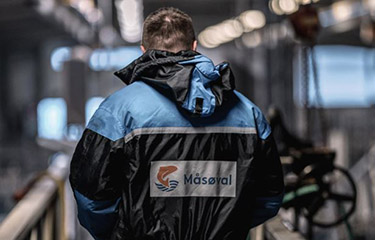
Photo courtesy of Måsøval
