


Seltjarnarnes Iceland-based salmon-farming company Ice Fish Farm AS (IFF) has reported an increased Q2 operating income of NOK 87 million (USD 8.3 million, EUR 8.5 million) for the three months ending 30 June, 2022, compared with NOK 69 million (USD 6.6 million, EUR 6.7 million) in Q2 2021.
Ice Fish Farm’s concentration on selling on the spot market allowed it to achieve a good price for relatively small-size fish, IFF said in a filing with the Oslo Stock Exchange, where it is listed. However, its operating loss before fair-value adjustment of biomass was NOK 85.8 million (USD 8.2 million, EUR 8.4 million), following a biomass write-down of NOK 104 million (USD 9.9 million, EUR 10.1 million) due to an outbreak of infectious salmon anaemia (ISA) at the Berufjordur Hamraborg and Svarthamar farming sites in May 2022.
Its Q2 2022 EBIT-per-kilogram, adjusted for one-off biomass write-down, amounted to NOK 16.20 (USD 1.54, EUR 1.58) per kilogram, compared with 13.90 (USD 1.32, EUR 1.35) per kilogram a year previously.
In Q2 2021, IFF’s operating profit stood at NOK 15.1 million (USD 1.4 million, EUR 1.5 million). The producer’s harvest in the last quarter amounted to 1,117 metric tons (MT), up slightly from 1,090 MT in Q2 2021. This took the company’s total harvest for the year to date up to 3,829 MT, compared with 2,586 MT in the first half of 2021.
For the full year 2022, it expects to harvest a total 11,300 MT. This figure includes harvests made between January and May by fellow Icelandic salmon-farming company Laxar Fiskeldi, which IFF acquired in the quarter. The deal increased its maximum allowed biomass by 16,000 MT to 43,800 MT.
IFF also acquired 33 percent shares in the Búlandstindur harvesting station and now owns 67 percent of all shares in the company. The total purchase price was NOK 1.05 billion (USD 99.8 million, EUR 102.3 million).
The company’s total harvest volume for H2 2022 is expected to be about 5,000 MT, with contracts secured for approximately 50 percent of this volume.
Ice Fish Farm said all fish in its Berufjordur site are expected to be harvested by the year end. The current crop is performing well and no ISA virus has been detected at the location in recent weeks, it said. It will start a vaccination program against ISA in Q4 2022, with the aim to vaccinate all its fish against the virus in 2023.
“This will enable us to continue getting a price premium for certified premium quality and sustainable salmon,” its Q2 report stated.
Meanwhile, the company’s application for a license for 10,000 MT in Seyðisfjörður is being processed by authorities, with the expectation that it will be issued in summer 2023.
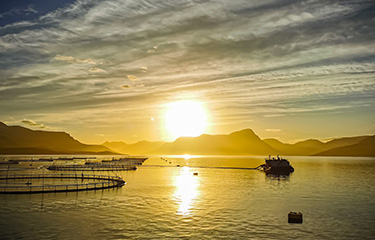
Photo courtesy of Ice Fish Farm/Kevin Sinclair
