






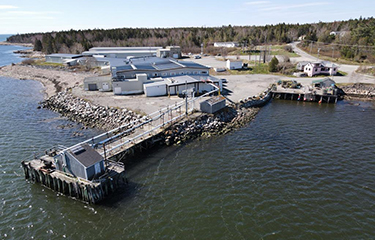
Former American Aquafarms CEO Keith Decker has successfully auctioned off the company’s facility in Gouldsboro, Maine, U.S.A. for USD 975,000 (EUR 895,000), the Ellsworth American reported.
Decker announced his resignation from American Aquafarms in early May and soon after announced the facility would be up for sale as compensation for USD 1.125 million (EUR 1.03 million) the company owed him. The company originally bought the 100,000-square-foot facility in 2020, with plans to use the facility for a closed net-pen salmon aquaculture operation in Frenchman’s Bay, before legal efforts and permit trouble effectively ended the project’s hopes of getting off the ground.
Opposition to the project was great enough that it spawned a state-level bill, LD 1951, “An Act Regarding Marine Finfish Aquaculture,” to amend maximum stocking densities for salmon. During hearings for that bill, Maine Department of Marine Resources Commissioner Patrick Keliher revealed the American Aquafarms proposal was shut down for a number of reasons.
“This was NOT due to a technicality, as some would have you believe,” he said. It was denied due to many failures of the applicant, including failing to demonstrate a qualified genetic source, and because the hatchery could not meet our standard in law or rule, and because samples sent to DMR were improperly cared for.”
The building and a few lots of land associated with the property were all sold to local entrepreneurs Timothy Ring and Kevin Barbee. Ring is the founder and former owner of Gouldsboro-based Ring’s Paving, while Barbee owns and operates Barbee construction.
Barbee told SeafoodSource that in the week since the auction they’ve received plenty of interest in the facility.
“There’s a big push to keep it as a working waterfront,” Barbee said. “There’s no solidified plans yet, but we’re looking at a lot of options.”
The facility, he said, comes with large lobster tanks and other existing equipment and dock access that makes it ideal for a seafood-related application – but finding the right one that will pay for the costs of maintaining the building will be difficult.
“We talk about working waterfronts, but there isn’t much waterfront work anymore,” Barbee said. “We’ve got the seaweed option, you have kelp, people may want to rent the wharf, but that’s not going to add up to pay for a building.”
He said the land has a few valuable assets outside of the building itself. A wellhead on one parcel can supply 150 gallons of fresh water a minute, and there’s potential for gravel operations – a boon for Barbee and Ring given their construction backgrounds.
For now though, Barbee said the future of the building is “a clean slate.”
“We want it to be sustainable, we want to help the local economy,” he said. “We’re open-minded right now for something to put in there.”
Photo courtesy of Keenan Auction Company
