






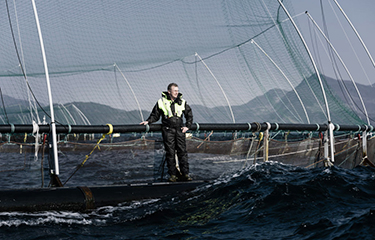
Delivering his company’s 2022 results on 16 January, Grieg Seafood CEO Andreas Kvame hailed 2022 as a “record-breaking year” for the company. Never before in its 30-year history had the Bergen-headquartered salmon producer “achieved a higher operational EBIT, seen a stronger market, or harvested higher volumes,” Kvame said.
However, the company chief also acknowledged “challenging biological conditions” in Grieg’s Norwegian regions in Q4 2022 , particularly at its Finnmark operations, and said Grieg is working on a new plan to address this issue and others that emerged for the firm over the past year.
“As a result of inflation and the biological events of last year, which impacted cost levels negatively, we are launching an improvement program to review all aspects of our operations and identify areas where we can increase profitability across our business,” he wrote.
According to its report, Grieg had been able to reduce farming costs through operational improvement initiatives in recent years, but in 2022, inflation across in the industry, particularly affecting feed prices, drove costs upward.
Additionally, biological events that plagued the company in 2022 will continue to affect its farming costs until the impacted fish are harvested. Kvame said that while underlying biological conditions are improving across Grieg’s breadth of operations,, its improvement program will look to reduce costs.
Grieg’s report confirmed an operational EBIT of almost NOK 1.74 billion (USD 170.5 million, EUR 159.3 million) for 2022. This was nearly four times that of the previous year and was achieved despite its fourth-quarter earnings falling from NOK 265 million (USD 26 million, EUR 24.3 million) a year previously to NOK 156 million (USD 15.3 million, EUR 14.3 million).
At the same time, Grieg’s 21,186-metric-ton (MT) harvest of Atlantic salmon in the Q4 2022 was 8 percent short of Q4 2021’s 23,727 MT, but the full-year ended up at 84,697 MT, up from 2021’s 75,601 MT.
Greig’s Norway Rogaland and Norway Finnmark operations achieved their highest-ever harvest volumes (collectively 64,411 MT) and operational EBITs in 2022, but both experienced higher farming costs. Rogaland’s costs from NOK 43.60 (USD 4.27, EUR 3.99) per kilogram in Q4 2021 and NOK 51.80 (USD 5.07, EUR 4.74) in Q3 2022 to NOK 54.60 (USD 5.35, EUR 5) in Q4 2022 as a result of inflation and mortality at a site.
Finnmark’s year-end farming cost of NOK 54.10 (USD 5.30, EUR 4.95) per kilo was up from NOK 37.80 (USD 3.70, EUR 3.46) in Q4 2021, and NOK 48.10 (USD 4.71, EUR 4.40) in Q3 2022, due to inflation in input factors and writedowns related to a Spironucleus salmonicida parasite outbreak. This led to the early harvesting and culling of fish in certain pens.
Grieg said it believes the source of the parasite to be the water intake at its Adamselv freshwater unit. It said it is taking measures to improve water treatment and disinfection to reduce future risks of Spiro entering the facility. The company is also planning a collaboration with Norwegian research institutions to close knowledge gaps related to the parasite, commonly known as spiro.
Grieg’s British Columbia Canada operations also experienced higher farming costs in Q4 2022 due to low harvest volumes and the discontinuance of eight farms in the Sechelt (shíshálh Nation) region. The Canadian unit’s operational EBIT was a loss of NOK 22.90 (USD 2.24, EUR 2.10) per kilo, versus NOK 4.10 (USD 0.40, EUR 0.38) in Q4 2021. Its Q4 2022 harvest volume of 1,467 MT was down from 4,058 MT in Q4 2021.
Looking forward, Grieg said it expected its total expected harvest for Q1 2023 will be 11,000 MT, with Rogaland contributing 5,300 MT and Finnmark 5,700 MT. No harvest is expected from British Columbia. For 2023 as a whole, Grieg expects a harvest volume of 82,000 MT. Of this, Rogaland is projected to supply 29,000 MT, Finnmark 28,000 MT, BC 20,000 MT, and Newfoundland 5,000 MT.
Grieg currently has 13 seawater licenses in Newfoundland, each with an allowance of one million fish at first stocking, increasing to two million fish in subsequent stockings. Its aim is to harvest 15,000 MT of salmon in Newfoundland by 2026. The company has also been awarded rights to develop the Bays West aquaculture area, stretching from Bay d’Espoir west towards Burgeo and Port-aux-Basques, where it has the potential to produce an additional 15,000 MT to 20,000 MT of salmon annually. Together, these areas will provide a long-term annual harvest potential of up to 65,000 MT, Grieg said.
In regard to the Norwegian government’s aquaculture resource tax proposal, which will generate an effective tax level of 62 percent for the country’s salmon-farming industry, the report confirmed that Grieg Seafood has put all growth investments on hold until a final version is adopted and its terms publicized. It estimates these equate to approximately NOK 2.3 billion (USD 225.3 million, EUR 210.5 million).
This tax proposal is currently under review and the final version is expected to be adopted by the Norwegian Parliament before the summer.
“Grieg Seafood will then assess how the tax will impact the company’s strategy and plans, and allocate investments to the farming regions with the biggest potential for sustainable and profitable development and growth,” the company said.
Photo courtesy of Grieg Seafood
