






Bakkafrost Group delivered total operational earnings before interest and taxes (EBIT) of DKK 303.4 million (USD 45.1 million, EUR 40.6 million) in the third-quarter of this year, an increase from the DKK 168.3 million (USD 25 million, EUR 22.5 million) posted a year previously, and eclipsing the DKK 251.8 million (USD 37.5 million, EUR 33.7 million) achieved in Q3 2017, thanks largely to a strong biological performance.
The Faroese salmon farmer made a profit for Q3 2019 of DKK 180.9 million (USD 26.9 million, EUR 24.2 million), down from DKK 355.9 million (USD 53 million, EUR 47.6 million). For the first nine months of 2019, its profit was DKK 582.4 million (USD 86.7 million, EUR 78 million), compared with DKK 966.9 million (USD 143.9 million, EUR 129.4 million) in the corresponding period of last year.
Bakkafrost’s farming segment delivered an operational EBIT of DKK 231.5 million (USD 34.5 million, EUR 31 million) in the last quarter – up 65 percent from DKK 139.6 million (USD 20.8 million, EUR 18.7 million) in Q3 2018.
In total, it harvested 12,938 metric tons (MT) gutted weight of salmon in the last quarter, up from 7,217 MT in Q3 2018. The average HOG weight of the salmon produced in the west region was 5.79 kg, and for the north region it was 4.9 kg.
Its total harvested volume for the first nine months of this year was 39,254 MT, up from 32,356 MT a year ago. Its harvest guidance for 2019 is 54,500 MT.
In 2020, Bakkafrost expects to harvest 57,000 MT.
The group’s value-added processing (VAP) segment, which produced 3,694 MT of skinless and boneless portions of salmon, posted an operational EBIT of DKK 25.9 million (USD 3.9 million, EUR 3.5 million), up from DKK 2.8 million (USD 416,729, EUR 374,763) in Q3 2018.
In its interim report, Bakkafrost said the salmon spot prices “decreased significantly” over the three-month period and while this had a negative effect on the farming segment, it had a positive effect on its VAP segment’s profits.
“Despite 10 percent lower salmon spot prices during the third-quarter for 2019, compared to the same quarter last year, Bakkafrost has delivered strong operational results this quarter. The average size of the harvested salmon has been exceptionally high, which has put us in a very good position to withstand the difficult market situation. The biological performance has been very good with high growth rates for the salmon. Sea lice and mortality rates have been amongst the lowest for many years. This is a result of committed and skilled employees and a strong effort on a continuous improvement of the biology and the welfare of the salmon,” said Regin Jacobsen, CEO of Bakkafrost.
Bakkafrost’s fishmeal, oil and feed (FOF) segment delivered earnings before interest, taxes, depreciation and amortization (EBITDA) of DKK 94.5 million (USD 14.1 million, EUR 12.6 million) in the last quarter, more than doubling the DKK 41.4 million (USD 6.2 million, EUR 5.5 million) achieved in Q3 2018, with its sales of fishmeal reaching 33,874 MT. Some 26,156 MT of this feed was used internally.
However, the group expects a decrease in the production volumes of fishmeal and fish oil in 2019, compared to 2018.
Meanwhile, on 4 November, Bakkafrost submitted a draft mandatory offer document relating to the Scottish Salmon Company (SSC) to the Oslo Stock Exchange for approval. Such approval is expected during this week and Bakkafrost expects to launch the mandatory offer by the end of the week.
SSC has 60 salmon farming sites across the west coast of Scotland and the Hebridean Islands.
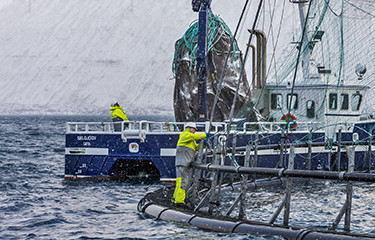
Photo courtesy of Bakkafrost
