






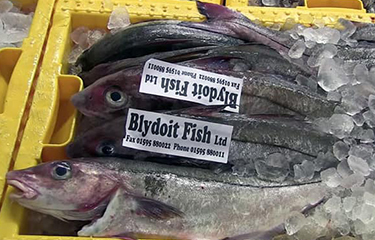
Blydoit Fish, a wholesale and retail seafood supplier based in Scotland’s Shetland Islands, is up for sale.
After 20 years in business, its four owners have decided that the time is right to move on. According to James John Shearer, who helped found Blydoit in 2003 as a means of selling the catch from his whitefish fishing vessel, the Mizpah LK173, there is a “tremendous opportunity” for a new owner to further develop the business.
A keystone of the local community, Blydoit sells a full range of fresh and smoked fish and shellfish to hotels, cafes, restaurants, takeaways, the local hospital, care homes and local shops. The company is actually the only wholesale supplier of seafood in Shetland, and Shearer is keen for the business to remain on the island.
While the Mizpah has now been sold and all of Blydoit’s product is currently purchased from third-party suppliers, the business has grown steadily over the years, both in terms of revenue and a reputation for quality, Shearer told SeafoodSource.
“We are proud of the legacy we've built over the last two decades and would like to thank our customers for their support,” Shearer said. “This is a fantastic opportunity for a new owner to continue the tradition of providing our Shetland and trade customers with fresh fish.”
Blydoit Fish obtains much of its fish from the markets in Lerwick and Scalloway, and its salmon and shellfish are obtained from local purveyors. All its wild-caught fish is inspected by independent quality assurance company SSQC Ltd., to ensure they meet the company’s standards. Blydoit’s filleters process the fish at a fully equipped unit in Scalloway, which is sold to consumers at the company’s two fishmonger outlets, and to trade customers in Shetland and Orkney. Its sales are handled by Shetland Seafood Auctions, which operates the largest computerized Dutch auction system in the U.K., and which sells approximately 60 metric tons (MT) of fresh white fish every day.
Blydoit Fish currently employs 18 people across three sites and processes around five metric tons of fish every week. Turnover in its most recent financial year was GBP 1.8 million (USD 2.2 million, EUR 2.5 million) and the company remains profitable, according to Shearer. He said opportunities lie in building the customer base and profit levels by taking trade sales beyond Shetland and Orkney, or in setting up an online retail presence. Blydoit could also be brought into an existing food-related operation that does not currently have the business assets, knowledge, or customer base to operate within the seafood industry. This would facilitate an instant broadening of a buying company’s proposition, deliver guaranteed business and income, and offering immediate access to an existing customer base, he said.
Shearer said he is happy to consider a transitional handover period to ensure a smooth continuation of supply. He asked that those interested in learning more about the business contact him at +44 (0)7831 798104 or [email protected].
Shearer said seafood is part of the DNA of Shetland, which is part of an archipelago that lies 170 kilometers northeast of mainland Scotland and 220 kilometers west of Norway. The islands are surrounded by some of the richest fishing grounds in the world. Additionally, the topography of the islands creates voes and inlets, many of which have been developed as aquaculture sites for salmon and mussels, which find export markets around the world.
Seafood worth more than GBP 320 million (USD 399 million, EUR 366.2 million) per year is produced in the Shetlands, accounting for one third of Shetland’s economic output. Shetland has major landings of pelagic and whitefish, and its capital of Lerwick has the second-most landings by volume in the U.K. for blue whiting, mackerel, and herring. The fish markets in Lerwick and Scalloway were rebuilt in 2020, and in 2021, more than 50,000 MT of fish and shellfish worth around GBP 80 million (USD 99.2 million, EUR 91.5 million) was landed in the two ports.
In the aquaculture realm, Shetland’s salmon industry produced nearly 40,000 MT of fish for market in 2022 worth more than GBP 285 million (USD 353.6 million, EUR 326.1 million), as well as four million smolt. It is also a significant provider of skilled local employment, which helps the islands to attract younger generations to remain on the islands.
Farming of blue mussels (Mytilus edulis) has taken off over the past few years, and now provides around 80 percent of Scotland’s entire output. In 2022, just over 7,000 MT of mussels were produced in the islands.
The Scottish government’s Vision for Sustainable Aquaculture to 2045, sets out its long-term aspirations for the finfish, shellfish, and seaweed farming sectors, as well as the wider aquaculture supply chain. It includes a desire to increase seafood production across both the wild-catch and aquaculture segments, to enable the industry to contribute to the country’s blue economy and net zero ambitions. The document also calls continued efforts for Scotland’s seafood industry to be globally recognized as innovative, productive, successful, and sustainable, with Shetland playing a major role in this expansion.
Photo courtesy of Blydoit Fish
