






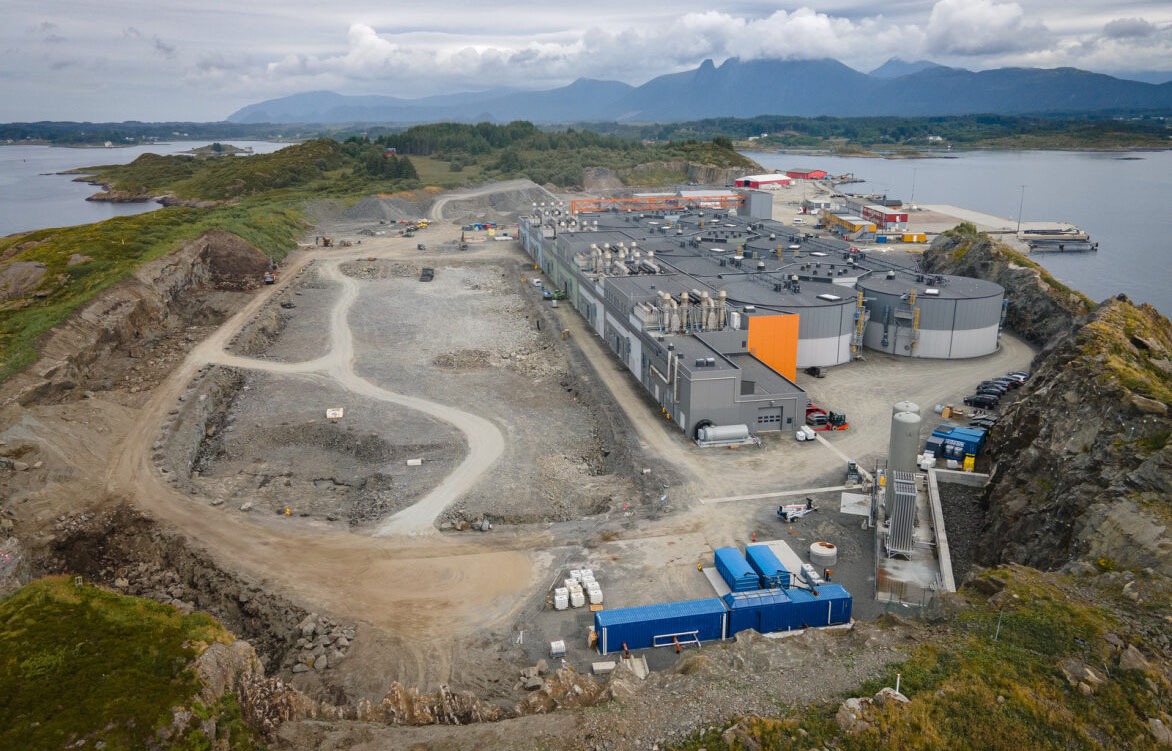
Indre Harøy, Norway-headquartered land-based salmon farmer Salmon Evolution reached breakeven earnings before interest, taxes, depreciation, and amortization (EBITDA) in its farming segment during Q4 2023, ending its first full year of operation on a high note even as its planned farm in South Korea through the K Smart Farming joint venture with Dongwon Industries faces challenges.
In its Q4 2023 results, Salmon Evolution said its farming segment achieved an operational EBITDA of NOK 43,000 (USD 4,000, EUR 3,700), marking the first time that the segment has avoided a negative EBITDA. That amount came on operating revenue of NOK 85.8 million (USD 8 million, EUR 7.5 million) – an increase over the NOK 26.8 million (USD 2.5 million, EUR 2.3 million) the company posted in the same quarter of 2022.
"Q4 2023 marked a significant milestone for Salmon Evolution, having harvested over 1,100 tons HOG with good results and reaching breakeven EBITDA in the farming segment for the first time,” Salmon Evolution CEO Trond Håkon Schaug-Pettersen said in a release.
The 1,104 metric tons (MT) head-on gutted (HOG) harvest in Q4 2023 was a record for the company and resulted in sales revenue of NOK 83.6 million (USD 7.8 million, EUR 7.3 million). That revenue came from an “all-in price realization” of NOK 76.40 (USD 7.14, EUR 6.67) per kilogram.
Salmon Evolution said its farming segment saw continued strong biological performance in Q4 2023 and had more than 2,200 MT of standing biomass as of 31 December 2023. The company also achieved all-time-high biomass production in the quarter, gaining a total of 1,439 MT in net biomass growth.
Salmon Evolution's farming segment’s remaining NOK 2.3 million (USD 215,000, EUR 201,000) in revenue came from other sources, “primarily related to government grants,” the company said.
For FY 2023, the company’s farming segment posted revenues of NOK 158 million (USD 14.8 million, EUR 13.8 million), up from the NOK 46 million (USD 4.3 million, EUR 4 million) it posted in FY 2022. Over that same period, its EBITDA ran into the negative at a loss of NOK 23.2 million (USD 2.1 million, EUR 2.0 million) – bettering the loss of NOK 34 million (USD 3.2 million, EUR 2.9 million) it posted in 2022.
The company's operational earnings before interest in taxes (EBIT), however, was worse in Q4 2023. The company posted an EBIT loss of NOK 16.7 million (USD 1.5 million, EUR 1.4 million) – a bigger loss than the NOK 10.7 million (USD 1 million, EUR 935,000) the company lost in Q4 2022. For FY 2023, the company posted an EBIT loss of NOK 68 million (USD 6.3 million, EUR 5.9 million), which was worse than the NOK 38 million (USD 3.5 million, EUR 3.3 million) it posted in FY 2022.
Salmon Evolution said its farming costs are currently on par with the rest of the salmon farming industry. The company is currently still working on Phase 2 of its land-based Indre Harøy facility, which will increase its overall salmon capacity to a projected 16,000 MT HOG.
“Throughout the second half of 2023, the company has completed the initial groundworks for the grow-out section, as well as preparations for the intake station,” Salmon Evolution said.
The company said it is identifying and working on cost savings and efficiency gains compared to Phase 1, which will include functional improvements to the salmon farm.
Salmon Evolution posted an overall revenue of NOK 88.8 million (USD 8.3 million, EUR 7.7 million) in Q4 2023, which was up from NOK 28 million (USD 2.6 million, EUR 2.4 million) in Q4 2022. Its overall operational EBITDA also improved to a loss of NOK 16.2 million (USD 1.5 million, EUR 1.4 million) in the quarter, compared to the NOK 22.6 million (USD 2.1 million, EUR 1.9 million) loss it posted in the same period of 2022.
Profit in Q4 2023 worsened compared to the same period of 2022. Salmon Evolution posted a loss of NOK 50.8 million (USD 4.7 million, EUR 4.4 million) in Q4 2023, which was a greater loss than the loss of NOK 6.5 million (USD 608,000, EUR 568,000) it posted in Q4 2022.
For FY 2023, Salmon Evolution posted revenues of NOK 168 million (USD 15.7 million, EUR 14.7 million), which was up from NOK 47 million (USD 4.4 million, EUR 4.1 million). Its operational EBITDA, however, was worse for the year, reaching a loss of NOK 84 million (USD 7.8 million, EUR 7.3 million) compared to a loss of NOK 68 million (USD 6.3 million, EUR 5.9 million) in FY 2022.
Losses before tax for FY 2023 also increased. Salmon Evolution posted a loss of NOK 145 million (USD 13.5 million, EUR 12.6 million) before tax, compared to a loss of NOK 32 million (USD 3.0 million, EUR 2.8 million) before tax in FY 2022.
Along with the presentation of its results, the company added an update on its planned expansion to the North American market. Salmon Evolution said it has narrowed down its site selection to two main areas – one covering the U.S. Pacific Northwest and portions of Southwest Canada and the other covering most of Atlantic Canada.
“As previously communicated, the focus with respect to sites is centered around areas with an established salmon farming industry, mirroring the group’s approach for Indre Harøy in Norway,” the company said. “Salmon Evolution sees a significant value in leveraging existing aquaculture infrastructure and value chains, enabling both scale and cost leadership, as well as reducing operational and biological risk.”
Existing aquaculture infrastructure is one of the hang-ups the company is experiencing at its planned expansion location in South Korea. The project's overall logistics at the South Korean farm site are “challenging,” Salmon Evolution said. Some of that challenge involves site-specific circumstances, like relatively long and shallow shorelines causing issues with intake and discharge of water.
“Additionally, given that Korea has no existing salmon farming industry, certain other infrastructure items and regulatory framework are impacting the project cost as well as operating cost,” Salmon Evolution said. “The project is currently engaging with relevant authorities in South Korea to shore up government financial support and to improve project economics. Clarification around this is expected during Q2 2024.”
Photo courtesy of Salmon Evolution
