






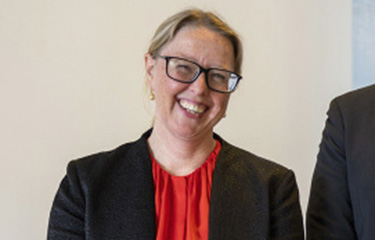
More than eight months have passed since Susanne Arfelt Rajamand was named CEO of Nuuk, Greenland-headquartered Royal Greenland.
New to the seafood industry but familiar with the wider food sector – her background includes time spent with such giants as consumer goods company Unilever and dairying co-op Fonterra – the transition has been smooth, mainly because she inherited leadership of a company with tried and tested strategies that are achieving positive results, Arfelt Rajamand told SeafoodSource.
“It’s been a busy period, as you can imagine – coming into Royal Greenland from outside this industry and getting to understand seafood, getting close to our senior and middle management and also many of our customers,” she said.
In 2022, Royal Greenland posted an ordinary profit before tax of DKK 235 million (USD 35 million, EUR 31 million) and revenue of DKK 5.8 billion (USD 866 million, EUR 788 million), up 2 percent, though sales volumes were down 5 percent, according to its annual results, released in May.
Upon her arrival, Arfjelt Rajamand said what struck her first and foremost about the seafood industry is the depth of experience and capability that exists throughout.
“Compared to a lot of other industries, it has many ‘lifers,’ and this has led to its functional capabilities being incredibly strong,” she said. “It’s also clear that no year is like another. While that’s true in most industries, it seems to be even more the case in seafood and the category that we’re in – wild-caught. When we get up in the morning, we don’t know what will be in the nets. That … requires the ability to adjust and adapt – not only from year to year but as we pass through [the calendar].”
Arfelt Rajamand said she was already familiar with the Royal Greenland brand and many of its seafood products long before the call came to lead the company – growing up, they were a regular feature of her family’s weekend meals and celebrations. She said this was one of many reasons she decided to take the job, as well as the fact that it’s a company “that really walks the talk,” she said.
“It does what it says. The integrity of the company and all of its employees has always been at the forefront. That’s a very important trait, and it was important for me [when] taking up the role,” she said.
Another big attraction was the attention Royal Greenland lends to productivity, sustainability, and environmental, social, and governance (ESG) efforts. Arfelt Rajamand said the company’s vertical integration and the ownership of the Greenland government gives the company a very “different connection” with ESG than most other companies.
“We are Greenland; Greenland is us. There is of course a lot of responsibility in that, but there’s also opportunity that very few companies have,” she said.
Royal Greenland’s approach to diversification, which is evident in the company’s manufacturing operations in Canada, Chile, and Greenland, also attracted Arfelt Rajamand to the CEO role. In addition, the geographically broad demand for its products make it “an extremely global organization,” Arfelt Rajamand said.
“Growing up in Denmark, I wasn’t aware how very international Royal Greenland is, but having now been to quite a few countries myself, I felt this would be a really exciting and interesting place to be,” she said.
Under previous CEO Mikael Thinghuus, who joined at the end of 2010, the company’s North Atlantic Champion strategy underwent a transformational change, dragging the company out of the financial, commercial, and strategic crisis, with large deficits turned into solid profits. Repaid debts and operational investments in the Canadian provinces of Newfoundland and Labrador, Nova Scotia, as well as Chile and Norway, paved the way for growth, and improved financing led to the development of Asian and North American markets.
Over the past five years, Royal Greenland has committed to a major overhaul of its fishing fleet, including the construction of four new trawlers for fishing prawns, Greenland halibut, cod, and pelagics. The latest new build, the 82.3-meter “Tuugaalik,” recently delivered by Spanish shipbuilder Astilleros de Murueta, will help the company dive into halibut, cod, and shrimp fishing and processing. At the end of last year, the company ordered a fifth trawler, the “Akamalik,” which the company expects to receive in 2025.
“It’s a company that has been on a great journey,” Arfelt Rajamand said. “It faced some significant challenges when Mikael came in, but a lot of effort went into stabilizing that. So [my appointment] was not to deliver a turnaround; it was a great place to come into – it’s somewhere that I will be able to support the team in the onward journey.”
This stability has granted her the time to work with Royal Greenland’s leadership team to determine how best to move forward. The company’s current strategic plan runs until 2024, and early in her tenure, she decided to stick to that schedule. In the meantime, Arfelt Rajamand has led an effort to identify and analyze the challenges and opportunities available to Royal Greenland. Arfelt Rajamand said this foundational work could filter into the company’s next strategic plan but is quick to insist that there won’t be any massive shifts. What people can expect is more of a continuation or slight adjustment to what Royal Greenland is already doing, she said.
However, there are a couple of key areas to which Arfelt Rajamand is keen to apply her knowledge and experience. Drawing on her time with Unilever, she said she will push to market Royal Greenland’s unique selling points and product mix in ways that underline its credibility and credentials.
“We are doing so many amazing things as a company in the areas of product quality and sustainability, but we are also [operating] across many markets and many channels. That fragmentation makes it difficult to [establish our] superiority,” she said. “The fantastic thing is that when many companies do a 6P [product, price, place, people, promotion, and presentation] analysis, it starts with the products. Here, we have … so many reasons why consumers should prioritize us, and utilizing some of my experience to get those stories out in different ways is definitely something I am looking to do.”
Arfelt Rajamand also wants to invest more resources in talent development within the company.
“We are extremely fortunate that many people in this industry dedicate their entire lives to delivering good seafood, but we cannot take that for granted,” she said. “We should continually invest in the people that come in.”
Financially, the immediate focus is to continually reduce debt, and a program is in place to enable that, Arfelt Rajamand said. Achieving this will allow the company to prepare for future investment and growth, emphasizing four key areas – land-based investments, talent development, navigating post-Covid and high inflationary pressures, and utilizing data and digitizing the business.
Arfelt Rajamand acknowledged there are merger and acquisition opportunities in the seafood market for businesses with money, but that Royal Greenland has no immediate plans in this regard.
“We are in a much better place than many, but we need to make sure we take care of bringing down the debt of the trawlers. Once we are further into that program, we may look out for selective M&As,” she said. “Not everything will be for us … [but] when those companies come up, we will have a serious look at them,” adding that the right fit would consider the company’s focus on circular processing, high-quality raw materials, and unique sourcing.
Arfelt Rajamand said there’s plenty within Royal Greenland’s current operations to keep her busy. The brand has seen extremely strong demand coming from Asia, while its European sales have dropped off, and Brexit has made navigating the U.K. market much more of a challenge.
“Europe is going through a bit of a reset,” she said. “We are committed to our European strategy, but we will also stay close to what that means for our different species and different markets. It’s requiring us to think differently about how we go to market and how we conduct our operations. We are hoping 2023 will be a reset year, bringing us back closer to normality.”
Photo courtesy of Royal Greenland
