






The Sustainable Fisheries Partnership (SFP) and Purina Europe have recently partnered to launch the Bycatch Solutions Hub, a web-based platform that aims to connect seafood retailers and businesses with organizations capable of in-the-water solutions to reduce bycatch.
The goal of the collaboration, which the two organizations launched at Seafood Expo Global (SEG) in April 2023, is to decrease barriers preventing business and seafood retailers from supporting bycatch reduction, with a focus on collecting and disseminating information on successful methods being deployed globally. Additionally, the hub matches companies based on interest, funding, and expertise to organizations implementing solutions to protect endangered, threatened, and protected (ETP) species from ending up as bycatch.
“One of the biggest barriers to companies and seafood retailers is not knowing how and where to find practical solutions and projects in need of funding. There is a lot of information about bycatch, gear, and best practices, but it’s fragmented across various sources, making it extremely difficult to get a full understanding of the issues and solutions,” SFP Biodiversity and Nature Director Kathryn Novak said. “SFP created the Bycatch Solutions Hub to improve visibility of the existing efforts being implemented by fishers to reduce the bycatch of marine wildlife and to provide easy access and connections to others just getting started.”
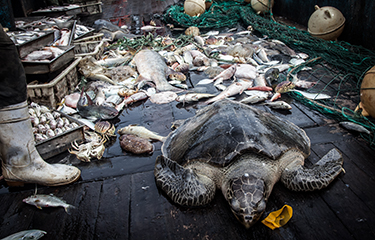
Bycatch occurs when fishers catch non-target species, such as sharks, whales, dolphins, sea turtles, seabirds, and protected or quota-limited fish. The U.S. Marine Mammal Commission estimates commercial fishing globally kills or seriously injures around 650,000 marine mammals annually.
The hub’s community network features webinars, meetings, and interactive events to foster collaboration between users. Industry members can also learn about specific bycatch species and associated fisheries that impact them. Companies can sort solutions and projects by region, fishery, gear-type, or bycatch species.
Two major connections have already formed on the hub: a U.S. retailer funding a pilot project in Panama implementing electronic monitoring systems that collect at-sea bycatch data, and a project funding at-sea testing and trials of new ropeless lobster traps. The technology eliminates the use of buoy lines by using acoustic device attached to the boat that inflates a float bag, which brings deployed traps to the surface.
“If we can bring visibility to the successful use of these practices, it not only highlights the leaders in the industry who are reducing bycatch but also empowers retailers and major buyers to know these practices work and that they can seek them out in the market,” Novak said.
Projects that need funding can apply to the hub as long as have an organized group of participants, a clear plan to reduce bycatch, and make a commitment to provide regular progress reports. Once approved, the project summary goes up on the site and receives promotion through newsletters and outreach, after which SFP facilitates donations and payments.
“There are other platforms with information on bycatch best practices and initiatives, but the hub was created specifically for the seafood industry. We’ve designed the site to be searchable on a map showing fisheries and gear, we provide contact information for gear manufacturers, and we highlight successful implementation activities,” Novak said.
On the investment side, stakeholders can search projects on the hub to find one that aligns with their interests.
“Through the hub, we’re building a network of contacts and stakeholders who are driving solutions, so we also hope it will be a platform to kickstart new projects to reduce ocean wildlife bycatch. [That way] we can be a sort of ‘matchmaker’ to facilitate those connections,” Novak said.
Another main goal of the platform is to publicly recognize companies leading the industry toward better protection of ocean wildlife, Novak said.
“Protecting ocean wildlife doesn’t have to be at odds with fishing livelihoods. Creating a more sustainable seafood supply chain and reducing bycatch can be good for the environment but also good for business,” Novak said.
It’s an opinion shared by Purina Europe, the pet food arm of Nestlé, which is funding the Bycatch Solutions Hub.
“By joining forces with SFP and launching the hub, Purina Europe aims to catalyze collective action within the seafood industry, enabling companies to find and support practical solutions to reduce bycatch,” Nestlé Purina Petcare Europe Raw Material Buyer Nicola Bedding said. “Through this collaboration, funding and expertise can be mobilized to protect hundreds of thousands of sharks, sea turtles, marine mammals, and seabirds from harm in commercial fisheries. By facilitating the exchange of information, best practices, and innovative ideas, the hub establishes a community that fosters collaboration, knowledge-sharing, and ongoing progress.”
Purina Petcare is one of the world’s largest pet food companies, with CHF 18.1 billion (USD 20.4 billion, EUR 18.6 billion) in sales in 2022. It initiated a partnership with SFP in 2019, becoming a Target 75 Champion.
"This partnership forms part of Purina’s wider commitment to advance the regeneration of ocean ecosystems." the company said. "To best identify the origins of fish products, our buyers work closely with their suppliers to collect relevant data. This includes information on the species, country of origin, and the fishery from where the fish originated, along with the fishing practices used. We provide seafood purchasing information to our independent, nonprofit partner, the Sustainable Fisheries Partnership (SFP), to assess risk at the origin of our seafood supply. We publish this list to hold our suppliers and ourselves accountable and drive industry-wide transparency."
Photo courtesy of Tara Lambourne/Shutterstock
