


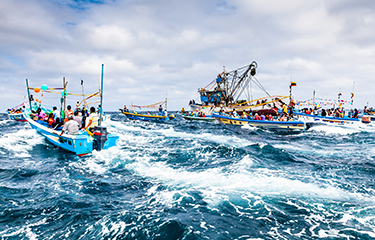
Ecuador’s annual seafood exports to the United States are now under threat due to the South American country’s failure to meet U.S. standards for limiting whale and dolphin bycatch.
Ecuador’s seafood exports to the U.S. total about USD 1.6 billion (EUR 1.46 billion) annually. The U.S. imported 226,480 metric tons (MT) of fisheries products from Ecuador in 2021, including tuna, shrimp, mahi, and swordfish.
According to a report from the Center for Biological Diversity (CBD), the Animal Welfare Institute (AWI), and the Natural Resources Defense Council (NRDC), Ecuador’s Organic Fisheries Law, enacted in 2020, was considered a significant step forward for the country’s fisheries regulatory system, but it lacks requirements restricting the entanglement of whales and dolphins.
“We’re concerned about the intelligent creatures entangled in Ecuadorian nets, but we’re also worried for Ecuador’s hardworking fishers. If they can’t sell their fish products in the lucrative U.S. seafood market, it will be a huge economic blow,” CBD International Program Director Sarah Uhlemann said. “Ecuador’s government needs to build on its new fishing law by tracking and limiting bycatch to save marine mammals and their export fishing industry.”
Under a U.S. legal requirement dating from 2016, all countries exporting seafood to the United States must prove that they meet the same marine mammal protection standards applied to U.S. fishers. As of 1 January, 2024, the United States will ban noncompliant seafood imports from countries that are not meeting those standards.
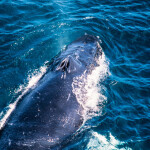
Ecuador’s sea is home to nearly 30 different species of marine mammals, but the country fails to monitor whale and dolphin populations or sufficiently track how much bycatch occurs in its export fisheries, the report found. Scientists have documented several dolphin species caught in gillnets as bycatch, including a declining population of bottlenose dolphins in the Gulf of Guayaquil. Marine mammal bycatch is often used as bait used for fish-aggregating devices (FADs), according to Kate O’Connell, a marine wildlife consultant with the Animal Welfare Institute.
“The U.S. government should encourage Ecuador to proactively address this issue through improved monitoring of its bycatch, and an explicit ban on the use of marine mammals as bait,” she told SeafoodSource.
According to NOAA, bycatch is a global threat to many populations of marine mammals. Worldwide, fishers kill or seriously injure an estimated 650,000 dolphins, whales, seals and other marine mammals every year.
“Our recommendation is that Ecuador work to reduce bycatch by instituting a monitoring program to fully understand how whales, dolphins, and other marine mammals are doing in Ecuadorian water [and] more robustly track bycatch of these animals, setting a safe limit for bycatch in all fisheries and ensuring that limit is met through enforcement,” Uhlemann told SeafoodSource.
The 2016 U.S. law allowed nations seven years to improve their bycatch programs and continues to offer capacity-building assistance through the National Marine Fisheries Service.
To ensure effective implementation of the Marine Mammal Protection Act, Congress originally established a five-year exemption period to allow foreign nations sufficient time to develop regulatory arrangements comparable to U.S. programs, to reduce marine mammal bycatch. That exemption period underwent a few extensions as NOAA Fisheries reviewed applications from more than 130 nations, representing more than 2,500 exempt and export fisheries. The U.S. National Marine Fisheries Service is now set to decide in November 2023 which global fisheries have sufficient standards, and nations will have until 31 December 2023 to possess a comparability finding for their commercial fishing operations in order to export fish and fish products to the U.S.
The United States has some of the strongest protections for marine mammals in the world, including conducting marine mammal stock assessments via population surveys, monitoring bycatch, and limiting the number of bycaught animals – called the “potential biological removal” level. Due to those protections, NRDC Global Biodiversity Conservation Director Zak Smith called for the U.S. to take a tough stance against Ecuador.
“[Ecuador] had more than six years to get its fisheries and marine mammal programs up and running in time to show results, but it failed to do so. U.S. fishermen and consumers shouldn’t suffer from that failure; Ecuador's noncompliant seafood should be banned,” he said.
CBD, AWI, and NRDC previously conducted similar assessments for Canada, Mexico, the U.K., India, France, and South Africa.
“Without comprehensive monitoring of how bycatch impacts these populations, Ecuador cannot demonstrate that it meets U.S. standards," Smith said.
Photo courtesy of Ecuadorpostales/Shutterstock
