






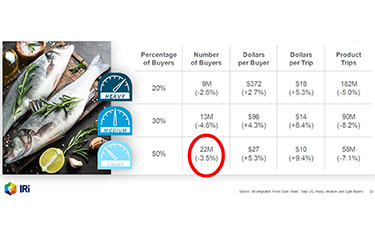
The gap in spending between the top 20 percent of seafood buyers and the bottom 50 percent of buyers is a sign of how seafood should try appealing to infrequent shoppers, according to IRI Executive Vice President and Practice Leader Chris DuBois.
DuBois, speaking during the National Fisheries Institute's Global Seafood Market Conference, held from 15 to 19 January in Palm Springs, California, U.S.A., highlighted the massive gap in spending between frequent seafood consumers and infrequent consumers.
For finfish, according to the data, frequent buyers – representing the top 20 percent of purchasers – had a “dollars per buyer” of USD 372 (EUR 344) in 2022. Meanwhile, the least-frequent shoppers, a group containing half of all consumers, had a "dollars per buyer" score of USD 27 (EUR 25).
“It’s dramatically different how much heavy buyers buy than light buyers,” DuBois said. “So if you want to drive sales of fish, this becomes the biggest lever that you’re going to see in the dollars per buyer side.”
The number of infrequent buyers also heavily outnumbers the frequent buyers – 22 million people are “infrequent buyers.”
“If you want to find targets to go and drive your business and bring numbers up this year, that’s exactly it,” DuBois.
There is positive news on that front, DuBois said, as infrequent buyers spent roughly 5.3 percent more on finfish in 2022 than they did in years past – but that increase was partially offset by a drop in trips for seafood, with the number of trips infrequent buyers made to buy seafood down 7.1 percent in 2022.
The story is largely the same for shellfish. Frequent buyers purchase as much as USD 281 (EUR 260) worth of shellfish each year, compared to just USD 21.00 (EUR 19.45) for infrequent buyers.
Those numbers represent declines, however. Frequent buyers bought 16.3 percent less shellfish in value terms in 2022 compared to 2021. And product trips decreased even more, dropping by 24.4 percent. Infrequent buyers also saw value decline – by 14.1 percent, according to IRI data – and product trips dropped by 21 percent.
Still, the massive gap between infrequent buyers and frequent buyers of shellfish in value terms is an anomaly and companies should take notice.
“Heavy buyers buy almost 14 times more than light buyers. That’s a lot,” DuBois said. “Think about the average brand, most of the time you’re going to go to the top five or 10 percentile of buyer before you start seeing a 10 times difference.”
Finding those smaller groups of buyers and pulling them in to the category should be an important piece of any company’s marketing strategy, given the massive gap between frequent buyers and infrequent buyers, DuBois said.
The gaps are similarly large for frozen seafood. Frozen seafood heavy buyers increased overall product trips by 17.8 percent in 2022, compared to a much smaller 3.4 percent increase for infrequent buyers. The "dollars per buyer" rate was again vastly different between the two groups as well: Frequent buyers had a dollars per buyer total of USD 288 (EUR 266), compared to just USD 31.00 (EUR 28.72) for infrequent buyers.
“This has been a powerhouse category,” DuBois said of frozen. “In fact, if I think of one category, one set of doors that deserve more space in most retailers, it’s this category.”
Overall, DuBois said, the climate is “ripe” for finding new ways to drive demand for seafood by targeting the infrequent buyer.
“There’s a new way to drive demand. It’s not just a circular, it’s not just a display in a store. Social media has become a huge mechanism,” he said. “Why? Because 81 percent of adults use it multiple times a day.”
Image courtesy of IRI
