






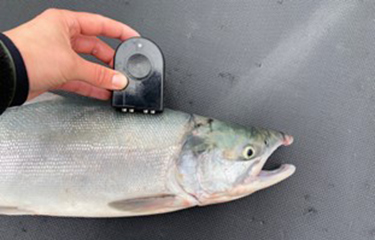
Certified Quality Foods (CQ Foods) has partnered with the Bristol Bay Regional Seafood Development Association (BBRSDA) and Alaska-based seafood processors to pilot a new method of measuring and assuring salmon quality.
The project, which received USD 20,000 (EUR 18,200) from the BBRSDA, is using CQ Foods Certified Quality Reader 3.0 (CQR 3.0) to measure thousands of different salmon being caught in Bristol Bay this summer. The new tool uses bioelectrical impedance analysis to determine the meat quality in a wide variety of different proteins, and CQ Foods is using the tool to measure the quality of the fishery’s sockeye salmon.
CQ Foods said the data can be used by both fishermen and processors in Bristol Bay to refine handling practices to ensure better fish quality – and in turn higher prices. According to CQ Foods, historically processors have paid extra for fish chilled below a certain temperature, but fishermen often have to wait until freshly caught fish can be brought down to the desired temperature.
“This means wasting precious time during a short, intense season where many boats will fish over 18 hours per day for three weeks,” CQ Foods.
That additional time, especially amid record volumes of sockeye – the fishery caught 60.1 million sockeye salmon in 2022 – can take time away from fishermen who are already at the limit.
“The additional fishing time and/or sleeping time helps fishermen’s bottom line and improves fishery safety, as sleep deprivation is a common factor in accidents and injuries,” CQ Foods said.
CQ Foods Co-Founder and Chief Scientific Officer Keith Cox said the Bristol Bay salmon fishery offers unique challenges and serves as a great test-bed for the company’s new technology.
“This is a very remote fishery with high volume. Our devices have to perform reliably in a wet environment, often with rough seas. They also have to be able to function offline, as the internet is usually unreliable or not available,” Cox said. “All of the challenges presented by Bristol Bay were factored into creating the new 3.0 version of the CQR device and analysis platform, all while reducing production costs.”
Currently, a significant amount of quality documentation still relies on paper-based recording, which is later transcribed to digital formats for analysis – an inefficient process that can also lead to gaps in data, Cox said.
For Bristol Bay, salmon quality is of increasing concern amid recent large runs. BBRSDA Executive Director Andy Wink told SeafoodSource the fishery has also gradually shifted in the last few decades in a way that makes quality more relevant.
“Bristol Bay has made huge strides to improve quality over the past 25 years, as the fishery transitions from one reliant on canned product towards one that primarily produces fillets,” he said. “Last year's run far exceeded any previous season and carried a risk for massive overescapement. Putting too many fish upriver can overgraze lakes and stunt salmon productivity for many years to come. The fishery avoided massive overescapment in 2022, but quality suffered for some fish as it was not possible to get them all frozen or canned as fast as normal.”
CQ Foods said the CQR could provide a more objective measure of quality that’s fast and reliable, helping reduce bottlenecks and those old paper quality slips. That additional time savings allows for more fishing, and the additional data from a digitized process with objective measurements can help fishermen hone in on best practices to improve fish quality.
“In-season management can pinpoint quality issues occurring at different stages, such as on fishing boats, tenders, docks, or inside processing plants,” CQ Foods said. “Post-season management entails analyzing fleet-wide data, including metrics such as the percentage of the fleet using proper icing techniques or slide mats, and ranking boats based on quality performance. These insights facilitate targeted handling practice education to rectify issues for future operations.”
Photo courtesy of CQ Foods
