

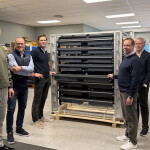



German metals specialist the Wieland Group has landed a contract for brass mesh cages for a fish farm installed in a typhoon-prone area of southeast China.
Some 90 tons of Wieland BlueSea Brass Mesh were supplied to a customer – which Wieland isn’t naming due to confidentiality clauses – who chose the nets because they’re more durable and lower-maintenance than plastic, according to the Ulm, Germany-based company.
Wieland did give details of the customer’s project, which it describes as “one of the biggest offshore deep-water aquaculture farms in the world” is being built off the coast of Mawei, near Fuzhou, in Fujian Province. It features five semi-submersible Spar Fish Farm pens each 140 meters in diameter and 12 meters high, with a total volume of 185,000 meters cubed. Fish production projected at 8,000 to 10,000 metric tons per year is expected to start this autumn.
Wieland technicians working out of the company’s office in Shenzhen have been involved in the project since 2017, the company told SeafoodSource.
“The high mechanical strength of the special brass prevents fish escapes, as the brass mesh does not only resist predator attacks, but also strong environmental loads like waves and currents, making the solution ideal for the offshore Mawei region, as it is a typhoon area,” a company representative wrote in an email.
With a clientele in the global automotive and industrial sectors, Wieland now sees big opportunities in aquaculture and is getting more enquiries from China.
“Definitely yes, we see an increasing demand for sustainable offshore solutions with brass mesh as a recyclable and robust material,” the firm’s spokesperson told SeafoodSource.
The firm appears to have cornered a niche in the market.
“There are currently no other suppliers capable to produce brass nets of 12-meter width and mesh size between 20 and 50 millimeters for offshore applications,” it said. “There are different local nettings suppliers, but these are more suitable for coastal or particular type of farming methods and products. Other copper fabricators are thinking about providing materials for such applications but none are making chain link fencing by themselves.”
Wieland’s cages save on maintenance costs because they’re “far less susceptible to encrustation and biofouling than cages made of plastic fibers,” the company said. Likewise, brass mesh cages also improve water flow and circulation, maintaining a higher oxygen level, according to Wieland.
Photo courtesy of Wieland
