






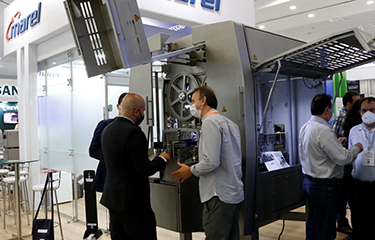
Processing equipment manufacturer Marel saw record order intake from China in 2022.
In its Q3 2022 results, released 2 November, the Reykjavík, Iceland-based firm said overall, its orders received were up 18.4 percent year-over-year to EUR 427.1 million (USD 427.3 million), with orders to-date in 2022 at EUR 1.3 billion (USD 1.3 billion), up from EUR 1.1 billion (USD 1.1 billion) year-on year. Its revenue reached EUR 450.6 million (EUR 450.8 million), up from EUR 331.9 million (USD 332 million) in Q3 2021, and its earnings before interest and taxes were EUR 46.2 million (USD 46.2 million), up from EUR 36 million (USD 36 million) in Q3 2021.
However, its seafood division, Marel Fish, had an operational performance below expectations, with its earnings before interest and taxes (EBIT) at a loss of 5.5 percent even though its Q3 2022 revenue reached EUR 43.6 million (EUR 43.6 million), up 15.6 percent. The company said it had fast-tracked its integration of recent acquisitions Curio and Valka, and had taken a EUR 7 million (USD 7 million) write-down on the insolvency of Stranda Prolog.
The company said its short-term outlook was threatened by Norway’s salmon-farming tax proposal, but that its medium-term outlook for its fish segment was good. Marel is targeting EBIT margin expansion for Marel Fish, relying on an improved product mix to boost sales. On that vein, it said it had introduced new products for whitefish and tilapia processing, including its FilleXia machine, which it said is “revolutionizing the tilapia processing industry that until now has relied on a large, highly skilled workforce to fillet the fish manually.”
“We are proud of being the customer’s choice when it comes to fish-processing solutions and equipment in China, allowing the processor to grow and scale up,” Marel Marketing Manager Atli Sigurður Kristjánsson told SeafoodSource. “There have been good investments around the globe and China is no different. In general, 2022 was a record year in order intake, where salmon has been driving the growth. In addition, there have been good investments in all markets around the globe. It is clear that processors are actively investing in technology and software.”
Kristjánsson said China has recently been more receptive to high-tech processing solutions.
“If we look at the fisheries sector, there has been steady growth in waterjet technology onboard the vessels along with other solutions,” Kristjánsson said. “Due to Marel’s investment in innovation and our partnerships with our customers we have been able to offer solutions that drive improvements in the processing plants and on the vessels, where we utilize more of the raw materials and become more sustainable.”
Chinese processors have struggled with rising input costs and disruptions from lockdowns triggered by China’s zero-COVID policy. Additionally, demographic challenges are driving up labor costs, making automation more of a necessity. Earlier this year, based on population projections from the United Nations, French investment bank Natixis has projected 145 million people will age out of the workforce in Asia between 2022 and 2040, with 78 percent of the decline to happen in China.
Photo courtesy of Marel
