






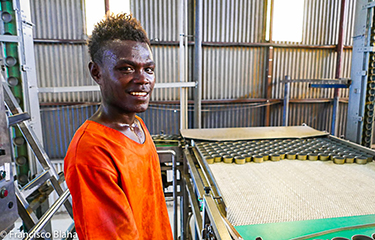
The United States is considering investing in a tuna-canning facility under construction in the Solomon Islands.
The Bina Harbour Tuna Processing Plant will be the Solomon Islands’ second tuna-processing facility after the SolTuna factory in Buno. It will have a 26,950-metric-ton annual capacity and will employ up to 1,600 people. The project will also include a commercial wharf housing the country’s domestic fishing fleet and an export terminal and complementary facilities to enable tuna exports, according to Radio New Zealand.
An agreement between the government of the Solomon Islands and the World Bank’s International Finance Corporation (IFC) includes around USD 40 million (EUR 36.8 million) in funding from Australia and New Zealand via apublic-private partnership. The United States is also considering contributing to the project through the USAID program, according to the Forum Fisheries Agency.
New Zealand Acting High Commissioner to the Solomon Islands Don Higgins said his country’s government sees the project a critical part of its Pacific outreach. IFC Asia Pacific PPP Transaction Advisory Team Manager Thomas Lubeck said he expected it to have significant impact in boosting the local economy.
"This project has the potential to change people's lives in Solomon Islands, creating jobs and sustainable growth at a time when the nation has been hit hard by the impacts of the Covid-19 pandemic," Lubeck said at the groundbreaking event in 2020.
Solomon Islands Minister for Fisheries and Marine Resources Nestor Giro said the project will "create employment, derive more benefit from our sovereign tuna resource, and add an important Solomon Island contribution to our economy."
"[The government's] vision is that Bina Harbor will grow beyond this project to become the country's first climate-resilient international shipping port," Giro said.
Daniel Suidani, the premier of the Solomon Islands province of Malaita, where the new factory is being built, said the facility will manufacture products targeting the European Union market
"It's expected the tuna industry will be able to charge a premium through sustainability and best labour practice certification,” Suidani said. "The Bina Harbour project offers the opportunity for a world class tuna processing facility based on sustainable resources at a climate resilient port, offering opportunities for quality employment and diversifying our province's economy."
Every year, around 150,000 metric tons of tuna is caught in the exclusive economic zone of the Solomon Islands, the equivalent of around 7 percent of the total catch in the Western and Central Pacific Ocean. While tuna caught in the Solomons’ EEZ has an estimated value of USD 180 million (EUR 166 million), but much of the fishing in its waters is done by foreign fishing vessels under licensing agreements and processed elsewhere due to a lack of onshore processing capacity, FFA reported.
The United States, Australia, and New Zealand have been competing with China for influence in the Pacific. China organized a summit with Pacific Island countries in December 2021 to further cooperation in fisheries and has been funding infrastructure projects in the region through its Belt and Road Initiative. In May 2022, the Quadrilateral Security Dialogue (Quad), comprised of the U.S., India, Japan, and Australia, began offering satellite-based intelligence to Pacific nations, focusing on smaller Pacific Island nations where China has been building a greater economic and political presence. And it has committed to opening new embassies in Tonga, Kiribati, and the Solomon Islands, and granting sovereign status to New Zealand territories Niue and the Cook Islands.
In September 2022, at the United States-Pacific Island Country Summit, U.S. President Joe Biden said he will push for the U.S. Congress to supply USD 60 million (EUR 55.2 million) per year for the next decade, or USD 600 million (EUR 552 million) total for a new economic assistance agreement with the Forum Fisheries Agency. That would triple the funding currently provided by the U.S. to the FFA. Much of the funding will go toward the South Pacific Tuna Treaty, which funds fishing-permit fees for U.S. trawlers to operate in the exclusive economic zones of most Pacific Island nations.
“A great deal of the history of our world is going to be written in the Indo-Pacific over the coming years and decades. And the Pacific islands are a critical voice in shaping that future,” U.S. President Joe Biden told representatives from 14 Pacific island nations attending the event. “And that’s why my administration has made it a priority to strengthen our partnership with your countries.”
Photo courtesy of Francisco Blaha
