




Northport, Alabama, U.S.A.-based Harvest Select nearly closed during the Covid-19 pandemic.
Facing a shortage of employees and an upside-down market for its channel catfish, the company struggled to find a path forward, Harvest Select CEO Randy Rhodes told SeafoodSource at the 2023 Seafood Expo North America.
“I don’t give up to easy, I don’t think I’ve ever given up – I always fight back,” Rhodes said. “It was so uncertain, we didn’t know what we were thinking, we didn’t understand it. We were trying to be very cautious, and we protected our employees as best as we could."
Rhodes said some of the company's best employees – mostly older employees who had been with the company for decades – left out of concern for their safety, and were difficult to replace.
“We had one guy that was retiring in three months. He had planned on retiring for a couple of years, and ... [we were] facing this unknown challenge,’” Rhodes said. “I asked him, ‘Do you want to go ahead and retire now instead of sticking around and taking the chance of getting sick?’ I wanted him to retire on his own time. He’d been working with me for 40 years. It was a tough call, but it was good for him – I didn’t want him to get unhealthy.”
The company eventually found a comfortable balance between safety and productivity, according to Rhodes, but labor shortages became acute at times. Harvest Select operates in some of the poorest and most-rural counties in Alabama, which Rhodes said exacerbated its labor challenges. Additionally,
“In the last two years, we’ve had to schedule when we’re going to deliver and pick up product a lot different[ly] than in the past. In the past, you could call and say ‘Hey, I’m coming tomorrow,’ or ‘Hey, we’re coming tonight,’” Rhodes said. “In the last two years, or more, we’ve had to say, ‘We’ll be there in two days or three days.’”
In the end, Harvest Select's survival hinged on a few critical business decisions that helped alleviate the labor crunch. One part of the strategy was reopening a facility the company had previously shuttered in Birmingham, Alabama, which had a larger labor pool compared to Uniontown, population 2,000, where it previously based its operations.
Another part of the strategy was sourcing labor through the H-2A temporary agriculture work visa program, and a work-release program from a nearby prison, which helped the company reverse its fortunes.
“It allowed us to sit down together and rethink things. The immediate resurgence that we had, and the initiative that we had, allowed us to get out of the doldrums,” Rhodes said.
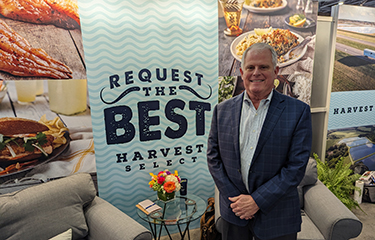
Harvest Select's presence at Seafood Expo North America showed the result of that effort.
“Our goal was to come to Boston and rethink and restrategize where we ought to be going forward,” Rhodes said. “I’ve used this word before, and it might not be the right word, but I think we became dull in the last three or four years. And I don’t want to be dull.”
To address its labor shortage, Harvest Select has continued to tap into the H-2B immigrant worker visa program and the H-2A temporary agriculture work visa program. It has also switched to a more-flexible work-scheduling system.
“That’s something we would have never thought of five years ago,” Rhodes said. “We would never have expected to not adhere to that exact work schedule and that exact time onboard and time off that we normally had.”
Harvest Select emerged from the seafood expo with solid leads and new business insight, Rhodes said.
“Everyone here is pumped up, and we’ve got some really good new thoughts.”” Rhodes said.
Photo by Chris Chase/SeafoodSource
