





 Northern prawn
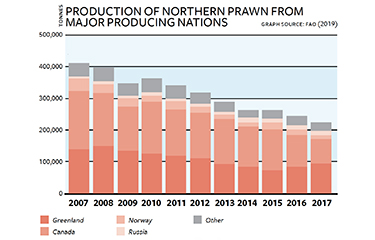
One of the most common coldwater species is the Northern prawn, accounting for 36.23 percent of all coldwater species. In 2017, Greenland (42.13 percent), Canada (34.09 percent), and Norway were the main suppliers of the Northern prawn.
However, the catches for all three countries have been dwindling. While in 2010 the global catch of Northern prawn was still above 360,000 MT, in 2017 only about 220,000 MT were landed. The main reason for this decline is that governments reduced the quotas for many of the fisheries, as stocks were under pressure. Global catches have stabilized from 2017 to 2018 and production is expected to slightly increase further in 2019 and 2020. The drivers behind the increase of production are the increased quotas in Greenland and the increased fishery activities of Russia and other Baltic states who fish in the Barents Sea.
Although volumes from Russia are marginal, it is an up-and-coming player in the Northern prawn fisheries. Several Russian fishing companies such as Norebo Holding have invested in offshore shrimp trawlers to become less dependent on imports of Northern prawn.
Coldwater fisheries for the Northern prawn are divided into two sectors: onshore and offshore. Onshore, the coldwater shrimp are caught by local fishermen in relatively small vessels. The offshore fisheries (mostly otter trawlers) use much larger factory vessels which normally have the machinery to cook and freeze the product onboard.
The difference between the two types of fisheries is big. For example, the Canadian onshore fishery consists of about 260 license holders from Newfoundland and Labrador which, in 2015, together caught about 32,000 MT of Northern prawn. Meanwhile, the offshore Canadian fishery consists of only 10 factory freezer vessels which generally catch around 60,000 MT per year.
In West Greenland, on the other hand, there is a less-marked contrast between the two types. In 2017, 61.5 percent of the 86,000 MT of Northern prawn caught came from offshore fisheries, consisting of eight factory vessels. The (coastal) onshore fisheries, consisting of 27 smaller vessels, were responsible for the rest of the catch.
