






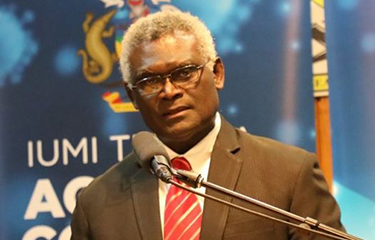
The Solomon Islands Fisheries and Marine Resources Minister Nestor Giro signed a memorandum of understanding with the head of state-owned China National Fisheries Corp. (CNFC) during a visit to Beijing on 16 May.
The MoU will “allow CNFC to invest in [the] Solomon Islands in areas of mutual interest,” according to a Solomon Islands government statement. While the MoU dodges specifics, the aim from the Solomon Islands is to expand its fishery operations and pave the way toward innovative development projects in the industry.
Giro also met China Deputy Agriculture Minister Ma Youxiang during the visit, the latest in a string of recent visits between leaders of Pacific Island nations and Chinese economic officials. For Pacific Island nations, it is a means to securing economic security, while China works to increase its presence in the region. Securing access to natural resources like fisheries – as well as strategic ports – appears to be part of China’s strategy for the Pacific region.
The Chinese government has approached several Pacific Island nations with plans to expand investment opportunities and offer more security in the area. Its latest overture was delivered 25 May, when it asked 10 Pacific Island nations to sign a sweeping deal that involves increased access to tuna quota and a free trade agreement as well as security guarantees and infrastructure investments.
The U.S. State Department warned the agreement could destabilize the region and will deepen international tension over burgeoning Chinese influence.
“We are concerned that these reported agreements may be negotiated in a rushed, nontransparent process,” U.S. State Department Spokesperson Ned Price told the Associated Press. “China has a pattern of offering shadowy, vague deals with little transparency or regional consultation in areas related to fishing, related to resource management, development, development assistance, and more recently even security practices.”
Micronesia President David Panuelo said the deal will heighten already-frayed Sino-U.S. tensions and threaten regional stability, and vowed not to sign the deal. However, the Solomon Islands government seems more amenable to the agreement following its signing of its MoU with China, and a separate security pact that will see China increase its military presence in the Solomon atoll.
Solomon Islands Prime Minister Manasseh Sogavare has faced local protests against his government’s previous acceptance of police training and financial assistance from China. Internationally, there is also growing unease regarding Sogavare’s growing closeness with China.
Debates about the benefits and drawbacks of Chinese involvement are occurring around the globe, following China’s burst of diplomatic activity focused on agricultural and fishery cooperation with developing nations. Regarding fisheries, in 2022, China announced it would aim to pursue investment opportunities in the seas of East Africa and the South Pacific. A Chinese Ministry of Agriculture and Rural Affairs (MARA) document titled “Opinions on Promoting the High-Quality Development of Pelagic Fisheries during the 14th Five-Year Plan” said it hoped to expand Chinese fleet access to waters in Latin America, West Asia, and South Asia, with the goal of maintaining production of its distant-water fleet at 2.3 million tons.
Chinese Agriculture Minister Tang Renjian and his Deputy Minister Ma have both been especially busy in their diplomatic overtures, making visits to Papua New Guinea in April and May, while Ma met with the Kiribati agriculture and fishery minister in Beijing on 11 May. Ma has also met fishery officials from Samoa, Cambodia, Myanmar, and Malaysia in recent months, frequently offering promises of sustainable economic development of ports and maximizing of the potential of local fisheries.
“As a responsible major country, China will follow the principle of prioritizing ecological protection and resource conservation and is ready to conduct close and practical cooperation with Kiribati in fisheries on the basis of friendly consultation and mutual benefit,” Tang told Kiribati Fisheries and Marine Resources Development Minister Ribanataake Tiwau during a press conference.
Tang struck a similar note when meeting Papua New Guinea Fisheries Minister Jelta Wong in May.
“China is willing to carry out fishery cooperation with PNG, which will help increase people’s income and well-being, conserve fishery resources, and promote sustainable economic and social development,” Tang said.
In contrast, meetings between Chinese officials and Western counterparts have slowed since China reopened, aside from visits by the ministers for agriculture and fisheries of both France and Ireland, and a 19 June visit from U.S. State Department Secretary Anthony Blinken geared toward diffusing Sino-U.S. tensions.
Those tensions have been exacerbated by aggressive moves by the administration of U.S. President Joe Biden to crack down on abuses by China’s distant-water fleet. Many environmental and labor-focused non-governmental organizations have applauded the U.S.’ tough stance, including C4ADS, a Washington, D.C., U.S.A.-based NGO.
“When regional fish stocks that are critical to the food and economic security of coastal developing nations are overexploited, it breeds instability that can be detrimental to long-term regional security,” C4ADS IUU Analyst Naujokas said. “For Pacific Island nations, fisheries are a social, cultural, and economic lynchpin that are undermined by exploitative fishing practices that have often been employed by the Chinese fishing fleet in areas around the world.”
Naujokas said countries entering negotiations with China on fisheries access agreements should educate themselves on China’s track record.
“There is a major need for greater transparency and accountability across the fisheries industry. This is especially true for China but also for all countries that have large, industrialized distant-water fishing fleets that operate on a global scale,” he said. “To achieve greater transparency and accountability, countries like China need to make information about the onshore beneficial ownership networks of their fishing fleets openly accessible, close the regulatory loopholes that allow fishing companies to conceal histories of past legal violations, and adopt more transparent reporting requirements for fishing companies operating out of their jurisdictions.”
Photo courtesy of Office of the Prime Minister of the Solomon Islands
