






On 28 March, Irish police raided the offices of a fishing company in County Donegal, in the northwest of the country, on the basis of information that the firm had paid bribes to an African leader for access to fishing rights.
Gardai have disclosed neither the name of the company in question nor the African country, but this type of investigation could be the first of many due to the rising value of continually scarce wild fish stocks, according to figures calling for transparency in fishing access deals.
“I would not be surprised if we see more of those cases appearing globally,” Fisheries Transparency Initiative (FiTI) Head Sven Biermann told SeafoodSource. “What so far has been often underappreciated is just how valuable fish have become.”
The international trade of fisheries and aquaculture products generated around USD 151 billion (EUR 137 billion) in 2020, according to the Food and Agriculture Organization.
Secrecy around fishery access agreements has allowed for corruption to flourish, according to Philip Chou, co-chair of the steering committee guiding the Coalition for Fisheries Transparency, a consortium supporting NGOs globally in efforts to persuade governments to adopt policies promoting transparent fisheries governance.
“Terms of fishing access agreements have traditionally not been disclosed to the public, despite the commodity, fish, being a common public resource,” he said. “Although bribery can still occur when a fishing access agreement is made public, knowing the terms at least provides some basis for civil society to evaluate if the deal is good relative to economic value, sustainability, and equity. Bribes are less likely to occur if the decision-making process was more transparent.”
Chou said he believes the Irish investigation is proof of the need to “publish all collected fisheries data and scientific assessments in order to facilitate access to information for small-scale fishers, fish workers, indigenous communities, industry associations, and civil society in developing fisheries rules, regulations, subsidies and fisheries budgets, and decisions on access to fisheries resources.”
Contacted by SeafoodSource for comment, several Irish fishing representative bodies declined to comment. A member of parliament for the Donegal area who is often vocal on fishery matters, Padraig MacLochlainn, also declined to speak on the issue beyond a one-sentence statement.
“As this matter is currently the subject of a police investigation, it would be inappropriate for me to comment,” he said.
The allegations surrounding bribery by the Irish firm have also focused attention on the impact of external operations by fleets from the European Union, which has prided itself on regulations it states guarantee fishery stocks will remain at sustainable levels.
"On top of the ecosystem harms caused by overexploiting fish populations in these waters, even where there are formal agreements in place, E.U. vessels are given extremely favorable conditions to fish non-E.U. waters that significantly undervalue the catch, at the detriment of local livelihoods,” Birdwatch Ireland Marine Policy and Advocacy Officer Sinead Loughran told SeafoodSource. “Current and future generations suffer from a reduction in fish available to catch through ongoing overexploitation and depletion of fish populations that can take many years to recover.”
Fisheries comprise a sector that is “highly exposed to corruption,” according to Biermann.
“It is clear that such competitive, lucrative sectors offer conditions where corruption can flourish,” he said. “Other contributing conditions that are present in fisheries include an increasingly regulated sector, a high reliance on third-party agents, complex global value-chains that span multiple authorities, countries and legal jurisdictions, and often weak or inadequate control structures.”
Biermann and FiTI have called for more transparency to curb corruption, by preventing or exposing nefarious acts.
The Garda investigation in Donegal undermines Irish protests about foreign vessels entering Irish waters, according to Laughran, referencing the recent detention of a Spanish trawler, the Persosa Dos, by the Irish navy.
“The huge concern at the presence of a super-trawler flagged under another member-state in Irish waters in the past few weeks is of course justified, and there’s an awful lot to be done to make fishing in Irish waters sustainable,” Loughran said. “However, it would be very hypocritical to be outraged solely at this happening in Irish waters, while Irish vessels can also commit similar harms of overexploitation.”
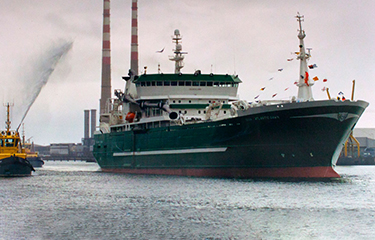
This isn’t the first time there has been an allegation of an Irish fishing company abusing local laws in African waters. In 2005, the Atlantic Dawn received a fine and an expulsion from Mauritania’s waters after allegedly fishing too close to shore. The vessel was fishing in Mauritanian waters under a private license obtained in 2000 from the administration of then-Maritanian President Ould Sid Taya. Then-Irish Premier Bertie Ahern negotiated a special agreement with the E.U. in 2002 to increase Ireland’s tonnage quota to include the huge Atlantic Dawn vessel, allowing it to fish in E.U. waters for a few months each year. In 2015, an Irish court ordered the vessel held and its captain fined for illegal discharge of bycatch. The 144-meter-long Atlantic Dawn was sold in 2007 to Katwijk, the Netherlands-based Parlevliet and Van der Plas and rechristened the Annelies Zlena, now flagged to Poland.
The issue of European vessels engaging in overexploitation of African fisheries reemerged in 2019, with the 2019 “Fishrot” scandal involving Samherji, an Icelandic seafood company. A document dump on WikiLeaks revealed how millions of dollars of quota payments made by Samherji were diverted to private bank accounts, instead of going to Namibia’s central treasury.
“If the country would have been a FiTI country by then, it would have been easier to spot discrepancies,” he said.
In May 2021, Mauritania submitted its first-ever FiTI report to FiTI, joining other African countries including the Seychelles, Senegal, Cabo Verde, Madagascar, and São Tomé and Príncipe. Mauritania is a candidate country for membership in FiTI, which has commended its recent efforts on fisheries governance reform but recommended it be more transparent around information regarding its rulemaking and enforcement. Guinea, São Tomé and Príncipe, and Senegal have already joined FiTI, and the organization has targeted Comoros, Ghana, and Guinea-Bissau as other African nations it would like to see join soon.
Photo courtesy of Atlantic Dawn
