


The Irish seafood industry has welcomed a EUR 25 million (USD 26.5 million) aid package recently granted by the European Union that aims to alleviate some of the negative effects of Brexit, such as reduced quotas and a downsized national fleet, which have led to skyrocketing local seafood prices and depressed consumption, Irish fishers claim.
Though most Irish seafood industry players think the package will provide some relief, they also believe the problems are too big and long-lasting for one aid package to fully fix.
Data from Ireland’s Central Statistics Office showcase that Irish seafood prices rose 15.6 percent in August compared to the same month in 2021, when the effects of Brexit started to hit home for the Irish fleet. The increase ran well ahead of the 6.3 percent overall inflation over the period and was above the rates for other sources of protein. Frozen fish prices rose highest at 28 percent over the two years, while poultry prices rose 24 percent in the same timeframe.
Some national media narratives have laid the blame for high seafood prices on the fleet’s dependence on fossil fuels. A report by national broadcaster RTE described fishing as far more dependent on fossil fuels than other industries. Aodh O’Donnell, the head of the Irish Fish Producers Organization (IFPO), dismissed that claim.
“A 2023 report by BIM [Bord Iascaigh Mhara, or the Irish Seafood Board] shows carbon emissions for the seafood sector are under 400,000 MT of carbon dioxide. That's less than 2 percent of the emissions produced in other key food sectors, including agriculture. This report on fish prices presents a narrow and unbalanced view,” O’Donnell said.
Instead, the IFPO has squarely blamed its troubles on a slump in local seafood consumption due to restricted quotas and the scrapping of trawlers under the E.U.’s post-Brexit settlement with the U.K.
“We lost 25 percent of our mackerel quota overnight in Brexit. That’s around 15,000 or 17,000 tons,” O’Donnell told SeafoodSource.
Irish vessels are seeing their quota opportunities fall while “rich Irish waters are being exploited by European and Nordic neighbors,” O’Donnell said.
“Demand at home is strong for Irish fish, but supply to the domestic market is limited, as we can only catch 15 percent to 18 percent of the fish in our own waters,” he said.
Ireland’s Central Statistics Office data backs up the claim that Irish landings are down, as fish landings by Irish fishing vessels declined by 15 percent in 2022. Its figures show that Irish vessels landed 175,000 metric tons (MT) of fish at both Irish and foreign ports in 2022, down from 206,000 MT the previous year.
O’Donnell warned that “activity at Irish ports is dominated by landings of foreign fleets,” but his claim is not borne out by data published by the Sea Fisheries Protection Authority (SFPA).
Foreign vessels landed 110,259 MT of the 285,705 MT in total seafood landed at Irish ports in 2022, and accounted for EUR 152.8 million (USD 162 million) of the EUR 480.8 million (USD 509.7 million) of the value of those landings, according to data collected by the SFPA.
France was the leading foreign fishing nation in Irish waters last year in terms of value landed at Irish ports, followed by Spain, the U.K., Belgium, and Norway. In tonnage, however, Norway at 48,070 MT was the top foreign fishing nation at Irish ports in 2022, followed by the U.K. at 25,259 MT, and France at 11,639 MT.
Regardless, the Irish fishing industry has fought a bitter campaign in recent years at what it perceives is an unfair burden the country has had to carry in the E.U.’s negotiations with Norway and the U.K. over access to shared stocks.
Some relief may be on the way, however. On top of the benefits from the aid package, O’Donnell and others said they believe inflation will continue to ease. Overall inflation is easing in Ireland, as the Irish government has set an inflation target of 2.9 percent for 2024.
“In reality, prices at the pier have reduced in the last year due to reduced demand in export markets driven by inflationary pressures,” O’Donnell said.
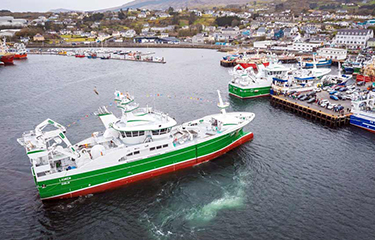
Photo courtesy of Irish Fish Producers Organization
