

Seafood conglomerate Jinghai Group and the city of Weihai are seeking national standing for a new port and industrial park that will service the country’s large and growing distant-water fishing industry.
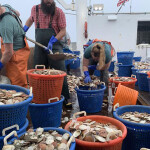
The Jinghai Group has spent CNY 2 billion (USD 300 million, EUR 260 million) building the Weihai Sha Wo Island National Distant-Water Fishing Base, which includes a port and seafood-processing and -trading facilities. The Jinghai Group recently hosted a large group of journalists at the site in Weihai to promote the project. The firm told the visiting journalists that it wants to double the amount of seafood being landed and processed at its port within five years, to 100,000 metric tons (MT), and to double that figure again by 2030.
The Jinghai Group – which operates distant-water vessels and processing plants, including eight squid-jiggers currently fishing in the Southwest Atlantic – wants the base to be given “national level-one” status by the central government, which would open the spigot of access to government funding and preferential supports. However, it faces an uphill battle, as a similar “level-one” base is in operation in Rongcheng, also in Shandong Province.
A “level-one” designation would add to a string of such “national” distant-water bases entitled to local and national subsidies. In southern China, the Lianjiang National Distant-Water Fishery Base currently under construction at a cost to-date of CNY 2.3 billion (USD 345 million, EUR 299 million), is the third in China – after the other base in Rongcheng and one in Zhoushan, in Zhejiang Province.
The Jinghai Group also wants to build a trading center at its Weihai base, a project it has dubbed the “North East Asia Seafood Trading Centre.” This would compete directly with an existing project in nearby Qingdao, the CAWM West Coast Market, operated by the China Supply and Marketing Agricultural Production Wholesale Market Holding Co., a subsidiary of a major state-run conglomerate. The company claims that it will be the biggest market of its kind in North Asia once it is completed.
Overcapacity is a trait long associated with Chinese industry and with competition between regional governments. A hint of the scale of China’s support and expansion of its distant-water fleet was revealed in a recently publicized document showing Qingdao – an hour’s drive from Weihai – had increased the scale of its distant-water fleet from 10 vessels in 2013, which caught 3,000 MT of seafood total, to 169 vessels operated by 31 firms, collectively landing an annual catch of 140,000 MT in 2020.
Photo courtesy of Jinghai Group
