


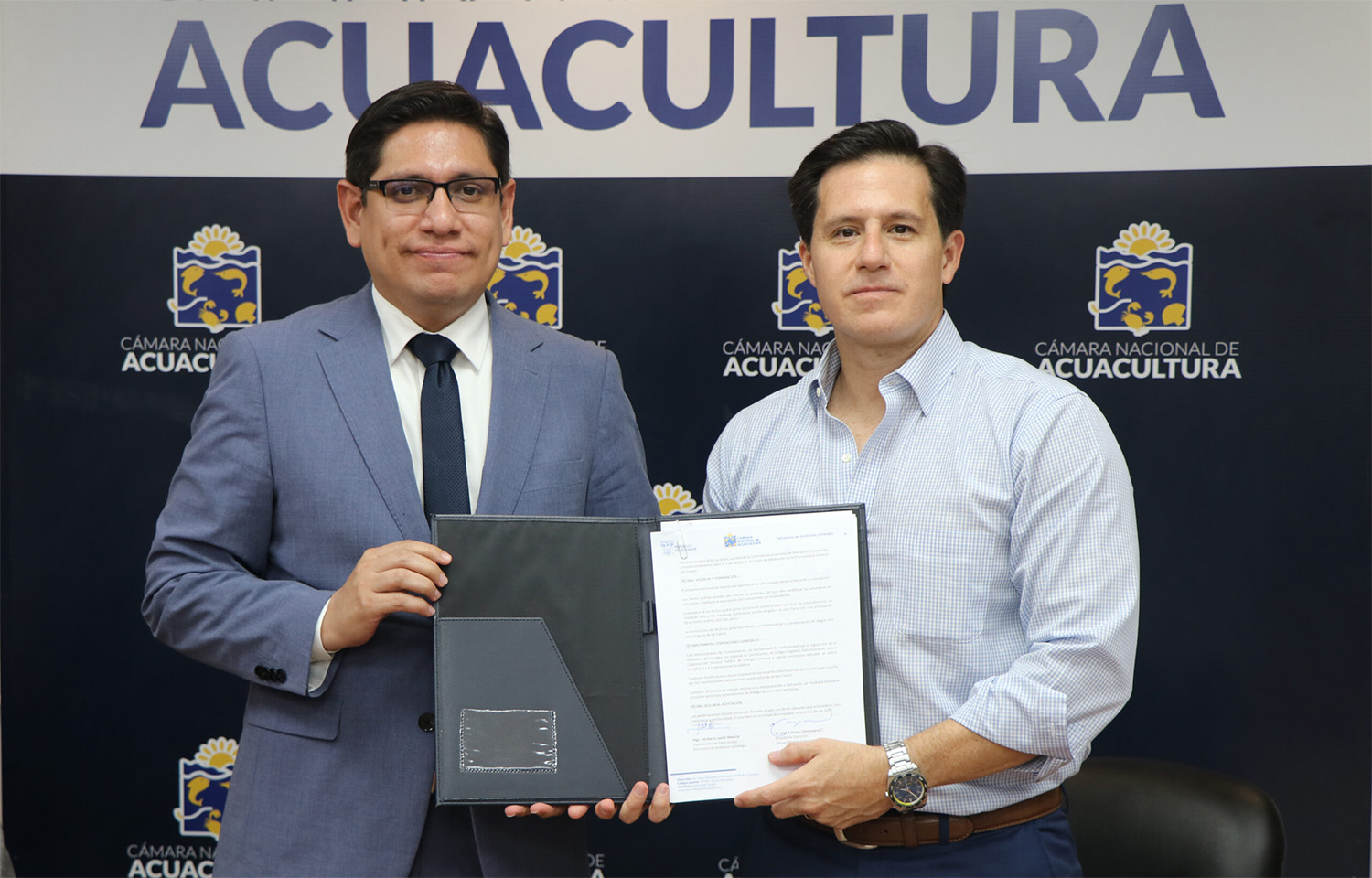
Ecuador’s National Aquaculture Chamber (CNA) and the Ministry of Environment and Energy (MAE) have signed a memorandum of understanding (MoU) to bolster the supply of electricity to the nation’s shrimp sector.
Currently, less than 10 percent of the nation’s shrimp sector operates with electricity, with the remaining 90 percent still depending mainly on diesel for the operation of pumping and aeration systems. Under the MoU, the industry and the state have set the foundations to accelerate the transition toward a more efficient, sustainable, and competitive energy matrix, CNA said in a release.
The initiative – the result of articulated work between the CNA; the Corporation for the Promotion of Exports and Investments (Corpei); the Sustainable Shrimp Partnership (SSP); the MAE; Arconel, which is the government agency for electricity regulation; and CNEL, which is a national electricity corporation – will seek to modernize Ecuador's regulatory framework, simplify connection processes, strengthen electricity infrastructure, promote self-generation, and foster increased private sector investment. These actions are intended to reduce operating costs, strengthening the energy security of productive areas and consolidating the international competitiveness of Ecuadorian shrimp – one of the country's most valuable exports.
The CNA and SSP established the Energy Working Group in September last year, which CNA Executive President José Antonio Camposano characterized as a proactive initiative by Ecuador's shrimp-farming sector to identify regulatory, procedural, and legal bottlenecks while engaging the private sector to develop alternative solutions that could help ease pressure on an already overburdened electrical system that has been underfunded for decades.
That working group was created as the sector said transitioning to a cleaner energy matrix was no longer just an environmental commitment but a key strategy to strengthen competitiveness and modernize the shrimp sector.
The Energy Working Group performed a technical-regulatory diagnosis and identified the main barriers to accelerating sector electrification. It defined a roadmap with 16 strategic actions aimed at modernizing energy infrastructure, structured in four axes: regulatory strengthening and connectivity, technical optimization and critical infrastructure, tariff sustainability and environmental simplification, and strategic investments and new energy models.
During the signing of the MoU, Camposano said the agreement represents a change of vision regarding the private sector’s role in the country's energy development. He said electrification is a key factor to strengthening the competitiveness of Ecuadorian shrimp and emphasized that the roadmap seeks to create the conditions for private investment to actively participate in the solution of the country's energy challenges.
“The [farmed shrimp] sector has been characterized by seeking solutions to its problems and not being part of the problem. Ecuador has a very fragile electricity system, inherited from past administrations that did not take the precautions in strengthening generation and transmission or thinking of other private sector intervention models that could complement the investments required to sustain a healthy energy system,” he said during a press conference following the signing of the MoU.
He added that the country has several positive examples that it could mirror from neighboring countries.
“But the sector ... which is a pillar of the Ecuadorian economy, cannot wait for solutions to be provided to it. It has to be part of that solution,” he said.
Camposano also stressed that the MoU will streamline the technical and regulatory mechanisms necessary for investments that benefit both the aquaculture sector and national energy development.
“The MoU seeks to facilitate mechanisms so private investment arrives faster and can be part of the solution. It is not a roadmap where the private sector receives a solution from the state or where the private sector seeks a solution from the state but, rather, the private sector intends to be an important factor in solving the country's energy problems,” Camposano said.
MAE Deputy Minister of Electricity and Renewable Energy Heriberto Javier Medina said that strengthening the electricity system requires close coordination between the public and private sectors, and he recognized the country’s historical errors and state bureaucracy regarding energy development.
“We are clear that the energy sector cannot do it alone; it requires the support of the private sector,” Medina said during the press conference. “The state model has not worked so well for us. We’ve had problems with delays in infrastructure, but that’s why we are here: to solve these problems that exist.”
He reiterated the MAE’s openness in working together on the revision of the regulations, simplification of processes, and establishment of conditions for the sector’s growing energy demands so they can be met with greater agility. Medina also said the nation is committed to promoting necessary regulatory adjustments to facilitate new investments and improve the efficiency of the national electricity system.
“We have made patches [to the energy model] along the way but the comprehensive solution is to reorganize the model to address commercial issues, [define] really efficient public prices, and perhaps carry out an energy auction process,” he added. “We are evaluating all this and are quite advanced in the conceptual model. What we are looking for is for private participation in the electricity sector to enter as soon as possible, which is what the system requires.”
Ecuador has had a fraught history when it comes to sustainable energy supply.
Ecuador’s government put an end to diesel subsidies for large shrimp farms at the end of 2022, which the CNA criticized at the time as unfair and inopportune.
Power outages battered Ecuador for months in 2024, with adverse weather conditions affecting areas where the country’s dams are located, which was particularly problematic as hydropower comprises nearly 60 percent of the energy the nation generates. Power cuts were estimated to have cost the shrimp industry millions of dollars, and observers feared extended cuts would cause a mortal blow to the sector.
Last year, national protests erupted in September after President Daniel Noboa ordered the elimination of a USD 1.1 billion (EUR 936 million) state subsidy for diesel. The cash-strapped government said the move would free up financing for social credits and programs, but it increased the price of fuel from USD 1.80 (EUR 1.53) to USD 2.80 (EUR 2.38) per gallon, sparking opposition from unions, students, and social and Indigenous organizations.
The government responded by declaring a state of emergency in conflict zones and a curfew in others.
