





U.S. scallop prices are stabilizing after a period of decline that saw them drop from USD 23 (EUR 21) per pound at the end of 2021 to just over USD 13 (EUR 12) per pound in August 2022.
Speaking at the National Fisheries Institute’s 2023 Global Seafood Market Conference in La Quinta, California, U.S.A. on 17 January, Clearwater Seafood Vice President of Sales Robert O’Sullivan and Raw Seafood Vice President of Sales Kane Kendall agreed scallop prices have rebounded from the drop they suffered in 2022.
“There was no inventory. Everybody was spending money like crazy. As quickly as we were putting up scallops, they were gone,” O’Sullivan said. “But post-Covid, that price wasn't sustainable. The demand wasn't there. So we started seeing prices taper off as we went through heavy fishing. And then once we hit winter months, there has been a stabilization, especially on the 10/20 category.”
Kendall said more buyers may be coming into the market as prices appear more reasonable to them, and in response to a 20 percent cut in the U.S. total allowable catch to 24 million pounds in 2023.
“There were astronomical highs on every single scallop size. It was not sustainable for 2022, but I wouldn't call what has happened a major correction,” Kendall said. “We saw some adjustments and once again, and this might be the new norm for now.”
Internationally, Canada’s predicted harvest for 2023 will be 14 million pounds total, with 11 million pounds coming from the offshore fishery and 3 million pounds from the inshore. China’s season, which ran through December, resulted in a 20 to 30 percent volume drop, but with a predominance of larger-sized scallops. Argentina’s supply is also expected to be down in 2023, as is Peru’s, though most of that country’s production heads to Europe. Mexico’s production was steady but the country suffers from inconsistent supply issues, O’Sullivan said.
Making up for these projected shortages is supply from Japan, which increased its production from 11.6 million pounds in 2021 to 15.9 million pounds in 2022. But the overall market is expected to see 10 million fewer pounds of scallops available in 2023.
“I would argue the prices that we're seeing today are reasonable. Well-priced scallops are a good value, they retail at a nice price point. So I actually think over the next few months, I guess as April hits and more landings in the U.S. happen, that might be the opportunity to buy in. But I think I'm bullish on this,” O’Sullivan said. ”This may not be what everybody wants to hear, but I think you can pass it on to the consumer. I think it's the best product coming out of water, but I'm riffing now. I think scallops will be more expensive as we head into the second half of the year.”
Kendell said U/10 scallops will remain very limited in availability, and the majority of the U.S. catch will be 10/20 count.
“We're starting to see a lot more 22-23 counts – that’s where the value is, in that 15-25 count range,” Kendell said. “If you can open up a spec like that for any large frozen volume customers, that's what you want to be. That's where you're going to get the best value.”
O’Sullivan said in 2022, his company continued to send scallops to the U.S. rather than Europe due to a large price differential, compounded by the strong U.S. dollar. But the situation is changing.
“We’re seeing that flip now – we're sending more product to Europe,” he said. “So more Canadian scallops will be sent [to Europe] and I think the U.S. product, which didn't ship a lot to Europe previously, we'll see some more of that as well. So that may have an even greater impact on availability of scallops in the U.S.”
Kendell said the medium-term outlook for the scallop market is positive.
“It looks like in 2023, we're going to hit our base bottom, and then we're going to start seeing an incremental growth on landings for the next five years – we hope up to 60 million pounds, and hopefully a price that's very competitive,” he said. “We expect the price to be favorable, so that way we can promote it to foodservice and retail to compensate for the additional volume.”
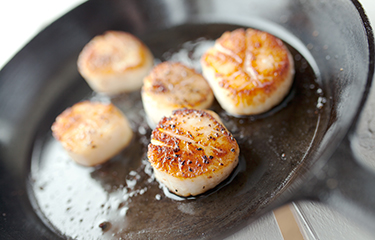
Photo courtesy of Rosalie.S.Photo/Shutterstock
